New York Rocket Battalion
Rockets seem anachronistic to the Civil War, seeing more use in earlier and later periods. They appeared shortly after the invention of gunpowder in 10th-century China, declining on battlefields after the Napoleonic era. Today’s militaries, of course, use missiles to deliver devastating payloads. With the power of historical hindsight, we know that traditional artillery was far more effective than rockets in the 1860s. But with such a large conflict brewing and many scientific discoveries to be made, having a battalion of rocket artillery was worth a shot!
In 1861, New York volunteers from the Albany area encountered a former British Major named Thomas W. Lion. Lion invented a type of rocket he thought would be more effective and organized several small units into a battalion using these weapons.[1] Thus, the New York Rocket Battalion was born in December 1861, serving in the defenses of Washington, D.C. from then until May 1862.[2]
In the capital, Lion lobbied for his design, advertising its use to frighten enemy horses and to demolish buildings and obstructions. The rocket would be fired from a breech-loading tube and boasted a range of three miles, creating a plume of fire fifteen feet in diameter upon impact. Each gun carriage mounted four rocket tubes. An alternate warhead could carry seventy-four bullets as shrapnel.[3]
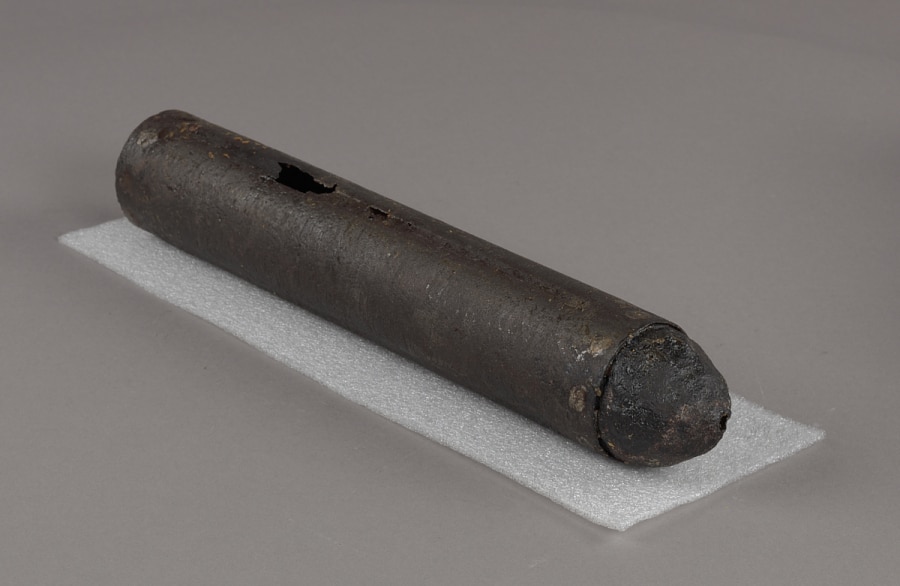
Members of the battalion soon had their hopes for their unique weapons dashed. On April 14, 1862, the unit trialed their pieces outside of Washington. One serviceman remarked, “They went and tried the Rocketts this afternoon and they proved as I expected a perfect failure. This Battalion has been a humbug all through.”[4]
Days before being transferred to New Bern, North Carolina, additional testing found the weapons subpar. Although their range was impressive, there was little control as to their direction, and the unit received six-pounder rifled artillery to use instead.[5] They suffered a handful of casualties in skirmishes, but that was the extent of the unit’s service.
Ultimately, the battalion disbanded in February 1863, with its two companies divided into the 23rd and 24th NY Light Artillery Batteries.[6] Although they never deployed their specialty pieces, some rockets saw use in the conflict. The U.S. Ordnance Department had manufactured rockets since 1848, as rocket artillerists saw combat in the Mexican-American War, although reports vary as to their effect. Evidently, this production ceased with the fiscal year ending June 1862, with 714 rockets made in the preceding twelve months.[7]
In 1864, Union officials pondered purchasing foreign-made rocket artillery. Chief of Ordinance George Ramsay wrote to Secretary of War Edwin Stanton, “Experience with rocket batteries during this war is not at all favorable to their usefulness. The same number of men and horses can produce more effect with the improved cannon and projectiles now used. Rockets have but little range and accuracy compared to rifled projectiles, and are liable at times to premature explosions and great eccentricity of flight. This department has no assurance that these rocket batteries have been tested in actual service, or that they possess the necessary requisites. I cannot, therefore, recommend their purchase.”[8]
Reports of Union forces continuing to possess rocket pieces throughout the war exist, although mainly in Southern newspapers claiming them as part of ordnance captured. Apart from some actions around Charleston, these cannot be confirmed, and, regardless, they made no significant impact on the battlefield. Southern rocketry crews met the same fate.[9] As Ramsay remarked, artillery by this point was more accurate, reliable, and effective on the battlefield. The New York Rocket Battalion was short-lived, but I salute its members for their willingness to take part in the experiment. They were as ashamed as any to discover that this duty is, in fact, rocket science.
[1] J.W. Merrill, Records of the 24th Independent Battery, N. Y. Light Artillery, U. S.V. (New York, NY: J.O. Seymour, Kennard, and Hay, 1870): 141. https://books.google.com/books?id=Y00IAAAAQAAJ.
[2] “Rocket Battalion of Artillery (General Barry’s),” New York State Military Museum and Veterans Research Center, accessed Oct 22 2025, https://museum.dmna.ny.gov/unit-history/artillery/rocket-battalion-artillery.
[3] Merrill, 145-147.
[4] “Civil War New York Rocket Battalion Soldier’s Diary,” BidSquare, accessed Oct 22 2025, https://www.bidsquare.com/online-auctions/cowans/civil-war-new-york-rocket-battalion-soldiers-diary-812895.
[5] Merrill, 148.
[6] “Rocket Battalion of Artillery (General Barry’s)”.
[7] Paul D. Olejar, “Rockets in Early American Wars,” Military Affairs 10, no. 4 (Winter 1946), 31-34. https://penelope.uchicago.edu/Thayer/E/Journals/Military_Affairs/10/4/Rockets_in_Early_American_Wars*.html.
[8] Olejar, 34.
[9] Ralph W. Donnelly, “Rocket Batteries of the Civil War,” Military Affairs 25, no. 2 (Summer 1961), 80-91. https://www.jstor.org/stable/19849892.


And the rockets red blare???
Great Read. Major Lion was a better lobbyist that rocket scientist
Interesting story. Thank you Aaron for sharing.
Curiously, rockets were carried by at least one unit during the 1862-1863 operations against the Native Americans in Minnesota and points west, although they may have been signal rockets, not ordinance.