Book Review: The Invincible Twelfth: The 12th South Carolina Infantry of the Gregg-McGowan Brigade, Army of Northern Virginia

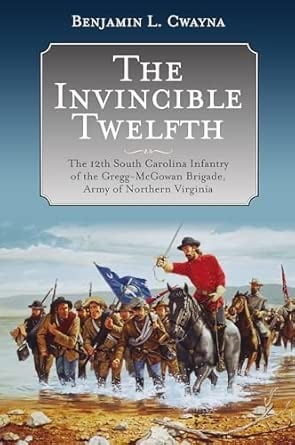
The Invincible Twelfth: The 12th South Carolina Infantry of the Gregg-McGowan Brigade, Army of Northern Virginia. By Benjamin L. Cwayna. El Dorado Hills, CA: Savas Beatie, 2025. Hardcover, 348 pp. $34.95.
Reviewed by John G. Selby
As modern regimental histories continue to pour out from publishers, it can be hard for a discerning Civil War reader to know which ones to buy. Not this time; first-time author Benjamin Cwayna has written a detailed “strictly military history” (xii) of an under-appreciated regiment in the hard-hitting Gregg-McGowan brigade from South Carolina.
The 12th South Carolina was formed in the spring and summer of 1861. Drawing its men primarily from several Upcountry counties, it mustered just over 900 when it was initially assigned to forts guarding entry points to Port Royal Sound. After a dreary winter and a disappointing performance in the battle of Port Ferry, the regiment looked forward to its reassignment to the Army of Northern Virginia in April 1862. Under the inspiring leadership of its new commander, Col. Dixon Barnes, the men of the 12th South Carolina joined two other South Carolina regiments in the newly formed Gregg Brigade (under the command of General Maxcy Gregg).
The 12th South Carolina had its baptism of fire at Gaines Mill. Engaged in a five-hour struggle to gain a hill and hold it, the regiment finally retreated when its commander Barnes, was wounded. After the battle Barnes recorded casualties at 148 men out of the 430 listed on the morning report. It would be the first of many times that the 12th South Carolina would suffer a casualty rate above 30 percent.
In August 1862 Gregg’s brigade (part of A. P. Hill’s division) was transferred to the wing of the army commanded by General Thomas Jackson. It soon had a chance to make its reputation when on August 29 at the battle of Second Manassas the 12th South Carolina had three choices: hold fast, retreat, or charge. The aggressive Col. Barnes ordered an attack, and the fierce surprise assault “cracked the center of the Federal line in the woods, overwhelming three regiments from three Union brigades.” (85) Later that day General Gregg ordered the 12th to rest, and told Barnes, “Your regiment, Colonel Barnes, has covered itself in glory.” (86)
The discipline and daring of the 12th South Carolina were noticed by generals, and thus it was no surprise that the regiment led the attack on Gen. Ambrose Burnside’s left flank at the battle of Antietam, helping to stop the last major Federal push of the day. The success came at a great cost; the regiment had 63 percent of the casualties in Gregg’s brigade, and one of the casualties was its leader, Col. Barnes. The next leader to fall was Maxcy Gregg at the battle of Fredericksburg, when the brigade was caught by surprise by Maj. Gen. George Meade’s Pennsylvania Reserves. These two leaders were soon replaced by two equally capable officers: Gen. Samuel McGowan as commander of Gregg’s Brigade and Col. John L. Miller as commander of the 12th South Carolina.
The now-small regiment was assigned guard duty at the battle of Chancellorsville, but with some new enlistments proudly marched into Pennsylvania in June 1863. The regiment was in the forefront of the assault on Seminary Ridge on the first day of battle, July 1, and when the three-day battle ended, the 12th reported 129 casualties.
When the 12th went into winter quarters in 1863—1864, it soon received some new volunteers. More critically, when the time came for re-enlistment in February 1864, the “entire regiment” voted to re-enlist by “unanimous affirmation.” (219) They were quickly joined by their fellow regiments in the McGowan Brigade, and received an official resolution of thanks from the Confederate Congress.
This esprit-de-corps would be sorely tested in the fierce fighting at the battle of the Wilderness and the battle of Spotsylvania Court House. For one of the few times in the war the 12th would be forced to retreat on May 6, but not before absorbing the second highest casualty rate in the McGowan Brigade that day. The 12th would restore its sterling reputation by holding the line at Spotsylvania’s “Bloody Angle for 18 hours” (245), thus giving Gen. Robert E. Lee time to build a new defensive line. The regiment had the highest number of casualties in the brigade that day.
The remainder of the war saw less fighting, but a slow loss of men from disease and desertion. Still, it stayed intact until the surrender at Appomattox, when 158 men surrendered. In its four years of existence, over 1,400 men had served in the 12th South Carolina, and 882 were killed or wounded in battle. This casualty rate of 63 percent is one of the highest of any regiments in the war, North or South.
Cwayna is to be commended for writing a history of a regiment and brigade that is often mentioned in battle accounts, but is less well-known than units such as the Texas Brigade. Much of that is due to a lack of primary sources. A large number of officers in the brigade did not survive the war, and those that did wrote limited works about their experiences. Cwayna used every letter, diary, memoir, and speech available to tell their story, undergirded by the official records. His book is ably supported by the maps of Hal Jespersen and photographs of some of the men in the book.
John G. Selby is a Professor Emeritus of history at Roanoke College and the former holder of the John R. Turbyfill Chair in History. A Civil War scholar, Selby wrote: Meade the Price of Command, 1863-1865; Virginians at War: The Civil War Experiences of Seven Young Confederates; and coedited Civil War Talks: Further Reminiscences of George S. Bernard and His Fellow Veterans.


One of our favorite books and new authors. Thank you for the review.