The Battle-born Babe of Flint River
I just finished reading Stephen Davis’ book The National Tribune Remembers the Atlanta Campaign: Battles, Skirmishes, Marches, and Camp Life as Recalled by the Union Veterans Themselves, published by Savas Beatie. The National Tribune, one historian proclaimed, was “the premier newspaper published for Union veterans of the Civil War and their families.”
In its pages I came across a story that moved me. While the story takes place in August 1864, it reminded me of the Christmas Story. No, not the one about Ralphie and the Red Rider B-B gun that takes place in Cleveland, but the one about the baby Jesus that takes place in Bethlehem. As I read the article, I was overcome with sentiments of the Christmas Spirit – love, kindness, generosity, and good will toward men. I was also struck by the similarities between the two stories. Both stories have a child born in a stable, wrapped in swaddling clothes, and visited by wise men bearing gifts. So, I thought it would make a nice story to read at Christmas-time[1]
The story was written by Dr. Edward O. F. Roler, medical director in Maj. Gen. John A. “Black Jack” Logan’s XV Corps as it marched toward the Flint River south of Atlanta in late August 1864:
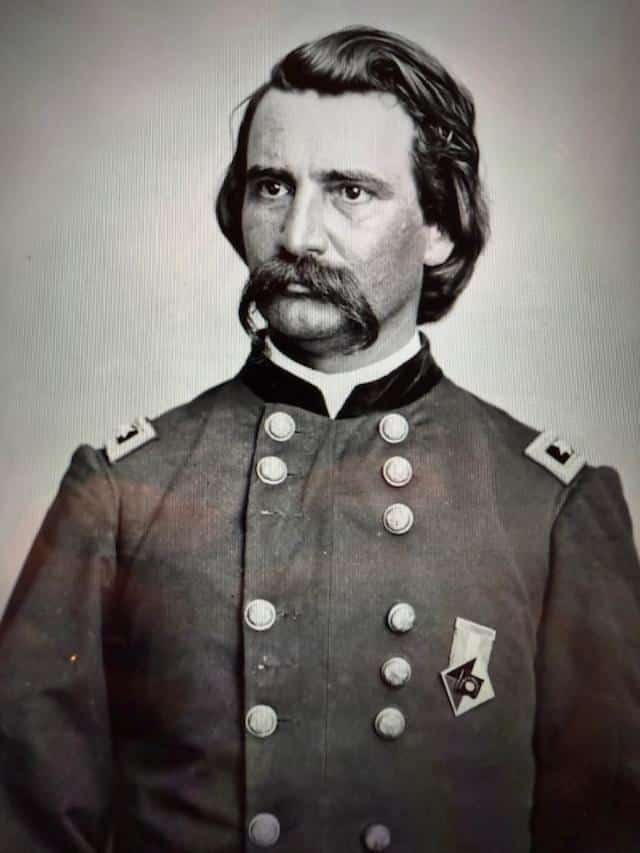
“It was the Summer of 1864, and the army under Sherman had fallen back from its position before Atlanta and swept around Hood’s rear, Gen. Logan leading the advance, I remember that the country was densely wooded, and that magnificent forests of pine, oak, and chestnut towered on either side of the road over which we marched. We were not molested until we neared the Flint River. There the enemy had planted a masked battery and, as we approached, it enfiladed our line. You could scarce encounter more disagreeable travelers on that lonely road than shot and shell, and the boys were not long in taking to the shelter of the timber. But Gen. Logan at once ordered up field battery of brass “Napoleons,” and presently accepted this challenge to an artillery duel. There was nothing to direct the fire of our gunners save the white puffs of smoke that could be seen rising above the foliage and the course of the enemy shots, but they nevertheless soon silenced the rebel cannon, and once more cleared the way for the column.
We then rode forward again, the writer in company with Dr. [John M.] Woodward, the medical inspector of Gen. Logan’s staff, and until his death, some four years ago, the head of the Marine Hospital Service. Just as we turned a bend in the road we emerged suddenly into a small clearing. A rude log cabin, surrounded by evergreen shrubbery, stood in the clearing, and hanging from one of the bushes we noticed a yellow cloth.
As medical officers, it naturally occurred to us at once that this was an improvised hospital of some sort, and we rode up to inquire,At the door of the cabin, as we approached, an old woman, evidently of the familiar “cracker” type, presented herself, but on seeing that we were “Yankees,” beat a hasty retreat. But we were not disposed to be so easily baffled, and calling her out again, began to ply her with questions.
She told us “there wa’n’t no wounded men, thar,” and when asked why she had put out a yellow flag there, she replied: “Waal, yer see, my gal is sick, and I reckoned ef I put out that yer hsp’t’l rag you’uns wouldn’t be pestern’ round so much.”
“What’s the matter with your child?” said I; “we are medical officers and perhaps we can do something for her.” “Waal, now,” she quickly responded, “ef you’ns is real doctors, just look in and see what you’uns all done with your shellin’. Time my gal was sickest, two of yourn shells come clar through my cabin, and, I tell you, it was right skeery for a spell.”
We accepted the old woman’s invitation and walked in. It was as she said. The cabin, built of rough pine logs, afforded but one room, about twelve feet square. A small log meat-house (empty) was the only out-building – the cow-stable having been knocked to pieces by our shells, except a small bark-thatched “lean-to” at the rear in which we found a loom of the most primitive sort and constructed in the roughest fashion, containing a partially-completed web of coarse cotton “homespun.” Aside from this loom, the only household articles visible were an old skillet, a rather dilapidated bed, two or three chairs without backs, and a queer collection of gourds. The shells had indeed played havoc with the interior. The roof had been badly shattered, and a stary shot had pierced the walls.
It had cut one of the logs entirely in two, forcing one jagged end out into the room so far that it hung threateningly over the bed upon which, to our astonishment, we saw lying a young girl, by whose side was a new-born babe with prints of the Creator’s fingers fresh upon it. It was a strange yet touching spectacle. Here, in this lonely cabin, stripped by lawless stragglers of both armies of food and clothing and shattered by flying shells of our artillery, in a storm and fury of the battle had been born this sweet innocent. The mother, we learned, was the wife of a Confederate soldier whose blood had stained the “sacred soil” of Virginia but a few months after his marriage and conscription into the service, and the child was fatherless. The babe was still clad only in its own innocence, but the writer with his handy jack-knife cut from the unfinished web in the old loom a piece of coarse homespun, in which it was soon deftly swaddled. Fortunately, we had our hospital knapsacks with us, and our orderlies carried a little brandy, with a few medicines and a can of beef extract, and we at once did all that our limited stores permitted to relieve the wants of the young mother and child.
But by this time quite a number of officers and men, attracted by the sight of the yellow flag and our horses waiting at the door, had gathered about the cabin, and, while we were inside, they amused themselves by listening to the old lady’s account of this stirring incident. One of the officers had given her some “store terbacker” with which she filled a cob-pipe, and the fact that she was spitting through her teeth with such accuracy as to hit a fly at ten paces, nine times out of ten, showed that she was enjoying herself after true “cracker” style. Presently some one suggested that the baby ought to be christened with full military honors, and it being duly explained to her that to “christen” was all the same as to “baptize,” she replied with alacrity: “Oh, yes! Baptized, I reckon, if you’ns has got any preacher along.”
This was all the boys wanted, and an orderly was at once sent back to the general commanding, with the compliments of the Surgeon and a request that a chaplain belonging to one of the regiments in the advance brigade might be allowed to return with the messenger to the cabin.
The general asked the orderly for what purpose a chaplain was wanted, and the orderly replied that the doctors (mentioning our names) were going to have a baptism.
Upon this, Gen. Logan (for he it was) significantly remarked, that the names mentioned were in themselves sufficient to satisfy him that some deviltry was on hand, but that, nevertheless, the chaplain might go. Then, inviting the colonel, who happened to be riding with him at the time, he set out himself for the scene, spurring “Old John” to a gallop, and soon joined the party at the cabin.
“General,” said the Doctor, as the former dismounted, “You are just the man we’re after.”
“For what?”
“For a godfather,” replied the Doctor.
“Godfather to what?” demanded the General.
The matter was explained to him, and, as the Doctor led the way into the house, the boys, who had gathered around the General in the expectation that the event would furnish an occasion for display of his characteristic humor, notice there was something in Black Jack’s face that they were not wont to see there, and that in his eyes there was a certain humid tenderness far from their usual flashing brightness. He stood for a moment silent, gazing at the unhappy mother and fatherless child, and their pitiful surroundings, and then, turning to those about him, said tersely:
“That looks —- rough.”
Then glancing around at the ruins wrought by our shells, and addressing the men in the cabin, he called out: “I say, boys, can’t you straighten this up a little? Fix up that roof. There are plenty of ‘stakes’ around that old stable – and push back that log into place, and help the old lady to clear out the litter, and – I don’t think it would hurt you any to leave part of your rations!”
Prompt to heed the suggestion, the boys leaned their muskets against logs, and, while some of them cut brush, others swept up the splinters and pine knots that the shot and shell had strewn over the floor, and not one of them forgot to go to the corner of the cabin and empty his haversack! It made a pile of commissary stores, consisting of meat, coffee, sugar, hard-tack, and chickens (probably foraged from her next-door neighbor) surpassing any that this poor “cracker” woman had probably seen or possessed at one time.
This done, the next thing in order was the christening, and the chaplain now came forward to perform his sacred office.
“What are you going to give her for a name? I want suthin peart, now,” said the grandmother.
She was told that the name should be satisfactory, and forwith she brought out the baptismal bowl – which on this occasion consisted of a gourd-ful of water fresh from the spring.
Gen. Logan now took the baby, wrapped in its swaddling clothes of coarse homespun, and held it while the chaplain went through with the ceremony. The latter was brief and characterized with due solemnity, the spectators behaving with becoming reverence, and thus the battle-born babe was christened “Shell-Ann.” I like to think that as the chaplain’s prayers were winging their way to heaven, the gory goddess who nurses a gorgon at her breast stayed with her red hand awhile!
The party now turned to leave the cabin and resume the march, when Gen. Logan, taking a gold coin from his pocket – a coin that he had carried as a pocket-piece for many a day – presented it to the old lady as a “christening gift” for his godchild, and the officers and men, as they had recently drawn their pay, added one by one a “greenback,” until the sum was swelled to an amount greater than this brave-hearted “cracker” had ever handled. Before parting, the General cautioned her to put the money in a safe place, lest some “—-bummer should steal it, in spite of everything,” and then, ordering a guard to be kept over her cabin until the last straggler had passed by, he rode away. The old lady’s good-bye was: “Waal! Them thar Yanks is the beatenist critters I ever seen!”
Ten days or so after this occurrence, the cabin being at that time within the enemy’s lines, the General, accompanied by the writer and 10 of his escort, rode back eight miles to see how our protégé was getting on and found both mother and child, in the language of grandma, “quite peart.” Whether Gen. Logan’s god-daughter is still alive or not I do not know, but five years after that visit word reached me that she then was. Certainly no one who witnessed that scene will ever forget the big-hearted soldier as he stood Sponsor – grim, yet gentle – for that poor little battle-born babe of Flint River.”[2]
Merry Christmas!
[1]Davis, Stephen, The National Tribune Remembers the Atlanta Campaign: Battles, Skirmishes, Marches, and Camp Life as Recalled by the Union Veterans Themselves, El Dorado Hills, CA, Savas Beatie, 2025, pp. 265-269. Sauers, Richard A., “Introduction,” Sauers, ed. The National Tribune Civil War Index: A Guide to the Weekly Newspaper Dedicated to Civil War Veterans, 1877-1943, 3 vols., El Dorado Hills, CA, Savas Beatie, 2018, pp. 1, vii.
[2] “Fifteenth Corps” [Edward O. F. Roler] “The Battle-born Babe of Flint River: Little Shell-Anna,” National Tribune, July 10, 1884, pp.1-2.


A truly heartwarming story. Brian, thank you for sharing.
Wonderful story. A common humanity across the lines.
I am reminded of the doctor Legrand G. Capers story of a baby borne of battle. Is there third party corroboration of this? Sounds like it actually could have happened. Col. Porter Alexander mentions a baby born prematurely due to errant Confederate cannon practise during the winter of ’61. Merry Christmas and Happy Holidays to all. Hope your new years champagne has no AI bubbles.
Further North, and a few months after this incident, the sudden appearance of a new inmate among the Johnson’s Island Confederate prison population, arriving by birth, strongly suggested that there was a POW of the female variety within that POW compound. This unexpected birth was reported in the December 15, 1864 edition of the Tiffin, Ohio Weekly Tribune. Both mother and child (a boy) were paroled.
Thanks for the “Black Jack” Christmas story.