Surgeon Logue is Flushed with Surprise

The USS Monitor was a unique ship. Designed by John Ericsson, the ship was chock-full of new technologies. It had the first revolving gun turret with unique gun carriages designed to minimize recoil. The gunports featured iron covers to protect the guns and gunners when not firing. It boasted an auxiliary steam engine to drive the turret as well as power ventilation blowers and pumps. Even the raising and lowering of the anchor along with the propeller were protected from exposure with iron. But one of the most interesting inventions was the first custom-designed, pressure-flushing, below-the-waterline “water closets” or “heads.”[i]
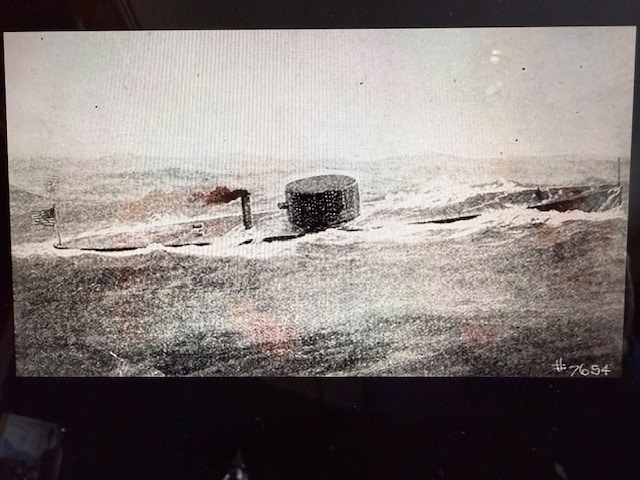
The Monitor was the first vessel where the crew was forced to live below the waterline for 24 hours a day. Up to this time, bathroom facilities on sailing ships consisted of slop buckets or chamber pots where the contents were simply tossed overboard. On paddle-wheeled steamers, such as the USS Cairo, the heads were located near the paddle-wheels so the waste was washed out by the turning paddles. Toilets depended on gravity and gravity can do little below the waterline. But on the Monitor, the heads were more like those on modern submarines, where Ericsson’s design was copied.[ii]
Ericsson designed a toilet that originally included an attached water supply, a pressure-sealed lid, an adjacent air pump, and a release valve, all of which had to be operated in the proper sequence. This was a decade before that famous plumber, Thomas Crapper, would popularize water closets. On the Monitor there were four “water closets” – two forward for the officers and two for the crew amidships near the engine room and galley.[iii]
It was essential that the proper sequence was followed. Step one in the process was to close a valve near the toilet; two, open a valve on the other side to allow sea water in; and three, activate a pump to force the waste out of the ship below the waterline. Ericsson had invented a mini-torpedo.[iv]
Operating the valves in the wrong order could be disastrous. An example was the Monitor’s Acting Assistant Surgeon, Daniel C. Logue. When the 40-year-old, native New Yorker answered the call of nature on the Monitor, he apparently forgot the precise sequence and suffered the indignity of having his 5’7’’ frame blown off the seat, into the air, by a jet of water when he went to flush.[v]
Modern submarine toilets are a modification of Ericsson’s design. The process still requires specific sequential valve operations with a fourth step that lets water back into the bowl, creating a water seal that prevents gases from escaping. The waste, instead of immediately being expelled into the ocean, is pumped into a storage tank onboard, which is pressurized. By opening an external valve, the waste is expelled into the sea. Modern subs use vacuum systems, and the tanks are pumped out when in port. This helps maintain stealth by avoiding noisy discharges.
But accidents sometimes happen. In April, 1945 German U-boat U-1206 was submerged off the coast of Scotland. A Kriegsmarine sailor incorrectly flushed the toilet, causing his submarine to flood with seawater. As a result, the U-boat had to surface within view of the British forces, who subsequently launched an attack. This led to the destruction of the submarine, the capture of 46 Germans, and three fatalities.[vi]
Ericsson’s innovations were cutting edge. He was always interested in the comfort and safety of all the crew serving on the Monitor. All it seemed except Dr. Logue, who resigned in October 1862.
Today, the euphemism for a toilet is called the “john.” It was not named for John Ericsson. It was named after Sir John Harrington, whose name in medieval times became synonymous for an “outhouse,” or privy. He actually called it the “jake,” but over time this changed to “john.” During World War I, American doughboys started referring to bathrooms as “crappers.” This was due to Thomas Crapper & Company’s name stamped on most English toilets.[vii]
[i] Hughes, Dwight Sturtevant, Unlike Anything That Ever Floated: The Monitor and Virginia and the Battle of Hampton Roads, March 8-9, 1862, El Dorado Hills, Savas Beatie, Emerging Civil War Series, 2021, p. 49. Ferreiro, Larrie D., George Mason University, “The Wrong Ship at the Right Time: The Technology of the USS Monitor and Its Impact on Naval Warfare,” International Journal of Naval History, Vol. 16, Issue 1, May, 2021, The Wrong Ship at the Right Time: The Technology of USS Monitor and its Impact on Naval Warfare – International Journal of Naval History
[ii] Mindell, David A., War Technology and Experience Aboard the USS Monitor, Baltimore, MD & London, The John Hopkins University Press, 2000, pp. 41-42.
[iii] Quarstein, John U., The Monitor Boys: The Crew of the Union’s First Ironclad, Charleston, SC, The History Press, 2011, p. 49.
[iv] Lienhard, John H., The Engines of Our Ingenuity, Cullen College of Engineering, University of Houston, Houston, TX. The Monitor’s Flush Toilet | The Engines of Our Ingenuity Migaki, Tim, The Tides of History, Maritime History, Technology, July 30, 2023. How to use a toilet on a submarine – Fair Winds & Following Seas
[v] Hughes, Unlike Anything, p. 49.
[vi] Elliot, Carter, “The High-Tech Toilet that Sunk a Submarine”, Sept. 17, 2015. German submarine U-1206 – Wikipedia
[vii] Whistler, Simon, “Today I Found Out,” YouTube. Why is The Toilet Commonly Known as the Crapper (or John)? – YouTube


And most astonishing, the first ship specifically designed to sink! In the long line of Swedish Submersibles, like the Vasa!