On the Road to Atlanta: Crisis at Peach Tree Creek
The Battle of Peach Tree Creek was John Bell Hood’s first sortie after taking command of the Army of Tennessee. The attack was the first sign of a dramatic change in strategy: offense instead of defense, as mandated by President Jefferson Davis. That blow fell on the Federal 20th Corps, which was by and large unprepared to receive an assault.
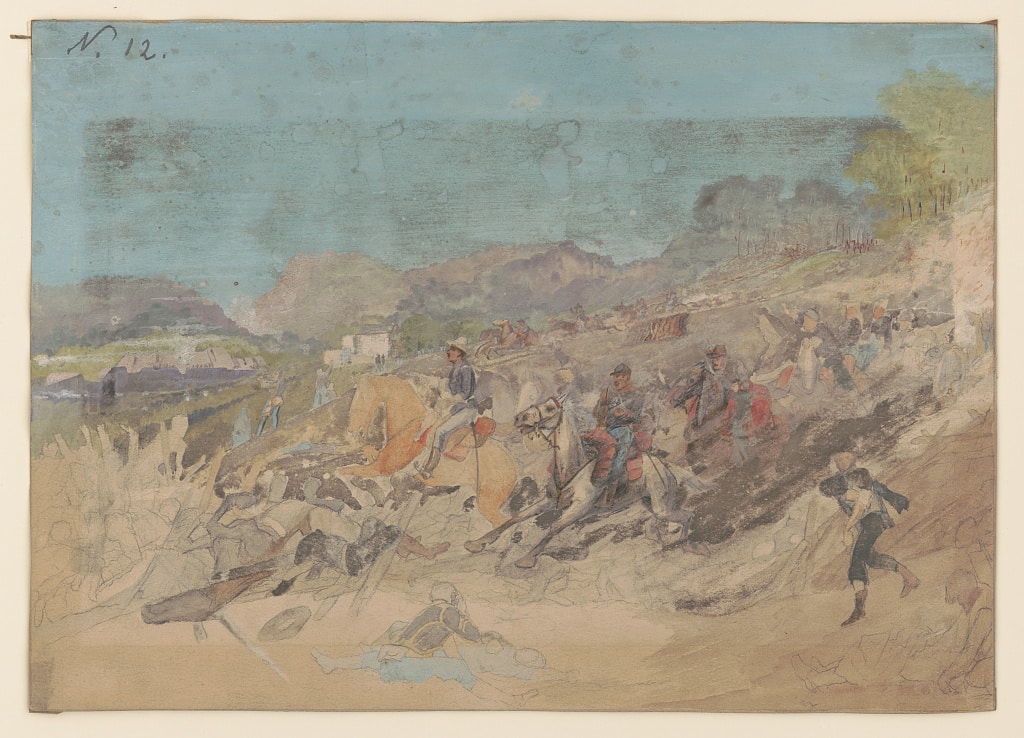
In this fight, John W. Geary’s Division was almost routed, nearly losing several cannon from the 13th New York Battery. The following passage describes the fight for that battery, as well as a dramatic description of the oncoming Rebels
Colonel Goddard’s lunge with the 60th New York to recapture Bundy’s lost guns coincided with other Federals coming into position to bolster Geary’s right flank. Major Cresson led the 73rd Pennsylvania westward into line just south of Lockman’s 119th New York. When the 60th had swept the last Rebels from Bundy’s position, Lockman in turn shifted the 119th farther south, passing behind the 73rd to extend the Pennsylvanians’ right a bit farther north. The next regiment to arrive was the 29th Pennsylvania, temporarily led by Lt. Col. Thomas M. Walker of the 111th Pennsylvania. Walker’s men were slowed by moving through the ravine to their front and were almost ordered back to their works by Geary, a mishap avoided only because “in the confusion of the moment the order was not properly heard.” They met “a squad of Rebels” in a second ravine, soon dispersed by Walker’s Company A, the only part of the regiment who could engage them. Next, they met a “severe fire” while coming into line, but the 29th unfalteringly took position on a rise which gave them a panoramic view of the action.[1]
Lieutenant Elias Cade of Company D, left almost breathless by the spectacle, nevertheless left a detail-laden description of the scene now unfolding before him:
“Two sections of the 13th N. Y. Battery (Dutch) . . . were captured by the enemy but were retaken. At one time they came so close to his battery that he (Lt. Bundy) gathered up a lot of musket balls laying near his pieces, charged his guns with them, and discharged them into the Rebel Ranks—It was a beautiful sight (if the word will apply to such scenes)—the country was open and hilly, and from a hill close by, a fine view was had of the whole affair. The rebels, looking more like a mob than a body of soldiers in their shirt sleeves (they wear white cotton shirts) sleeves rolled up, with nothing but a canteen strung over their shoulders, carrying their pieces at Right Shoulder Shift, as if they were going out to drill rather than fight. [They were] ‘rushing madly,’ waving their battle flags, which being shot down four or five times, were gathered up as quickly, and moved as lustily as before. Their imagined or apparent success was of short duration.”[2]
[1]OR 38, pt. 2, 314.
[2]July 20, Elias Cade Diary, Huntington Library.


