Book Review: The Devil’s Own Purgatory: The United States Mississippi River Squadron in the Civil War

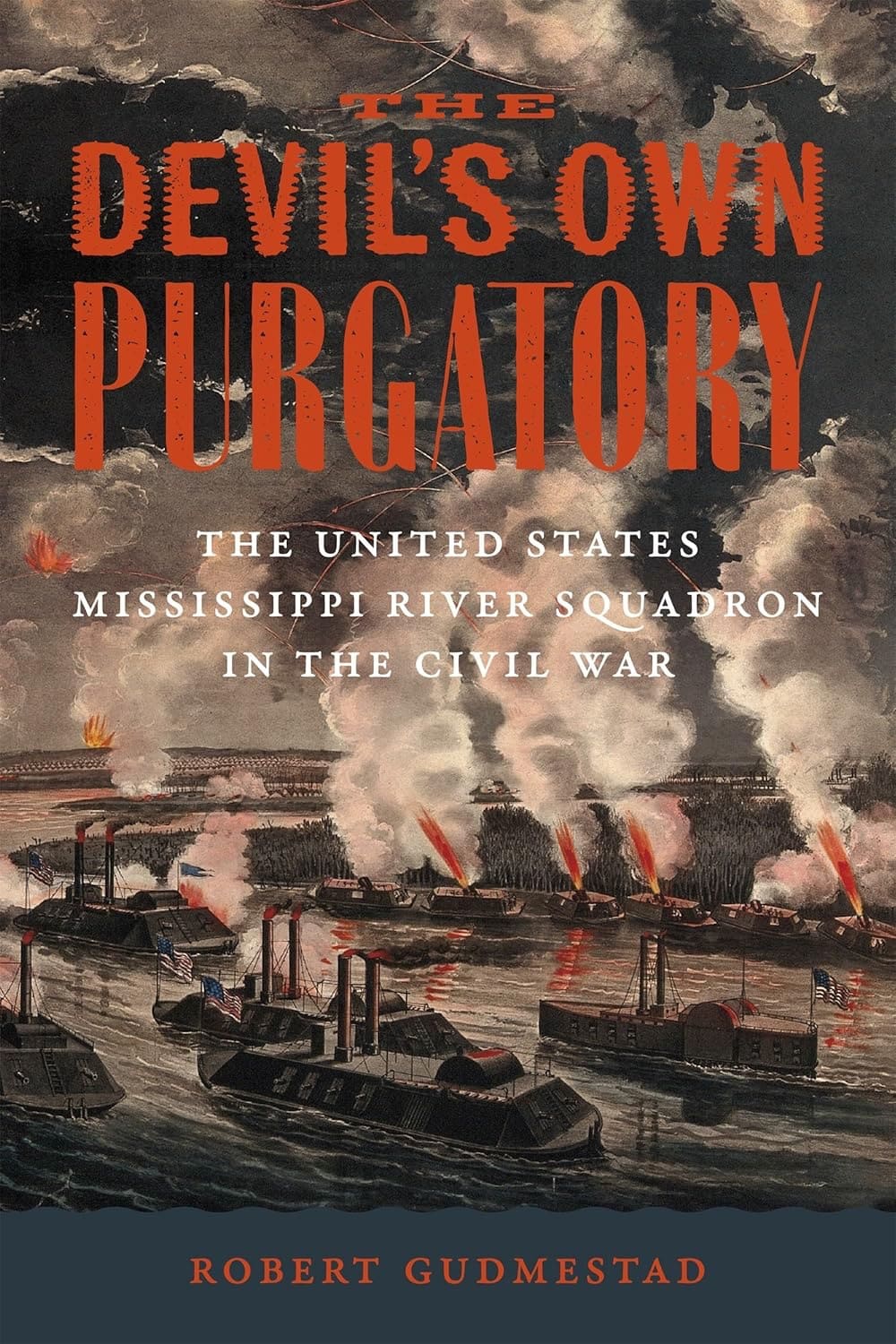 The Devil’s Own Purgatory: The United States Mississippi River Squadron in the Civil War. By Robert Gudmestad. Baton Rouge, LA: LSU Press, 2025. 309 pp. $50.00.
Reviewed by Neil P. Chatelain
The United States Navy’s Mississippi River Squadron was a motley collection of sailors and ships that proved instrumental in controlling the Mississippi River Valley. This century alone a host of books have been written on the squadron including Gary Joiner’s Mr. Lincoln’s Brown Water Navy, Barbara Brooks Tomblin’s The Civil War on the Mississippi, and many by Myron J. Smith. Robert Gudmestad’s The Devil’s Own Purgatory: The United States Mississippi River Squadron in the Civil War adds to this modern historiography with a social history exploring the sailors who manned these riverine warships.
The book divides the war into four major phases. Phase one included constituting the Western Gunboat Flotilla and fighting Confederate fleets until June 1862. Phase two lasted from July 1862 to April 1863 and included shifting to naval jurisdiction as the Mississippi River Squadron and seizing Vicksburg. Phase three lasted from May 1863 to April 1864 and focuses on battling irregular Confederate forces and patrolling inland waters. The final phase covers the war’s last twelve months and looks at how the squadron shifted in leadership, personnel, and effectiveness.
Gudmestad’s central theme circulates around how the Mississippi River Squadron and its sailors were a truly western organization that thought and acted differently from traditional seaboard blockading squadrons. Its sailors came largely from inland states, with a significant percentage comprising enslaved men who found their way abord ships by choice or by force. The ships were a motely hodgepodge of ironclads, tinclads, timberclads, and transports, built in western shipyards. They fought against Confederate fleets, Rebel guerrillas, torpedoes, channel obstructions, and riverine geography. Standing out in this exploration are efforts to forge a standalone riverine fleet which could simultaneously cooperate with ground forces to facilitate naval supremacy on the continent’s inland waters. Tied into this is the struggle to keep the fleet manned with ships and personnel while combatting enemy fire, boredom, political directives, and quests for coveted cotton and prize money.
Gudmestad’s bibliography is impressive and includes often uncited ship logbooks and muster rolls, as well as hosts of letters, diaries, and government correspondence. The book’s endnotes also have regular dialogue with other secondary studies, making the notations a critical element for any serious scholar.
What makes Gudmestad’s work stand apart is his data collection. Using a team of students, Gudmestad scoured surviving squadron muster rolls and collected information on over 14,000 sailors into a spreadsheet. This allowed for unparallelled use of macro statistics to help tell the story of these sailors. This data provides significant insight on how the squadron’s personnel changed over time. For example, Gudmestad was able to track when African American sailors joined the squadron in larger numbers, what they were paid, their specific jobs, and what type of vessels they served on. Other datasets tracked unconventional activity, such as how often Federal ships were attacked by Confederate forces ashore.
I had the privilege to speak in depth with graduate student Sean Nelson, who worked on the data compilation and analysis for this book. The team truly did their due diligence in collecting, processing, and interpreting all the information. These compiled datasets on personnel and activity add great value to the book’s story and demonstrate what macro statistical analysis can bring to Civil War studies. I look forward to seeing future scholars replicate this in other naval squadrons or other areas of the conflict.
The only real shortcoming is the book’s representation of opposing Confederate naval forces. Gudmestad regularly generalizes Confederate naval forces opposing the Mississippi River Squadron, though this is not unexpected as it is not a book on river activity itself, but Federal forces exclusively. It would have added to the social history’s value if more attention would have been paid to how Federal officers and sailors thought of enemy ironclads and gunboats, both those they actually faced in battle and those rumored to exist or that Confederates attempted to build.
The Devil’s Own Purgatory adds significant value to Civil War riverine historiography. The book puts readers on the decks of ironclads and tinclads alike and provides real looks at who served on these ships, their motivations, their strengths, and their shortcomings. It captures the mundane of training and patrols and the chaos of fleet actions and guerilla fighting. Most importantly, it merges qualitative and quantitative analysis to provide a detailed look at just who served on these inland waterways, helped split the Confederacy, and helped keep it divided afterwards.


