Book Review: From Gray to Blue: Galvanized Yankees in the American Civil War

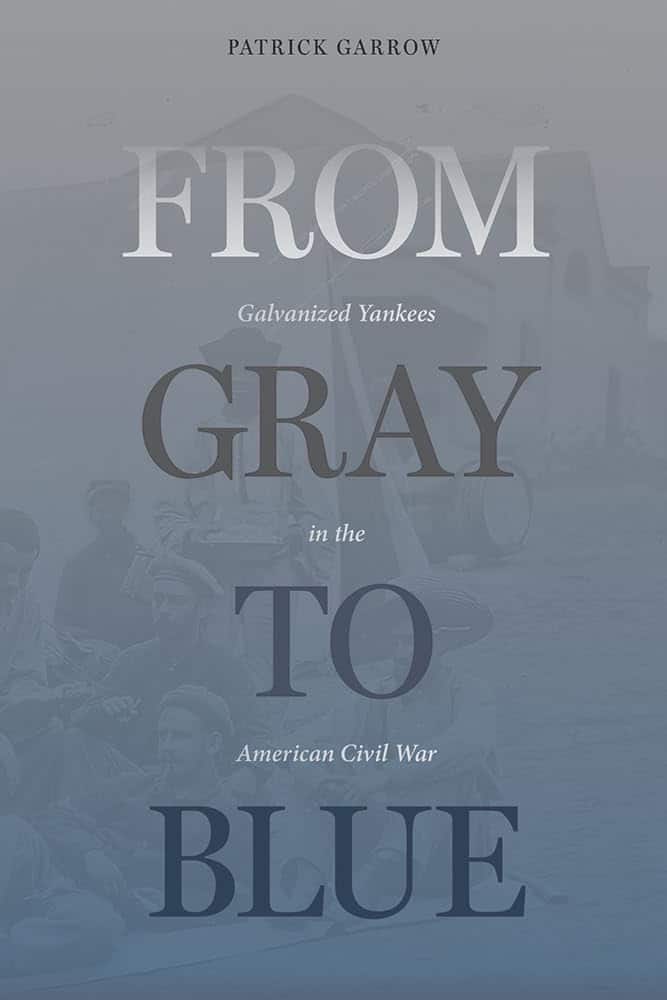 From Gray to Blue: Galvanized Yankees in the American Civil War. By Patrick H. Garrow. Knoxville: The University of Tennessee Press, 2025. Hardcover, 276 pp. $70.00.
Reviewed by Greg M. Romaneck
Wade Hampton Richardson mustered out of the Union 1st Florida Cavalry on November 17, 1865. Upon returning home, Richardson realized that many of his neighbors, and even family members, held great animosity towards him for donning the Union uniform and fighting against the Confederacy. In his own words Richardson noted, “I will add that a great many of my comrades never lived to get home, a greater number were killed after the war than fell in the actual service. I, myself went armed for months, not knowing when or where I might be attacked.” (101) Richardson eventually moved north, finished college, and lived in Milwaukee. As a transplanted Floridian, Richardson worked as a teacher, became a real estate agent, and wrote his autobiography, which detailed his unique Civil War service. Wade Richardson was one of over 100,000 southern White men who joined the Federal armed services.
Written as a follow-up to the author’s 2020 book titled “Changing Sides: Union Prisoners of War Who Joined the Confederate Army,” this publication details elements of the experiences of the thousands of Confederate prisoners, or former soldiers, who changed sides during the war. As author Patrick Garrow notes, the term “galvanized Yankee” was coined by Confederates who compared the transformation of former friends to blue-coated foes, to the industrial process of galvanization whereby iron was coated with molten zinc thereby altering its functionality and appearance.
There were several ways in which a former Confederate could galvanize and become a Union soldier. In some instances, newly minted Yankees took the form of Confederate soldiers who had completed their full term of service with the Confederate army and then chose to take a loyalty oath and join a Federal unit. In some cases, these secondary recruits received an enlistment bonus that could be funneled back to their family. In other cases, Confederate deserters would head north and enlist as substitutes, thereby freeing a northern man desirous of avoiding military service, while simultaneously earning a bonus for taking his place. However, while Garrow chronicles these types of enlistment initiatives carried out by former Confederate troops, the most common motivation to galvanize was the cruel reality of confinement in a Union military prison.
In some of his better pages, Garrow details the conditions that imprisoned Confederates faced in places such as Camp Douglas, Rock Island Prison, and Point Lookout. Faced with the very real probability of a lingering death in prison, tens of thousands of Confederates galvanized and joined newly created regiments. Many of these units were sent west to take on duties within the frontier, thereby freeing more traditional regiments to return east to fight in the major campaigns of the war. Although there is no way to get an accurate count on the number of galvanized Yankees who served on the frontier, it is fair for the author to declare, “The recruitment and use of galvanized Yankees strengthened the Union army while further weakening the Confederate army. The number of men who changed sides was not enough to affect the outcome of the war, but it was significant, particularly in the western theater.” (9)
In many instances, as Garrow describes, galvanized troops were more prone to desertion than typical Federal units. This was particularly true in galvanized regiments that enlisted for a three-year term of service rather than a single year. Further, while the use of galvanized enlistees was tactically beneficial to the Union military effort, these soldiers were not uniformly trusted or valued. For example, in Kansas, a state that experienced bloody irregular warfare as well as costly engagements with Native Americans, the presence of galvanized troops was decried. The Leavenworth Times, which held galvanized soldiers and deserters responsible for heinous crimes, commented about the service of the Third U.S. Infantry, which contained many galvanized troops, in this way, “We are opposed to paying galvanized rebels for cutting the throats of our neighbors and emigrants.” (168)
Upon the conclusion of their service, many galvanized Yankees had a difficult time reintegrating into their southern homes. Resentment of what was perceived as betrayal led to the abuse, and even murder, of many galvanized Yankees. Further, galvanized Yankees were generally not eligible for military or spousal pensions regardless of their wartime service in the Union Army. Looking at the experiences of returning galvanized Yankees, Garrow concludes that many of them went west to start a new life for themselves and their families.
In writing about galvanized Yankees, Patrick Garrow tackles a generally overlooked, and fascinating, subject. In terms of research, Garrow makes use of numerous primary data sources and does so in a meticulous and impressive manner. Each chapter focuses on a particular unit or theater of operations, and then provides demographic information about galvanized soldiers in a way that is impressive. While it is true that Garrow sometimes focuses more attention on the broad campaigns that galvanized soldiers participated in rather than their individual fates, readers will come away with new information about an obscure Civil War topic.
Greg M. Romaneck is retired after working for 34 years as a professional educator and consultant. During those years he held positions such as special education teacher, assistant principal, elementary principal, adjunct professor, director of special education, student teaching supervisor, and associate superintendent. Mr. Romaneck has also trained as a counselor and worked in areas such as crisis intervention, mediation, problem solving, and conflict resolution. Greg has had several books and numerous articles published on a variety of subjects such as Education, Psychology, Self-Improvement, Backpacking, Eastern Philosophy, Civil War history, Poetry, and Bible studies. Greg has also had nearly 3,500 book reviews published by Childrenslit.com, a popular source of information for educators, librarians, and parents regarding books for younger readers and has reviewed Civil War books for four decades for a variety of publications and magazines. Most recently Greg was the featured book reviewer for more than a decade with the Civil War Courier. Greg resides in DeKalb, Illinois and enjoys spending time with his family & friends, hiking, kayaking, backpacking, reading, and writing.


Could they double dip in retirement?
My 2XGreatGrandfather James Franklin Chester, served in the 27th Tennessee Infantry from 1861 till December 1863. He fought at Shiloh and Mumford, Perryville, Stones River, Chickamauga, and Chattanooga. He was captured at Missionary Ridge on November 25, 1863 and arrived at Rock Island prison in mid December 1863.
Family lore says he arrived at the camp in subzero temperatures. He was offered the opportunity to receive clean clothes, including socks and shoes, a great coat, and hot meals, and pay so he elected to join the 2nd United States Volunteer Infantry. This was a different regiment than the 2nd United States infantry.
Limited research indicates that he served in Kansas rebuilding some of the old forts and bridges, repaired roads and escorting new enlistees to Fort Leavenworth and protected settlers moving west. He returned to Tennessee in 1866.
Growing up, I heard all about his wartime experience as a confederate but nothing was ever said about his service in the union army.
But his widow did apply for his pension when he died in 1918.
Ancestry and Fold3 have opened up A lot of information that was not previously available to family researchers. His Galvanized service is now discussed At family reunions to the surprise of many. The common reframe is well it was cold. He was hungry and he didn’t fight against the Confederacy so it’s OK!