Book Review: Honey Springs, Oklahoma: Historical Archaeology of a Civil War Battlefield

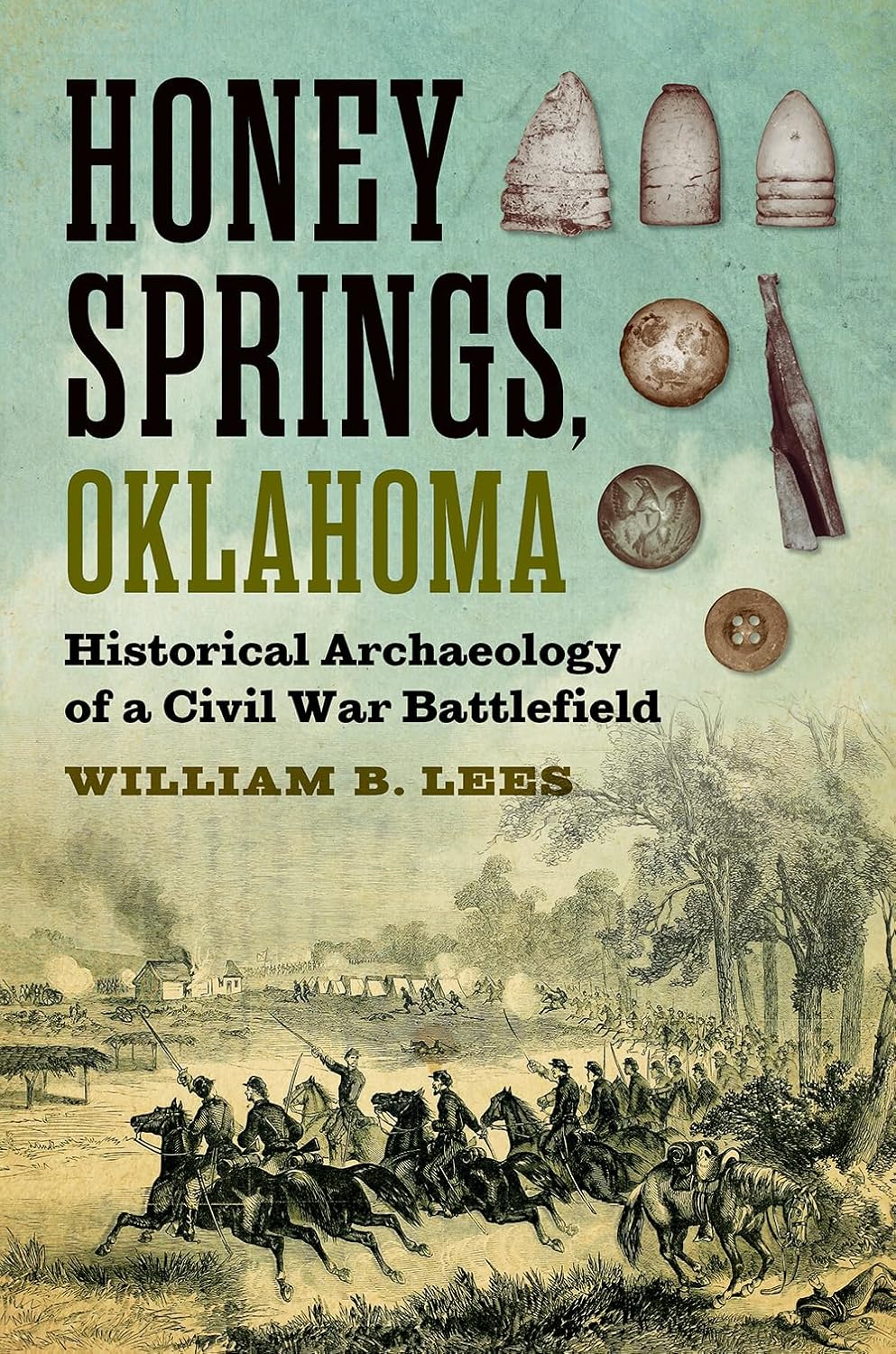 Honey Springs, Oklahoma: Historical Archaeology of a Civil War Battlefield. By William B. Lees. College Station, TX: Texas A & M University Press, 2025. Hardcover, 352 pp. $50.00.
Reviewed by Tim Talbott
Since the guns fell silent in 1865, books examining the conflict’s various battles have been the primary form of Civil War scholarship that the majority of enthusiasts consume. Certainly, numerous academic niche topics that explore a variety of subjects have provided us with a much better understanding of things such as why the war happened in the first place and how the soldiers and civilians experienced it and later made sense of the conflict. Additionally, it is true that for a number of reasons, books of the latter type have come to dominate much of the publishing market over the past several decades, particularly among the academic presses. With that said, campaign and battle studies—whether covering large well-known or small less-recognized operations and engagements—remain the mainstream reader’s avenue of approach to learning about America’s defining event.
Every so often studies appear that bridge certain elements of academic and traditional battle history quite well. A good example is the recently published Honey Springs, Oklahoma: Historical Archaeology of a Civil War Battlefield by archaeologist William B. Lees.
By combining facets of historical inquiry used most often to produce military history (primary and secondary sources, as well as examining the battlefield’s terrain) with archaeological studies of the ground (which historians less often incorporate for many reasons), Lees is able to provide readers with amazing analysis and a well-told story of what is typically considered the most significant Civil War battle fought in Indian Territory (modern day Oklahoma). As Lees explains in his introduction: “This book is the first that focuses solely on the Battle of Honey Springs. Unlike most works on the Civil War, I have built it by analyzing the historical record (memory), the landscape, and the physical, archeological remains of the fighting.” (3)
The battle of Honey Springs occurred on July 17, 1863, in what is now east central Oklahoma. It was unique in that it involved a Confederate force led by Brig. Gen. Douglas Cooper composed of Texas troops as well as American Indian units opposing a Federal force commanded by Maj. Gen. James G. Blunt that consisted of white and American Indian units, as well as a Black regiment, the 1st Kansas Colored Infantry. Fighting astride the strategically important Texas Road, the battle unfolded in three phases and ended in a Federal victory.
Lees organizes his study into six chapters. The first chapter, “History Remembered,” covers the battle’s written history, or “recorded memory,” as Lees calls it. Here he provides excellent context to understand how the battle developed, a historiography, and orders of battle, formed into a narrative; all elements found in traditional military history. But, as anyone who has written an account of a battle knows, and as Lees explains, “Questions remain . . . because written accounts are both imperfect and incomplete. Questions concern precise locations of events, the nature of conflict, and the actions of regiments. Ultimately, they also consider the cause of victory and defeat.” (75)
In the second chapter, “The Battlefield,” Lees brings in the archaeology aspect. “Being able to resolutely place and bound a battle on the modern landscape using the found artifacts is one the fundamental strengths that archaeology brings to the study of conflict,” Lees notes. “Only by using archaeological science to consider the collective whole through knowledge of placement on the battlefield do artifacts become a voice supplementing the memory-based narratives of the battle.” (77)
Along with archaeological finds, Lees incorporates concepts such as “battlespace” and KOCOA, “a military terrain analysis tool” that stands for Key Terrain, Observation and Fields of Fire, Concealment and Cover, Obstacles, and Avenues of Approach to help better determine what happened and where. (79)
The array of material evidence that Lees and his associates found on the Honey Springs battlefield during field work from 1994 to 1999 is impressive. Tables and images help readers better understand what all was unearthed. Documenting their finds with GIS information and then transplanting it onto maps helps connect the pieces to show where the fighting occurred and even where some units specifically fought.
Chapter Three, “From History to Artifacts,” examines the historical record of the units involved in the battle by understanding what they were equipped with and in some cases matches found artifacts to them. Most of the artifacts located were projectiles, both artillery and infantry. The variety of projectiles, everything from spherical and conical shoulder arms ammunition, to buckshot and breech-loading rounds and even metal arrow points, evidences the variety of weaponry used by the diverse units involved in the fighting.
Chapters Four, “Understanding the Fields of Conflict,” and Five, “Understanding the Terrain of Conflict,” further examine the three phases of the battle and emphasize the importance of terrain to what was possible for each side to achieve. In the final chapter, “Reading Between the Lines,” Lees discusses what has been discovered and learned from his triangulation approach and what questions remain and even arose from his research.
This important study reminds us of what is possible with a battle’s history, and that under certain circumstances scientific tools like archaeology can verify or challenge much of what we think we know. Readers will find Honey Springs, Oklahoma an informative book about an overlooked Trans-Mississippi theater engagement and an intriguing battlefield detective case study.


Sounds like a fascinating study! I love drilling down to the nitty gritty like this. There’s so much to learn outside of the usual sources
Tim, this was a wonderful review. Honey Springs, Oklahoma just got added to my wishlist. Thank you.
You absolutely hit the nail on the head at the beginning: “…books examining the conflict’s various battles have been the primary form of Civil War scholarship that the majority of enthusiasts consume.” Thank you for recognizing this and respecting the audience.
Well done review, Tim. Thank you. This book was on my Christmas wish list given its different geographical and archaeological approaches, so given your fine review I will move it up on my TBR pile.