Confederates Down Under: The CSS Shenandoah’s Visit to Melbourne
The Civil War may have been American, but the conflict had repercussions stretching well beyond the borders of the United States.
161 years ago today, the CSS Shenandoah dropped anchor in no less exotic of a port than Melbourne, Australia. Laid down in 1863 as a British ship, the CSS Shenandoah undertook a remarkable journey. In the face of Northern manpower and industrial might, the Confederacy had turned to commerce raiders – effectively a legal form of piracy – to undermine the United States’ economy and will to continue fighting.
The Shenandoah was one of the more successful elements of that strategy: For more than a year, the 230-foot long vessel terrorized United States merchant ships. Starting in the Atlantic, and working its way around the Cape of Good Hope toward the Pacific Ocean, the Shenandoah saw quick and early success. It did, however, develop problems with its propeller shaft that could only be fixed in port. With that in mind, her captain, Lieutenant James Waddell, made course for Melbourne.[1]

Understandably, the appearance of a Confederate warship so far from home drew considerably newspaper coverage in Melbourne. One paper, The Age, noted that “Our belligerent visitor is named the ‘Shenandoah,’ after that valley in Virginia, where General Stonewall Jackson won so many victories.”[2] It speaks to the global attention that the American Civil War received, and the impact of Jackson’s 1862 Valley Campaign, that no other description or explanation was needed, even for an Australian audience.
The Age went on to analyze the significant overlap between the crew of the Shenandoah, and that of the previous Confederate commerce reader, the Alabama. The paper even speculated at length that the Alabama’s captain, Raphael Semmes, might be aboard the visiting ship.
In what was perhaps a sign of Melbourne’s extreme distance from active hostilities, The Age and other Melbourne papers announced that tourists would be invited to row out to the Shenandoah to tour the ship and visit with the crew. For his part, Waddell and at least one other officer found the time to have their portrait taken in Melbourne.
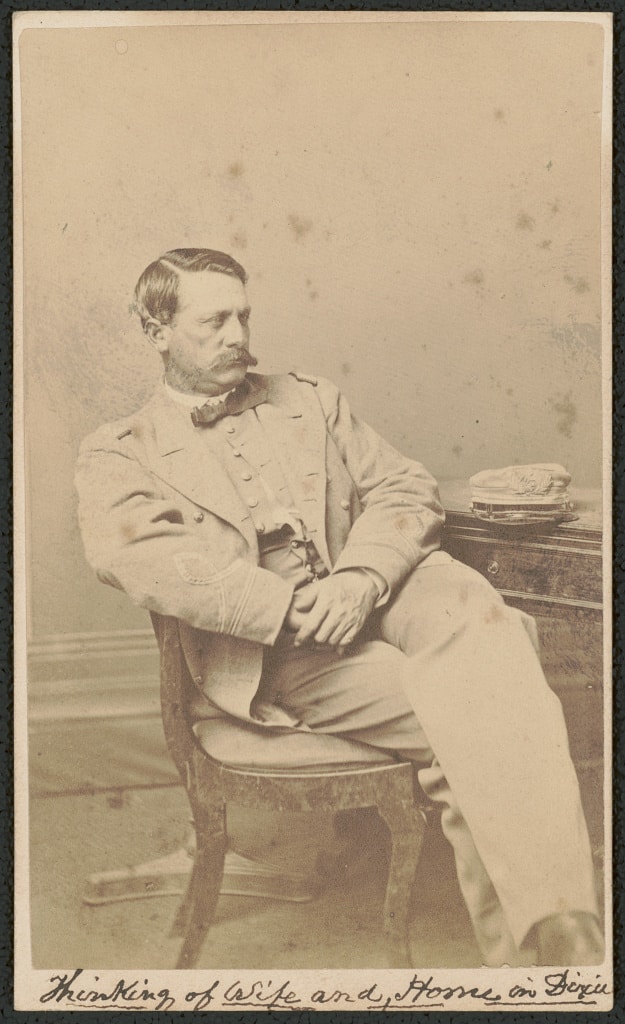
After nearly a month in port, the Shenandoah departed Melbourne and sailed north into the Pacific, where she captured or sank dozens more Union merchant ships. News traveled slowly in the 1860s, particularly at sea, and Waddell and his crew initially resisted the idea that the Confederacy had lost the war. As late as August of 1865, they may have been bound for San Francisco in a long-shot attempt at capturing the Union’s primary Pacific port. Arguably, the last shot of the Civil War was when the Shenandoah fired across the bow of a whaling ship off the coast of Alaska.[3]
If you’d like to read more about the Shenandoah, you can’t go wrong picking up a copy of A Confederate Biography: The Cruise of the CSS Shenandoah, released in 2015 by the late, and dearly missed, Dwight Hughes.
[1] “Shenandoah: 1864-1865,” Naval History and Heritage Command, March 2, 2016.
[2] “The Confederate War Steamer Shenandoah,” The Age, January 26, 1865.
[3] “Shenandoah: 1864-1865,” Naval History and Heritage Command, March 2, 2016.


Neat story, Patrick. Questions. Is the Shenandoah represented in the painting flying a British flag? If so, what is that about?
Let me chime in with some naval customs, tradition, and regulations … the artist is very deliberate is his placement and choice of colors … he is also taking some artistic license … DONEGAL is the artistic license part … vessels at anchor (in this case DONEGAL) or moored alongside a pier would fly the national ensign from the Ensign Staff, a fixture on the main deck at the stern … DONEGAL’s White Ensign (the flag of the Royal Navy) is flying from the mizzen gaff, where her colors would fly while the ship was underway … the artist probably wanted the ship to look more “alive” or “heroic — hence colors flying from the mizzen.
SHENENDOAH is flying four ensigns/pennants I recognize … the foremast is flying the Confederate national colors; the mainmast is flying a commissioning pennant; the Palmetto flag is at the top of the mizzenmast; and the Red Ensign (the Flag of British merchant vessels) flies from the mizzen gaff … so, we see SHENENDOAH’s three identities … Waddell is flying the Red Ensign – posing as British merchantmen — hoping to slip by any US Navy vessels patrolling off Liverpool … the commissioning pennant identifies her as a commissioned warship, and not a pirate – recall Waddell’s concern of being accused of piracy … and the Confederate national ensign flies from the foremast, showing her true identity.
Huzzah for Dwight–thanks for remembering him. And thank you for sharing this snapshot of the Shenandoah’s journey!