Book Review: The Boston Way: Radicals Against Slavery and the Civil War

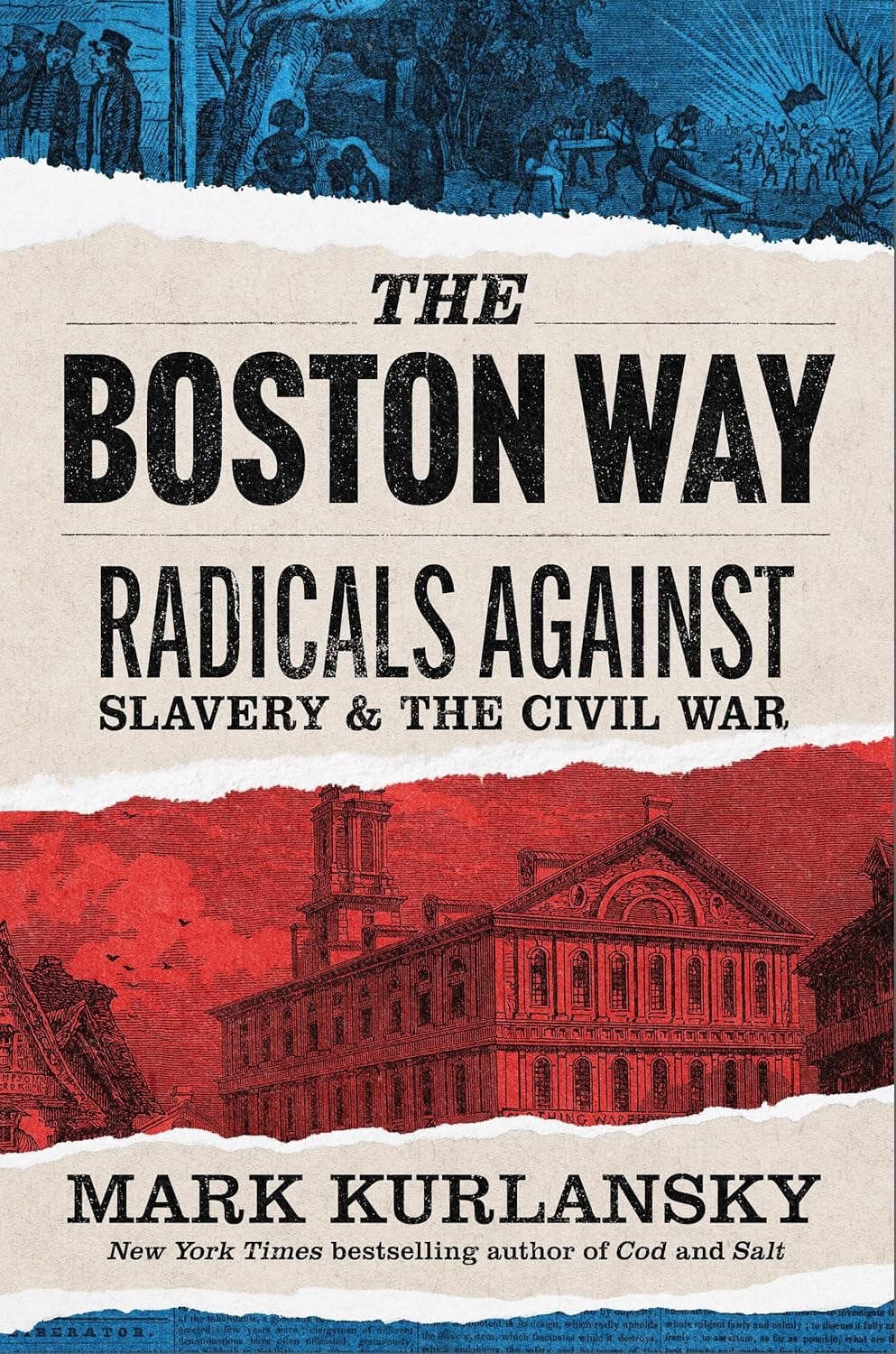
The Boston Way: Radicals Against Slavery and the Civil War. By Mark Kurlansky. Boston: Godine, 2025. Hardcover, 240 pp., $14.47.
Reviewed by Max Longley
The history of the abolitionist movement has received a great deal of attention from historians lately. No longer the warmongering fanatics of Dunning School historiography, the abolitionists are considered role models for intellectuals who desire to fight for what is right. Abolitionists were writers and editors, and regardless of their jobs they took time to speak and write in defense of their ideas. They were, in short, the kind of intellectuals other intellectuals want to be, speaking out against injustice at (frequently) great risk. Add the echoes of the activists of the 1960s, and abolitionists easily won the affections of modern historians. As an additional modern parallel, the abolitionists were feminists. They also tended to be prohibitionists, one notable area where they part company with 1960s activists.
Author Mark Kurlansky reviews the lives of many abolitionists known to historians (and often to the general public). These abolitionists (to some extent or other) operated in the greater Boston area. They included William Lloyd Garrison, Frederick Douglass, Lydia Maria Child, and Adin Ballou. The novelty of Kurlansky’s study is that he focuses on his subjects’ evolving views on nonresistance – or what we today would call nonviolent resistance. This is the stance the abolitionists started out with – with considerable inspiration from Garrison’s eloquence: speak boldly against slavery, but do not use violence against slavery or its supporters. Violence would be un-Christian and would compromise what these idealists (“zealots” to their enemies, of whom there were many) considered the purity of their witness.
Key abolitionists in Boston – Black and White – knew each other, and got together regularly – some called them a “Boston clique.” They knew in theory that Boston was not the whole of the universe – they often went into the hinterlands on the abolitionist lecture circuit. Which brings us to the most notable way in which they tried to carry out their nonviolent principles, because rowdies often interrupted their speeches and used violence against them – not only in the hinterlands but in Boston itself. In response to such disruptions, the abolitionists chose not to rough up the hecklers (as some lecturers might have been inclined to do), but to patiently endure the mistreatment in what they considered a Christian spirit.
In the early days of the movement, before their commitment to nonviolence had been subject to stresses and temptations, the Boston abolitionists were willing to denounce those who used violence in self-defense. Most notable were the criticisms of Elijah Lovejoy, who in 1837 shot at an armed mob trying to destroy his antislavery newspaper in Illinois. Lovejoy died, and the nonresistance faction disavowed him (though Kurlansky could have added that Elijah’s brother Owen went to Congress later to continue his brother’s crusade, and Owen by that time was recognized as an abolitionist in good standing).
The most advanced thinkers of the nonresistant persuasion even rejected voting and holding office, which involved cooperation in a violent political system. Of all the manifestations of nonviolence, this was the one which abolitionists most often ignored. Kurlansky only found a small handful of nonvoting abolitionists in Massachusetts. Abolitionists preferred dividing their suffrage between idealistic third parties (like the Liberty Party) and lesser-evil politicians (like Abraham Lincoln). Charles Sumner endured some criticism when he was elected to the U. S. Senate from Massachusetts on an antislavery platform, but he was able to stay in his position despite the anti-officeholding scruples of a few.
More direct challenges to nonviolent ideology arose when slaveholders came North in search of (alleged) fugitive slaves. Abolitionists organized in self-defense, and while some thought they could defend fugitive slaves nonviolently, there was plenty of violent resistance. For example, Frederick Douglass (who had shed his pacifism) and Thomas Wentworth Higginson (who was never a pacifist in the first place) both accepted the use of deadly force against anyone who was trying to enslave other human beings.
The next falling-away from pure nonviolence involved many abolitionists accepting violence by antislavery Kansans against a proslavery, government-backed faction. Now head of a New England peace society, Garrison tried to shame abolitionists against such militancy by saying that the same logic justifying violence in Kansas would justify supporting slave insurrections in the South.
Exactly, replied some. When John Brown came to Boston on a fundraising tour, he obtained some abolitionist money – the donors were aware that Brown wanted to free some Southern slaves but seemed vague about his specific plans. Those specific plans involved holing himself and some armed followers in a federal arsenal in Harper’s Ferry, Virginia – militarily foolish, but upon his capture Brown courageously capitalized on the propaganda value of his trial and execution in 1859. Abolitionist praise for Brown was ill-concealed (if it was concealed at all) behind the usual verbal disclaimers of approving-his-goals-but-deploring-his-methods.
So by the time of the Civil War, in the culmination of a long process of de facto acceptance of antislavery violence, most of the abolitionists – including Garrison – endorsed a war for the liberation of the slaves (pressing Lincoln to move beyond mere defense of the Union). Of Kurlansky’s abolitionists, I believe only Adin Ballou stuck to his pacifist guns (so to speak) during the war.
Kurlansky wistfully suggests that the nonviolent strain of abolitionist could be an inspiration to other activists. It might also be a warning that those who plan to adopt a stance of pure pacifism ought to be ready for the sacrifices – even sacrifices of principle – involved.


And yet abolitionists were often seen as fanatics in their day in the North and South. How times change.
Tom