Book Review: War Fought and Felt: The Emotional Motivations of Confederate Soldiers

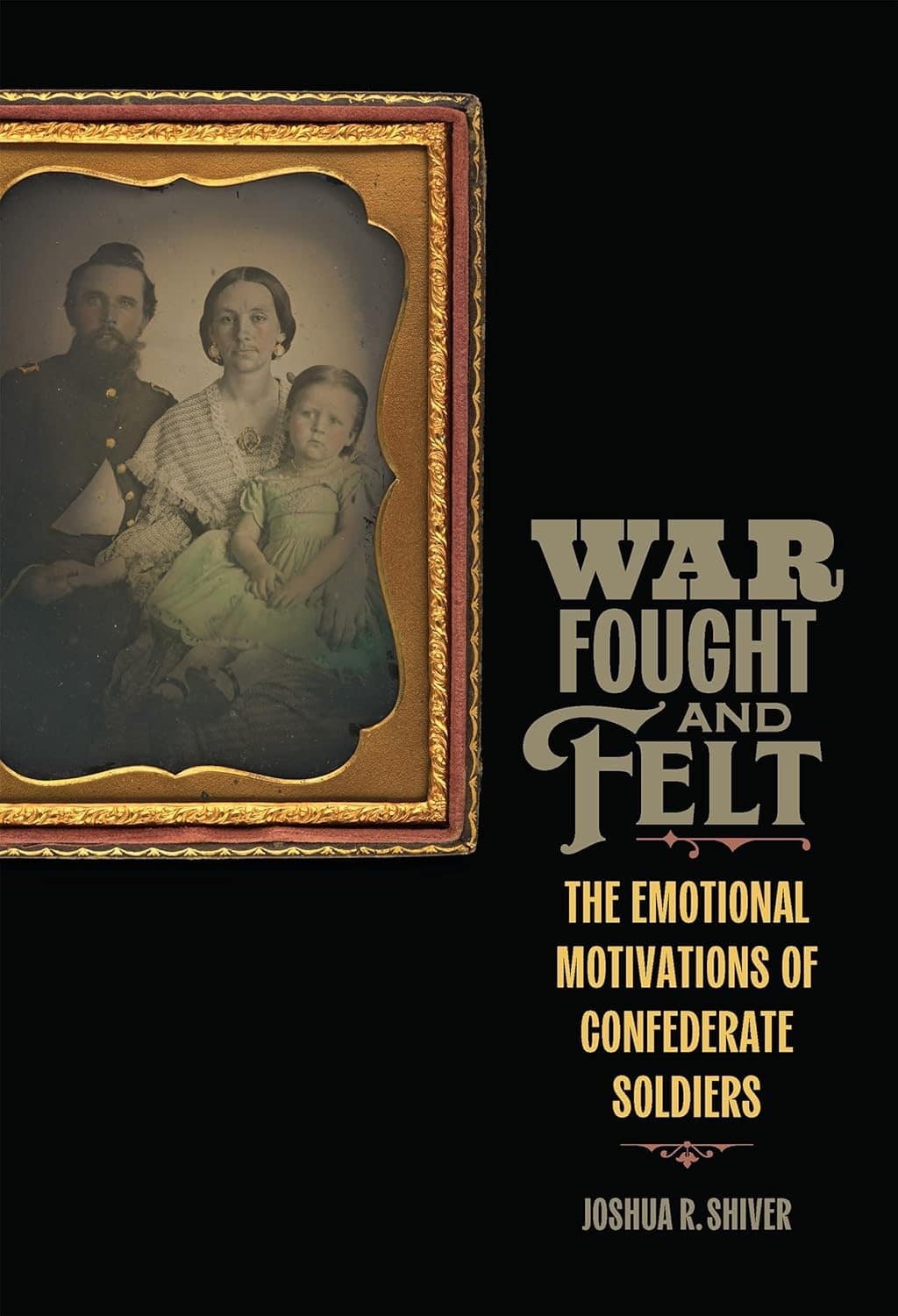 War Fought and Felt: The Emotional Motivations of Confederate Soldiers. By Joshua R. Shiver. Baton Rouge: LSU Press, 2025. Hardcover, 232 pp. $45.00.
Reviewed by Dr. James Hill “Trae” Welborn III
In this in-depth analysis of white southern manhood among Confederate soldiers during the American Civil War, historian Joshua R. Shiver builds upon recent emotions history and masculinity studies scholarship to successfully show how “the concentrated suffering endemic to war deconstructed and reshaped many [earlier social expectations as related to male emotions] and soldiers often took it upon themselves to weave new gendered constructions of emotional norms.” (p. 3) Shiver accomplishes his stated goal “to provide greater nuance in our understanding of the interrelationship between masculinity and male emotions in shaping Confederate soldiers’ motivations for fighting,” acknowledging the pronounced influence of “hegemony, patriarchy, white supremacy, or insecurity” while “rooting them in their emotional origins,” resulting in a “fuller picture of the Confederate soldier and his experience of war as a man who, though expected to restrain his emotions, found himself pulled taut between the cultural expectations of the world around him and the overwhelming feelings that he could neither shake nor repress.” (pp. 4-5)
Shiver accomplishes this nuance through a deep reading and analysis of “1,790 letters exchanged between 200 soldiers from one lower South state (Alabama) and one upper South state (North Carolina) and 366 family members and fifteen friends.” (p. 8) This relatively narrow, but rich source base enables Shiver to engage in more granular individual analysis while also contextualizing these hyper-personal experiences and perspectives within larger collective contexts.
Much of Shiver’s analysis is quantitative in nature, providing statistical data drawn from this source base to suggest general patterns of thought and behavior, and the emotional expressions linking the two. Shiver’s efforts to extrapolate broader representative conclusions from these particular soldiers and their friends and family are somewhat strained at times, but overall he deftly navigates the analytical line between overreach and myopia to fulfill his stated purpose of extracting more nuance than is typical of more sweeping conclusions about collective perspectives and experiences that predominate in the scholarly literature. Shiver achieves this effective balance by framing his evidence and analytical conclusions within the most pertinent recent historiography and through poignant application of interdisciplinary theories most prevalent within the emotions histories central to that historiography.
Shiver conveys “three sets of overarching relational categories: romantic, friendship, and parental” at the core of his analytical framing and organization of evidence. (p. 14) The structure of the book reflects this framing, with each chapter progressing chronologically from the Early Republic period through the Antebellum Era (chapter one) into the Civil War itself (chapters two, three, four, and five) and its aftermath (chapter six).
Each chapter respectively explores the intersection of Shiver’s three relational categories within its chronological context, with the middle chapters that parse out distinctive, but interrelated topical facets during the war being booked by chapter one and six on antebellum sectionalism and slavery and chapter six on the postwar battles to control the war’s effects during Reconstruction. Chapter five is particularly insightful in its analysis of the racial dynamics of shifting wartime masculinities in ways that center the complexities of human relationships within the slave system without any semblance of apologia for the systemic inhumanity and brutally oppressive context in which those human interactions developed and evolved. Chapter six then extends this nuanced analysis by way of explaining the often violent contentiousness of Reconstruction, its eventual demise, and the emerging Jim Crow regime that ultimately supplanted it.
Scholars will quickly recognize the robust historiography that Shiver engages in this work, especially more recent masculinity and emotions studies, with the scholarship of Stephen Berry, James Broomall, Diane Miller Sommerville, and Dillon Carroll foremost among them. This scholarly framing informs and enables Shiver’s “thick description” of soldiers’ varied emotional expressions amidst variable wartime and postwar contexts drawn from his selective but plausibly representative source base and demographic subset. This close reading of hyper personal sources augments the conclusions Shiver posits regarding soldiers’ shifting emotional state and expressive conventions, humanizing such perspectives and experiences without excusing the systemic prejudices and discriminatory practices that prevailed within the broader culture and society.
Decidedly aimed at a scholarly, academic audience familiar with both the historiographical and theoretical concepts being deployed in the analysis, the stories examined from these personal sources do lend the narrative a compelling element of human interest and drama that might appeal beyond the academy so long as readers accept the evidence-based analytical interventions that frame and frequently dissect that narrative. In sum, this is an important work of emotions history on evolving conceptions of white southern manhood across the Civil War Era that substantively advances scholarly conceptions and analytical frameworks for how to understand gender and emotion more broadly during that crucible of American history and culture.
Dr. James Hill “Trae” Welborn III is Associate Professor of History at Georgia College & State University in Milledgeville, GA. Born in Charleston, SC, reared in Fernandina Beach, FL, and educated at Clemson University (BA, History, 2005; MA, History, 2007) and the University of Georgia (PhD, History, 2014), Dr. Welborn specializes in American cultural history during the Civil War Era (1820-1880) and the long Nineteenth Century (1780-1920). His scholarship and teaching examine the emotional dimensions of evolving conceptions of virtue and vice, with particular focus on the role of violence in shaping these cultural values during these eras. His work also engages topics related to Civil War memory and Southern foodways. He is the author of Dueling Cultures, Damnable Legacies: Southern Violence and White Supremacy in the Civil War Era (UVA Press, 2023) and co-editor of Playing at War: Identity and Memory in Civil War Video Games (LSU Press, 2024). He is currently researching for his next book project, titled Tailgating with Jesus and General Lee: The Religion of the Lost Cause in Southern College Football.


When the review sailed into the sociological shoals of “‘gendered construction of emotional norms” I tacked away from both book and review as quickly as possible.
This is good historical analysis. A PhD wrote it! A scholarly study of Southern Civil War-era masculinity! We should all pay rapt attention. And, of course, he should get tenure at a university, a big check from the Mellon Foundation, and lots of gigs on C-SPAN.
Meanwhile, the rest of us can quietly resolve to do everything in our power to direct state funding away from colleges that produce academics like this, and toward education in useful trades. We can always repurpose the campuses of third-rate colleges into housing and other, more productive uses.
If academics wish to be condescending, that is their right. But it is our right to not pay for it. Let the academics, or Mackenzie Scott, pay for it.
It’s unfortunate that a broad and potentially interesting analysis like this can’t be made more accessible to a general audience.
At first I thought this was a parody, but maybe that is on me. ECW has a number of different constituencies and the gulf between them can be pretty wide. That is probably true for our culture as well.
i am sure this is what the average Confederate soldier was doing after his first battle: “the concentrated suffering endemic to war deconstructed and reshaped many [earlier social expectations as related to male emotions] and soldiers often took it upon themselves to weave new gendered constructions of emotional norms.” WTF?
Aye. I can only imagine the soldiers during and after a battle such as lets say Shiloh, or perhaps Hell’s Half Acre at Stones River, or retreating in abysmal conditions following Gettysburg reevaluating and reconsidering their thoughts on gendered constructions of political norms. If anyone needs an example of the rot that has set in in the halls of higher education this is a good one. GOOD GRIEF!
Brevity is the soul of wit, and the initial comment at the top of the list from our friend John wins the prize for his nautical repost.
As a “Rambling Wreck from Georgia Tech” I can’t help but note that the author’s academic training from both Clemson and UGA has served him as well qualified to expound upon video games and college football in Dixie.