Book Review: A Precarious Balance: Firearms, Race, and Community in North Carolina, 1715 to 1865

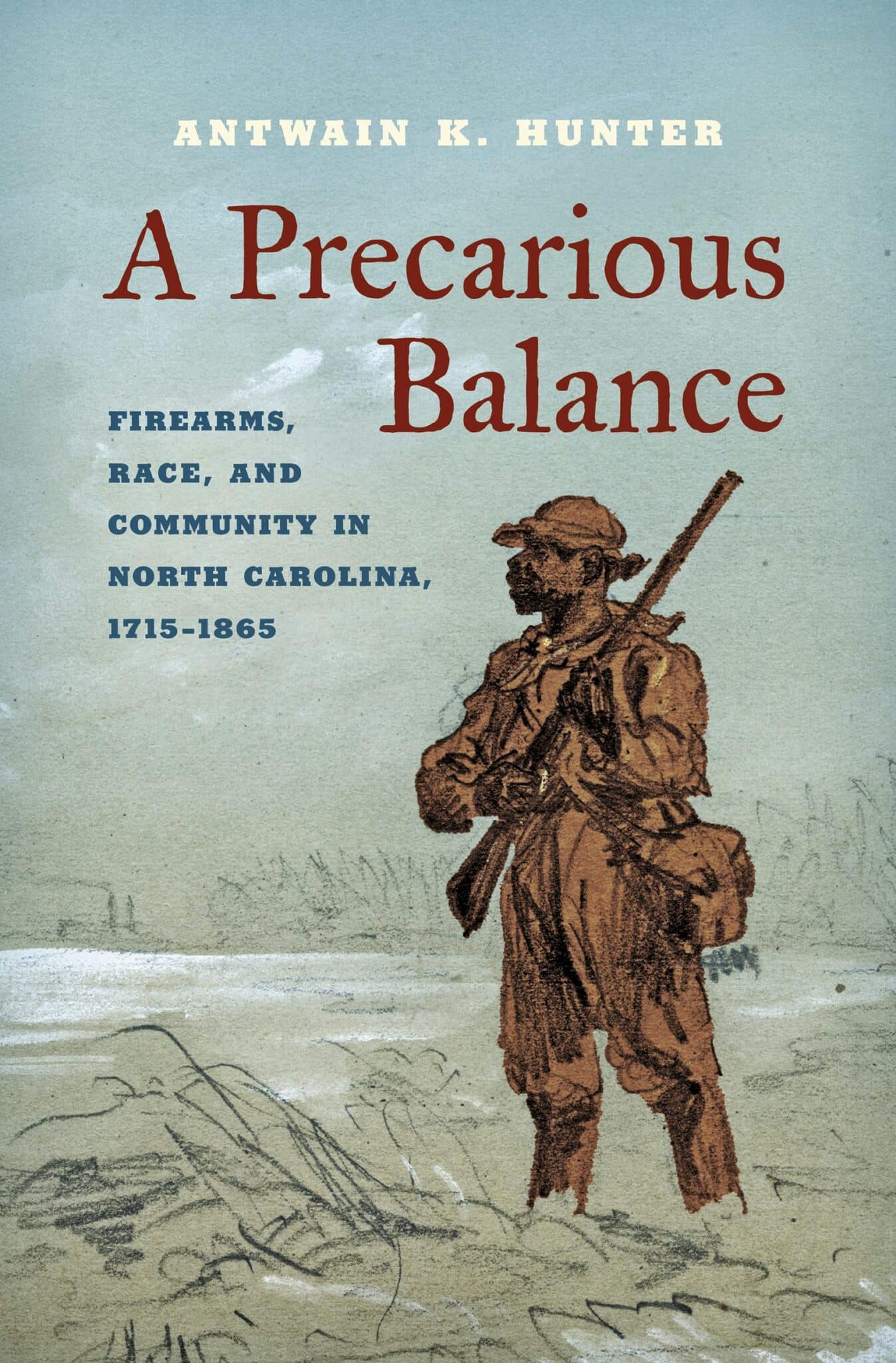
A Precarious Balance: Firearms, Race, and Community in North Carolina, 1715 to 1865. By Antwain K. Hunter. Chapel Hill: University of North Carolina Press, 2025. Softcover, 310 pp., $32.95.
Reviewed by Tim Talbott
From colonial times to the present, Americans have had a fascinating relationship with firearms. Across this timeline people’s perspectives on firearms have varied greatly depending on who possessed them and for what purpose those that had them used them. Adding to previous illuminating scholarship on this subject, but sharpening the focus by zooming in on a specific time period and place is A Precarious Balance: Firearms, Race, and Community in North Carolina, 1715 to 1865 by Antwain K. Hunter.
In the book’s introduction, Hunter explains that “This book examines how North Carolinians of different races and socioeconomic statuses understood African-descended people’s access to, possession of, and use of firearms during the late colonial and antebellum eras.” He notes that “The state sought a balance between curtailing Black people’s gun use and securing the benefits that it offered, despite the persistent threat of violence and the alleged negative influences that free Black residents had on enslaved people.” (2)
Whites of this period were often conflicted on Black firearm use. On the one hand there was the potential for abuse and misuse—a concerted revolt perhaps, or more likely, individual murder or robbery incidents. On the other hand, if enslaved and free Blacks could legally use or own firearms they could perform certain forms of needed labor—hunting for food to supplement their own or their enslavers’ tables, protecting property like crops and livestock from vermin and predators—that obviously benefitted the enslaver and or the enslaved and free Black community. Hunter contends that “Black North Carolinians capitalized on white people’s reliance on their armed labor to access firearms for their own purposes.” (2)
In addition to the introduction, which also provides readers with a thorough historiography on African Americans and firearms, Hunter organizes A Precarious Balance into five fascinating chapters that approach this topic a bit more thematically than chronologically. In order, the chapters are: “The Law in Theory and Practice,” “Enslaved People’s Law-Breaking,” “Armed Labor,” “The Free Black Community,” and “The Civil War.” The book concludes with an appropriate epilogue, “Firearms, Race, and the Steady March of Time.”
Each of the five chapters is well-developed, interpreted, and based heavily on primary source documents found in period “newspapers, manuscript collections, municipal records, session laws, congressional debates, legislative petitions, enslaved workers’ narratives, coroner’s reports, and court records from every level of North Carolina’s judiciary.” (5) Hunter explains that in many cases these primary sources are complicated due to several factors. These include the fact that they most often come from white perspectives and are far from a complete accounting due to many whites enacting their own modes of judgment and punishment when dealing with their human property as well as free people of color, and thus leaving no record. Still, as much as possible, the author paints accurate pictures of Black people’s experiences, too, by fully utilizing all source information possible such as their names, ages, and occupations.
While all of the book’s chapters offer readers fascinating examples and amazing insights that fill each chapter’s specific framing, the final one, “The Civil War,” was particularly outstanding. In it Hunter explains that the “precarious balance” between whites and Blacks over firearms possession and their use from the colonial and antebellum periods carried over into the four years of the Civil War, “but it was more useful and dangerous during the war,” particularly as emancipation increasingly became a stated war aim by the United States. (142)
As the nation split and as North Carolina debated its future within or without the Union, it “repealed the license provision of its 1841 firearm law, effectively ending free Black people’s gun access.” Soon thereafter the state’s legislators “strengthened the provisions for overseeing enslaved laborers,” giving greater power and efficiency to local officials. (143) Other legal provisions included prescribed punishments for treason to the state, a part of which allowed for the execution of free people of color who helped or encouraged enslaved revolts.
As one might imagine, documentation of events concerning this subject abound from the Civil War years. The conditions were too ripe not to do so. Hunter’s impressive research turned up an especially intriguing case involving Capt. William Tripp of the 40th North Carolina Infantry and his enslaved man Roden. While defending Wilmington, Tripp wrote to his wife in Beaufort County providing advice and instructions, which she relayed to Roden for overseeing the plantation’s operation. Tripp’s letters show his firm and abiding trust in Roden and his decision making, even when it came to protecting the Tripp family by using firearms to defend them and their property from reported local depredations by marauding free Blacks and enslaved runaways, Unionist civilians, and possibly Union soldiers.
As the war dragged on and Confederate manpower shortages became more severe, debate began in the Tarheel State over whether Black men should serve as arms-bearing soldiers. The vast majority of white North Carolinians opposed the idea and viewed it as undermining traditional modes of armed labor. Of course, United States military officials had no such qualms when finally authorized to enlist Black North Carolinians. Over 5,000 African American soldiers carried rifles serving in units raised in the state, adding to the Union military’s manpower while at the same time taking potential labor away from the Confederacy, a damaging double negative.
A Precarious Balance offers readers a nuanced look into a complex topic, and in doing so helps us better understand the past and present. Indeed, its relevance, along with its depth of research and readability are among this book’s many strengths.


