Book Review: Becoming St. Louis: Family, Faith, and the Politics of Citizenship, 1820-1920

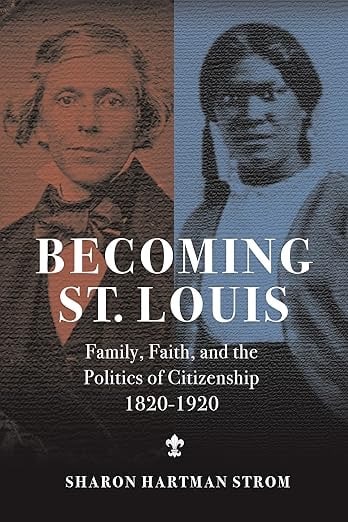
Becoming St. Louis: Family, Faith, and the Politics of Citizenship, 1820-1920. By Sharon Hartman Strom. Illinois: University of Illinois Press, 2025. Softcover, 216 pp. $28.00.
Reviewed by Gregory A. Mertz
Starting with the passage of the Missouri Compromise in 1820, continuing for the next 100 years up until Chicago supplanted St. Louis as the premier city of the mid-west, the people of St. Louis were “caught up in this mid-century crisis of the nation.” (48) That is how author Sharon Hartman Strom encapsulated her book on how the self-proclaimed “gateway to the west” played a prominent role coping with the tensions facing not just St. Louis, but the country as a whole, from the lead-up to the Civil War through its aftermath.
Becoming St. Louis is not simply a local history. At times, St. Louis was in the spotlight of the country, with incidents such as court case decisions, the viewpoints of political and religious leaders, and military actions having consequences that affected the nation as a whole.
One of the most momentous incidents occurring in St. Louis was the Dred Scott U.S. Supreme Court decision and the steps leading up to it. Dred Scott was an enslaved man who was purchased in Missouri by army surgeon John Emerson in 1833. Emerson took Scott to the free state of Illinois and then to Fort Snelling in the Wisconsin Territory,[1] before ultimately sending Scott back to St. Louis, Missouri. In 1836 an enslaved woman name Rachel, ironically also taken to Fort Snelling and then to St. Louis, successfully argued in the courts that she should be free, since she had been taken to a free territory. Scott made a similar claim in the St. Louis Circuit Court in 1846.
After several years of delays due to technicalities and Scott’s initial lawyer dropping the case to participate in the 1849 Gold Rush, the case eventually progressed up to the U.S. Supreme Court, which made a decision in March of 1857. The court determined that anyone of African descent could not be a citizen of the United States, and that provisions of the Missouri Compromise improperly interfered with the rights of slaveholders. Those St. Louis connected decisions had far-reaching repercussions.
“Dred Scott, the State of Missouri, and Kansas-Nebraska [namely, the principle of popular sovereignty] were now the focus of the nation’s most prominent headlines.” (51) During Abraham Lincoln’s famous House Divided speech in 1858, he pointed out that slavery could be determined to be legal in every state of the Union by a rational interpretation of the Dred Scott decision. This Supreme Court case set the tenor of all deliberations concerning black citizenship, not just in St. Louis, but across the nation.
The topics addressed in Becoming St. Louis are arranged topically rather than chronologically. Strom’s narratives flow easily through the respective subjects, enabling all topics addressed to follow to a logical conclusion in each chapter. Other important events taking place at the same time are mentioned to provide context, even though those events may be covered in more detail in a later chapter covering the appropriate topic.
Naturally, some of the same personalities are involved in different issues and appear in different chapters. This helps to provide a thread that both links the chapters and provides the reader with a more comprehensive understanding of characters who keep popping up in the narrative.
When someone who had been mentioned earlier in the book appears again, Strom often provides a brief recap of the person, which was a greatly welcomed contribution to the book. Indeed, one of the strengths of the book is the manner in which readers are shown how the key leaders in the community viewed several of the important issues at the time, developing a keen appreciation for what these people were like.
One of the reoccurring characters is Elizabeth Keckley. She was the formerly enslaved seamstress who became a well-known dressmaker for the wives of powerful Washington politicians. Because Keckley wrote a memoir, highlighting her friendship with Mary Lincoln, she is logically included prominently in the chapter titled, “A Race without a History Is Soon Forgotten.”
However, she is mentioned elsewhere in the book as well, including the chapter covering the Dred Scott Case. Keckley’s St. Louis owner was lawyer Hugh Garland, who represented Scott’s owner John Stanford in the famous case. In the chapter on the Civil War, we learn that Keckley’s son, who passed for being white and enlisted as a white soldier early in the Civil War, was killed in Missouri’s August 1861 battle of Wilson’s Creek.
The book is well organized, with the stories of several prominent St. Louis leaders being particularly engaging. Far from being a local history, Becoming St. Louis provides examples of how the turmoil that was evident throughout the country manifested itself in this unique city.
Greg Mertz earned a bachelor’s degree in Recreation and Park Administration at the University of Missouri and a master’s in Public Administration from Shippensburg University. He recently retired from Fredericksburg and Spotsylvania National Military Park where he worked for 36 years — 27 of them as the Supervisory Historian, managing the park’s visitor services and training hundreds of seasonal employees, interns, and volunteers in the art of interpretation. His interests in public history and preservation include service in several organizations outside of his 40-year career with the National Park Service. Greg is the founding president and a current board member of the Rappahannock Valley Civil War Round Table and is the vice president of the Brandy Station Foundation. In addition, Greg is the author of Attack at Daylight and Whip Them: The Battle of Shiloh, April 6-7, 1862, published by Savas Beatie in 2019.
[1] At the time, the region that later became Minnesota was part of the Wisconsin Territory. Paul Finkelman, Dred Scott v. Sandford: A Brief History With Documents, 2nd Edition (Bedford/St. Martin’s, Boston, MA 2017), p. 13.


