When Courage Made Her More Beautiful: Attraction, Strength, and the Women Behind the Civil War Record
ECW welcomes guest author Kristen Austin Cortez.
In June 1862, 2nd Lt. James H. Holmes of the 11th New York Cavalry rode to a Virginia farm near Middleburg with orders to seize a prized team of horses. While Holmes explained to the widow who owned them the government’s necessity, her daughter slipped quietly inside the house and reappeared at the gate with a revolver raised, eyes “snapping like fire.” She warned she would shoot the first man who tried to pass.
Holmes faced something he had not anticipated, “a beautiful woman defending her home.” He withdrew. Captain Seth Pierre Remington called Holmes, “Chicken-hearted,” tried himself to remove the horses the next day, and fared no better. They abandoned the mission as Holmes confessed that he “would not shoot the brave lady…for all the horses in the Confederacy.” What lingers in the regimental history is not embarrassment, but attraction. The young woman seemed, Holmes wrote, “more beautiful… because of her bravery.”[1]
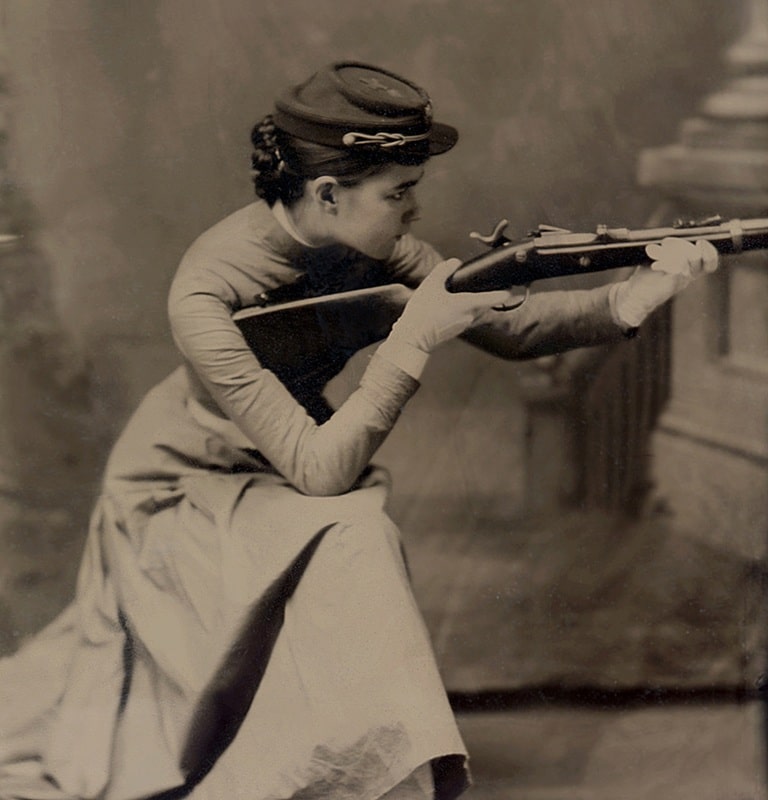
Through a 21st-century vantage point, the Civil War era appears as rigidly patriarchal. Legally and politically, it was. The social and domestic hierarchy of the time limited a woman’s worth and status to her father or husband; she had no autonomy or legal protection. Yet scattered through diaries, memoirs, regimental histories, and newspapers are moments when men did not recoil from female strength, but respected it. Again and again, wartime created a cultural elasticity in which female agency, especially when expressed through visible courage or open defiance, could be compelling rather than threatening to men. In wartime, courage could eclipse prescription. As historian Stephanie McCurry’s scholarship has demonstrated, women were hardly passive or innocent noncombatants in the Civil War.[2] The more revealing question is not whether they acted, but when, and why, their defiance drew admiration rather than resistance.
The pattern becomes clearer when we return to female influence in family roots. In the family history of Perry L. Austin, a celebrated sergeant in the 11th New York Cavalry, an earlier story survives. He begins his family history with his grandmother, Lucy French, alone in a frontier cabin in rural New York with her infant child while her husband traveled to Buffalo for provisions.
When she saw the blanket covering her unfinished doorway move, she reached for her husband’s rifle and fired. When her husband returned, a black bear lay dead outside. Austin recalled it with admiration, a story to pass on with pride to future generations.[3] His retelling suggests that respect for women who acted decisively under duress, even when doing so unsettled conventional expectations, may have been rooted not only in battlefield encounters, but in lessons learned at home.
Consider also the women who enlisted as soldiers during the Civil War. Blanton and Wike’s research shows that, of the documented cases alone, at least four hundred or more women successfully entered the ranks, including those who served for extended periods. Many were suspected, yet not always expelled; comrades often feigned ignorance or chose silence and protected them.[4] Competence and reliability earned trust. Performance often outweighed gender.
Although women were formally barred from enlistment, the demands of Civil War recruitment ensured the inclusion of women, whether men acknowledged it or not. Army doctors, desperate for manpower, frequently conducted farcical physical examinations.[5] Frances Louisa Clayton passed inspection in one of her husband’s suits with false facial hair. Maria Lewis enlisted alongside her father, and Lucy Gauss served beside her husband.[6] These examples reveal that entry into a male sphere was not always met with resistance or expulsion, but rather support.
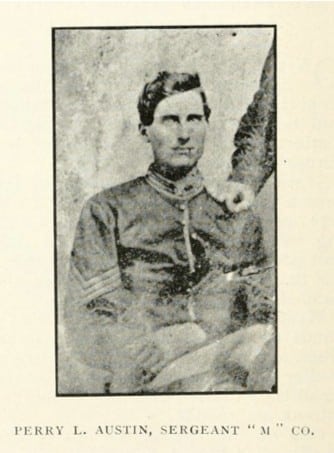
Smith, Thomas W. Smith, Thomas West, Scott’s 900: The Story of a Regiment (Chicago: Veteran association of the regiment, 1897), 256.
More significantly, once women demonstrated bravery and endurance, they garnered respect. The men in their lives were not repulsed, worried, or threatened by women who fought or challenged conventional gender roles, particularly when women were most needed.
Newspapers amplified these narratives. Reports of female soldiers and women’s wartime assertiveness drew public attention and often romanticized their bravery instead of dismissing it.[7] Women’s visible eagerness to enlist, or their public shaming of men who hesitated, was sometimes used to spur recruitment. At an August 1862 war meeting in Eden Corners, the Buffalo Daily Republic praised the village’s young women for displaying more patriotism and self-command than the young men, suggesting that female resolve exposed male deficiency.[8] Such coverage did not erase structural inequality, but it reveals that audiences could admire female martial agency, particularly when it appeared to serve national necessity.
Union soldiers expressed similar enthusiasm over defiant Southern women. Bell Irvin Wiley records initial repulsion at women who smoked, drank whiskey, took snuff, mocked Federal troops, and refused even the most basic gestures of hospitality, behaviors that openly violated nineteenth-century expectations of feminine delicacy. Yet irritation did not preclude fascination and attraction. One Illinois sergeant confessed that he “fell in love” in spite of a woman’s hostility and defiance. Wiley noted that such conduct was often regarded as “commendable indications of spunk.”[9] What should have marked these women as coarse or unfeminine instead rendered them vivid, spirited, and compelling. Even overtly “unladylike” resistance could heighten rather than diminish attraction.
In his Reminiscences of a Boy in Blue, Lieut. Henry Murray Calvert of the 11th New York Cavalry recounts a spring ride in 1863 near Poolesville, Maryland, with Miss Marshall, a local woman whose skill and confidence immediately impressed him. When he attempted a compliment, declaring that “one seldom sees a lady who possesses such an accomplishment,” she coolly responded with a rebuff. Later, when she boldly corrected his use of the word “rebels,” insisting he say “Confederates,” he readily conceded. Her constant challenges only heightened rather than diminished his intrigue, prompting him to later admit to “love.”[10]
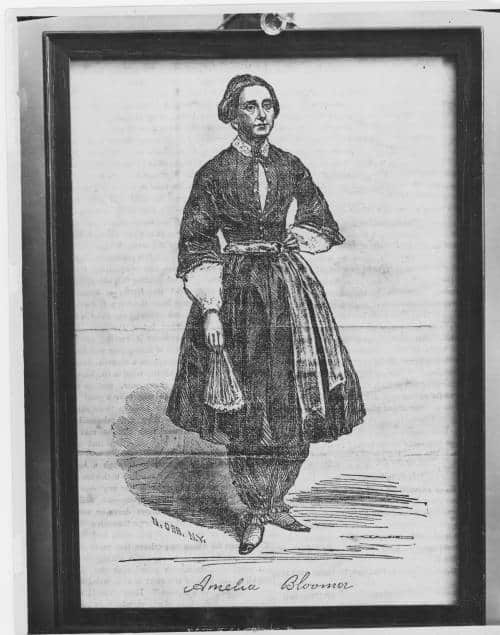
Of course, admiration had limits. The elasticity of public tolerance narrowed when female strength shifted from temporary crisis response to permanent systemic challenge. Before the war, Amelia Bloomer’s reform dress, including a short skirt over loose trousers, briefly captured public attention and scorn. Tied to women’s suffrage and dress reform movements, the costume provoked relentless scrutiny and vitriol, leading Bloomer and other suffragists to abandon it.[11]
Novelty could be indulged; sustained nonconformity around gender expectations proved harder to accept. When Dr. Mary Edwards Walker, a surgeon for the Union, pushed those dress reform boundaries further, refusing to revert to conventional femininity after the war, arrest, ridicule, and temporary rescinding of her Medal of Honor followed.[12] The culture that romanticized armed farm girls and applauded disguised soldiers proved far less comfortable with permanent transformation: courage in wartime could inspire admiration; courage as lasting challenge could unsettle.
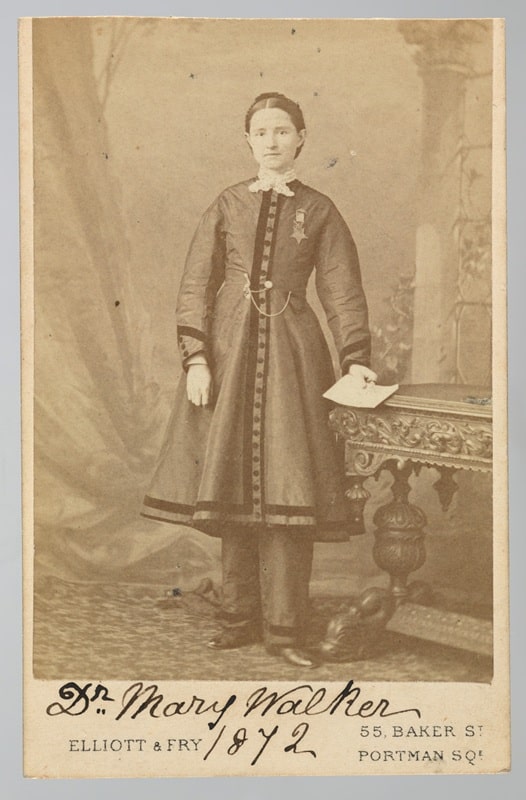
Although northern women had a tremendous impact on the abolitionist movement, bringing slavery into the national debate and influencing American politics, women were consistently denied the right to vote before, during, and long after the Civil War.[13] The American women’s suffrage movement began in the 1830s, but it would take almost a century to culminate in victory. Female attempts to challenge systems of power did not always attract male support; structural equality faced male resistance.
While the Civil War created a temporary necessity for women to occupy roles previously reserved for men, revealing a culture more elastic than expected, it did not secure women the right to vote. But when women challenged men and stood as combatants, at gates, at camps, at home, in meeting halls, they unsettled assumptions about who could claim courage and what men wanted, even if the political structure remained stubbornly resistant for decades to follow.
Kristen Austin Cortez earned her BA in English from the University of California at Los Angeles with minors in American Studies and Women Studies. She earned her Masters of Fine Arts in Writing at the University of San Francisco. Kristen teaches 11th grade AP Language and Composition at Los Gatos High School in the SF Bay Area and enjoys reading about the Civil War and traveling to Civil War sites and battlefields.
Endnotes:
[1] Thomas West Smith, Scott’s 900: The Story of a Regiment (Abridged, Annotated) (BIG BYTE BOOKS, 2015), 420.
[2] Stephanie McCurry, Women’s War: Fighting and Surviving the American Civil War. (Cambridge, MA: Harvard University Press, 2019), 13–14.
[3] Perry L. Austin, “History of Perry L. Austin and Family” (1918), under “Ancestry and Childhood,” accessed October 28, 2022, https://www.werelate.org/wiki/Person:Perry_Austin_%283%29
[4] DeAnne Blanton and Lauren Cook Wike, They Fought Like Demons: Women Soldiers in the American Civil War (Baton Rouge: Louisiana State University Press, 2002), 27, 51.
[5] Blanton and Wike, They Fought Like Demons, 47–49.
[6] Mariann Monson, Women of the Blue and Gray: True Stories of Mothers, Medics, Soldiers, and Spies of the Civil War (Salt Lake City: Shadow Mountain, 2018), Kindle edition, loc. 448–449.
[7] Blanton and Wike, They Fought Like Demons, 220, 262.
[8] Buffalo Daily Republic, “War Meeting at Eden Corners,” August 12, 1862.
[9] Bell I. Wiley, The Life of Billy Yank: The Common Soldier of the Union (Baton Rouge: LSU Press, 2008), 106.
[10] Henry M. Calvert, Reminiscences of A Boy in Blue 1862–1865 (New York: G.P. Putnam’s Sons, 1920), 63–67.
[11] Genevieve Carlton, “Amelia Bloomer: The Suffragist Who Fought for Women’s Dress Reform,” All That’s Interesting, 2021, https://allthatsinteresting.com/amelia-bloomer.https://allthatsinteresting.com/amelia-bloomer; Elizabeth Cady Stanton, Eighty Years and More: Reminiscences 1815–1897 (New York: European Publishing Company, 1898), chap. XIII, “Reforms and Mobs,” https://digital.library.upenn.edu/women/stanton/years/years.html.
[12] Mercedes Graf, introduction to Hit: Essays on Women’s Rights by Mary E. Walker (Amherst, NY: Humanities Books, 2003), 5–6, 8–9; The New-York Historical Society, “Life Story: Dr. Mary Walker (1832–1919), Trailblazing Civil War Surgeon,” Women & the American Story, text and image, https://wams.nyhistory.org/a-nation-divided/civil-war/life-story-dr-mary-walker/.
[13] Stanton, Eighty Years and More, on the influence of women on abolition and the denial of voting rights.


Very interesting subject! I enjoy reading these accounts when I come across them. It’s notable that in the context of occupying armies, the local men often ran and hid while the women of the household were left to defend their property. It was understood that women were to be treated with a special courtesy. I wonder how cultural or religious differences played a role in how these “fighting women” were perceived?
Enjoyed the article. Not sure if these are on point, but fwiw.
Anne Frobel, a southern women living [more like scraping by] on her farm in Union-occupied northern Virginia, wrote early in the war, in her now published diary, that a Northern officer took a shine to her and offered to go riding with her, to which she responded that they could ride to General Beauregard’s camp together., Beauregard being in Centreville, VA, approx 20 miles away, at the time. The Union officer’s ardor apparently dwindled after that, which was fine with her.
English Col. Fremantle, who toured the south in 1863 from Texas thru the fallen Jackson MS to Gettysburg, “…General Polk told me an affecting story of a poor widow… whose three sons had fallen in battle…she had only one left, a boy of sixteen. So distressing was her case that General Polk went himself to comfort her. She looked steadily at him, and replied to his condolences by the sentence, “As soon as I can get a few things together, General, you shall have Harry too.” The tears came into General Polk’s eyes as he related this episode, which he ended by saying, “How can you subdue such a nation as this!”
Fremantle, on his way back to England in 1863, “…My Northern friends on board the China spoke much and earnestly about the determination of the north to crush out the Rebellion at any sacrifice. But they did not show any disposition to fight themselves in this cause, although many of them would have made most eligible recruits; and if they had been Southerners, their female relations would have made them enter the army whether their inclinations led them that way or not.”
Very interesting read and perspective.
Made me think about how people don’t change, just society and what it deems as acceptable behavior. In this case, regarding genders.
Thanks, Kristen, for a thoughtful, well-researched, and very interesting look at some of the many contributions and courageous acts of women in the Civil War. I look forward to reading more from you in the future.