Book Review: Armies of Antietam: The Union and Confederate Armies at the Battle of Antietam

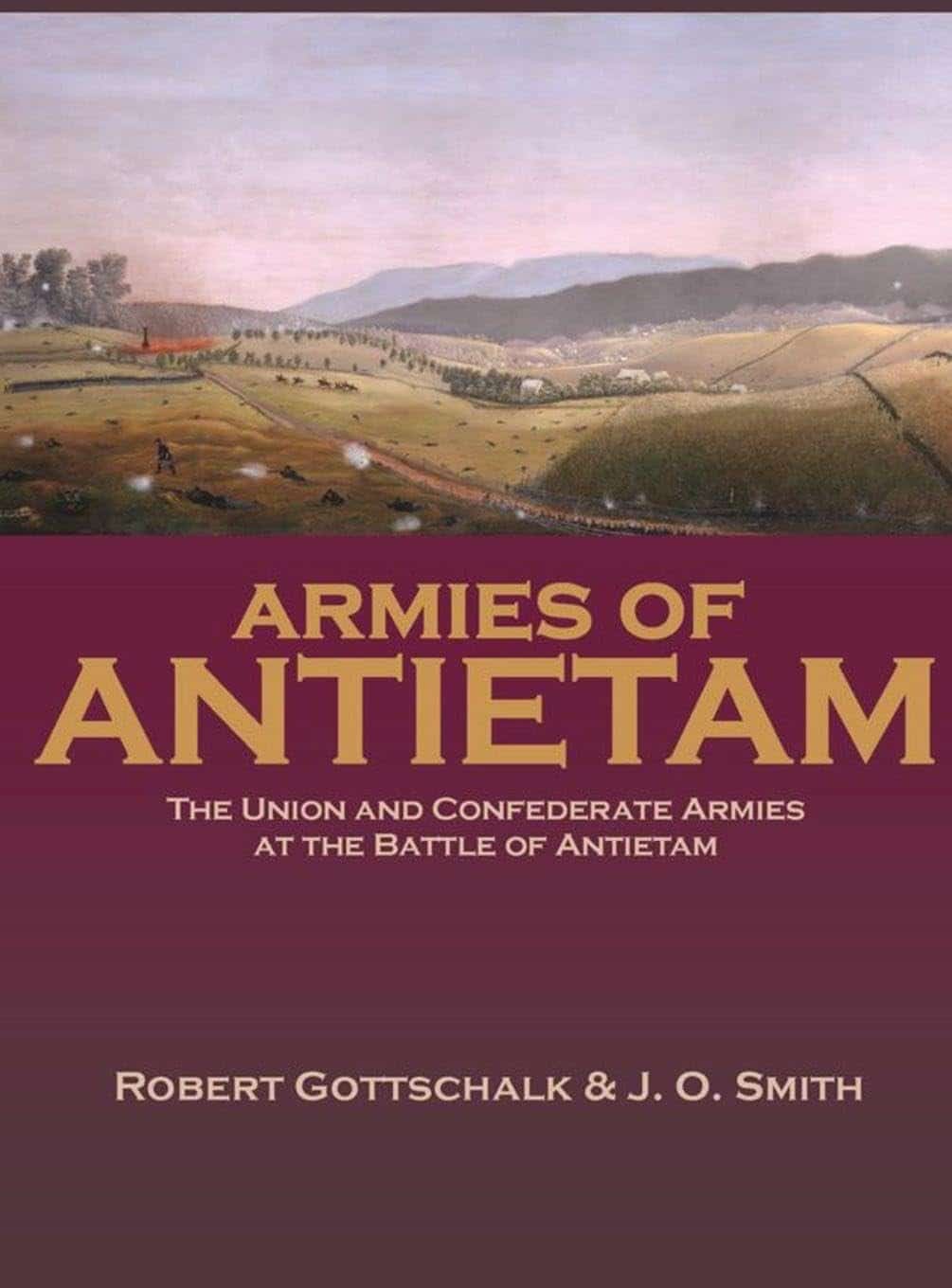
Armies of Antietam: The Union and Confederate Armies at the Battle of Antietam. By Robert Gottschalk & J.O. Smith. Sharpsburg: The Antietam Institute, 2025. Hardcover, 480 pp. $44.95.
Reviewed by Danny Brennan
The past decade has seen a welcome renaissance in scholarship on the Maryland Campaign. From the publication of I Dread the Thought of the Place by D. Scott Hartwig in 2023 to a wave of studies examining civilian experiences in the late summer of 1862, students of this critical campaign now have a wealth of new resources. At the forefront of this scholarly revival stands the Antietam Institute, which has produced multiple volumes and a biannual journal since its founding in 2021. These works have deepened our understanding of brigades, artillery operations, and command structures. Its latest publication continues this trend, offering an unprecedented look at the regiments and batteries that formed the armies.
Armies of Antietam is the collaborative effort of Robert Gottschalk, a former ranger at Antietam National Battlefield, and Jim Smith, a certified battlefield guide and the institute’s vice president. The project began as Gottschalk’s personal research into units of particular interest, gradually expanding until he enlisted Smith’s assistance. Together, they produced a comprehensive reference covering the Federal Army of the Potomac and Harpers Ferry garrison as well as the Confederate Army of Northern Virginia.
Gottschalk aptly describes the work as “a compilation of compilations.” (v) At its core are detailed orders of battle for each army, extending beyond the standard hierarchy of corps, divisions, and brigades to include army-level staff and headquarters escorts. Each regiment and battery is accompanied by a structured entry that provides a concise, but information-rich account of its service.
Entries follow a consistent format. Each unit is introduced with its name and, where applicable, nickname. The “Before Antietam” section outlines organization, recruitment, and early service, including company origins and prior organizational experience. The “At Antietam” section details troop strength, casualties, commanders’ biographies, and, when available, information on the weaponry used. Finally, “After Antietam” summarizes subsequent assignments and engagements. This clear structure makes the book accessible as a reference.
Smith and Gottschalk succeed not only in assembling orders of battle, but also in enriching them with valuable contextual detail. Lists of Medal of Honor recipients and occasional quotations add texture, while the inclusion of pre- and post-battle service underscores an important interpretive point: These units did not fight in isolation. Instead, they were shaped by a longer wartime experience that extended well beyond September 1862. Though not a narrative history, the cumulative effect of these entries reveals the broader human cost and continuity of the Civil War.
The book itself is a large hardcover volume that would look distinguished on any bookshelf or coffee table, particularly when placed next to the other red-and-gold volumes that the Antietam Institute has published. While not a pocket guide, it would not be unreasonable for a serious student of the campaign to travel around the Antietam battlefield with this volume in hand, allowing them to read entries around regimental monuments and unit tablets.
As with any “compilation of complications,” some omissions are inevitable. For example, the book includes company-sized commands such as the 1st Company of Massachusetts Sharpshooters (55), the 2nd Company of Minnesota Sharpshooters (56), the 2nd Company of Massachusetts Sharpshooters (88-89), and the 1st Independent Company of Michigan Sharpshooters. (96-97) However, they left out similarly sized units such as the Zouaves d’Afrique attached to the 2nd Massachusetts of the XII Corps. This may be excused by the fact that the colorfully clad company, which later formed the core of the famed 114th Pennsylvania Infantry, did not have any officers present in the action. Additionally, while the authors are generally thorough in noting casualties among commanders, a few are overlooked. This includes Col. Edward Cross of the 5th New Hampshire, who was wounded three times during the fighting around the Sunken Road. (43)
There are also factual inaccuracies. McClellan’s chief of cavalry was John Buford, rather than Cavalry Division commander Alfred Pleasonton. (1) Furthermore, Alpheus Williams, acting XII Corps commander for most of the battle, was not wounded in action (168). In fact, he found amazement with his safety a few days after the battle when he recalled, “I marvel, not only at my own escape, as I was particularly exposed, on account of raw troops to be handled, but at the escape of any mounted officer.”[1] Some years in officers’ biographies are misprinted, and Pittsburgh, Pennsylvania, is consistently spelled “Pittsburg.”
In a project with as large a scope as this one, these shortcomings are quite minor indeed. With Armies of Antietam, the Antietam Institute reaffirms its central role in advancing Maryland Campaign scholarship. Gottschalk and Smith have produced an indispensable reference work, one that will serve both scholars and dedicated enthusiasts for years to come.
Danny Brennan is a PhD Candidate at West Virginia University who works as a seasonal ranger at Gettysburg National Military Park. He is interested in exploring the culture and experience of Union soldiers in war and memory.
[1] Alpheus S. Williams, From the Cannon’s Mouth, ed. Milo M. Quaife (Detroit: Wayne State University Press, 1995), 130-131.


