Ex parte Merryman Revisited: Presidential Defiance or Fiction?
ECW welcomes back guest author Alex Kleinman.
Imagine a cautionary tale: in the middle of the night, mysterious agents invade the privacy of a leading citizen’s home. He is confined without any access to the outside world. His attorneys make a desperate plea for due process. Even when the courts demand release, the president coldly calculates: no mechanism exists to bend his will.
That is how 1861’s Ex parte Merryman is often framed: a confrontation between President Abraham Lincoln and Chief Justice Roger B. Taney, illustrating the separation of powers’ fragility.[1] The truth is more complicated.
A story exists underneath every legal dispute. As Union troops rushed towards securing Washington in April 1861, many in Maryland violently opposed them. Tensions erupted on April 19 when a mob attacked a Massachusetts regiment passing through Baltimore, leaving soldiers and civilians dead.[2]
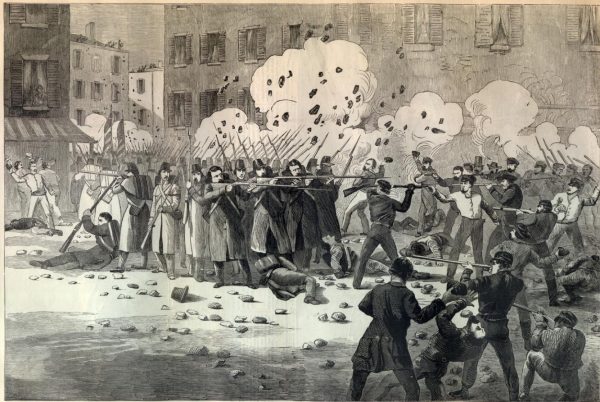
Lincoln responded by authorizing Gen. Winfield Scott to suspend the writ of habeas corpus between Philadelphia and Washington on April 27, 1861.[3] Enter John Merryman.
At 36, Merryman lived as a planter and served as president of the Baltimore County Commission.[4] In the middle of the night of May 25, 1861, federal troops arrived at his home, “aroused” him from his bed, and took him to Fort McHenry.[5] Arresting officers claimed Merryman served as “captain” of a secessionist “company in Baltimore county.”[6]
Within hours, authorities granted Merryman access to his attorney (and brother-in-law), George H. Williams, who drafted a petition for a writ of habeas corpus. General George Cadwalader, commander of the Department of Annapolis, denied Williams’s request for any written records. Thus, Williams relied on Merryman’s personal account. On May 26, 1861, Williams presented the petition to Chief Justice Roger B. Taney in Washington. Immediately, Taney left for Baltimore to hear the case.[7]
That afternoon, Taney issued an order directing Cadwalader to appear at 11:00 a.m. on May 27 and explain the arrest. Taney also ordered Cadwalader “produce the body of Mr. Merryman.”[8] Neither Merryman nor Cadwalader appeared.[9] Cadwalader responded via proxy that by the President’s authority, Merryman had been arrested for treason.[10] Taney promptly ordered U.S. Marshal Washington Bonifant to serve Cadwalader an attachment for contempt. Bonifant attempted to enter Fort McHenry on May 28, but was not admitted.
Here, proceedings reached an impasse. After delivering an oral opinion, Taney filed a written one with the U.S. Circuit Court for the District of Maryland on June 1, 1861.[11]

“The case, then, is simply this,” Taney wrote. “A military officer . . . issues an order to arrest a citizen of Maryland . . . he is seized as a prisoner . . . and when a habeas corpus is served . . . the answer of the officer is that he is authorized by the President to suspend it.” Taney rejected this premise. “The President . . . cannot suspend . . . habeas corpus, nor authorize a military officer to do it.” He reasoned that this power belonged to Congress, not the president.[12]
Taney acknowledged his limits. Stating that his judicial “power has been resisted by a force too strong for me to overcome,” Taney directed that the opinion be transmitted to the president to “determine what measures he will take to cause the civil process of the United States to be respected and enforced.”[13]
Merryman is widely remembered as the confrontation between the executive and judicial branches. Popular retellings portray Lincoln outrightly ignoring the Supreme Court. The myth is attributable to Taney’s embellishments.
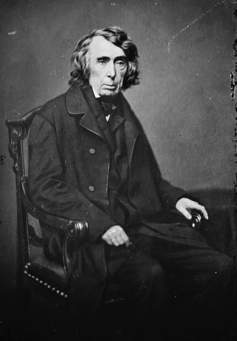
First, Lincoln was never a party to the case. Taney directed his order to Cadwalader, Merryman’s jailer. As legal historian Seth Barrett Tillman has persuasively argued, any judicial order thus could only have applied to Cadwalader, not Lincoln.[14] Even when Taney directed that the opinion be transmitted to Lincoln, his language (“determine what measures he will take . . .”) can hardly be construed as a command.[15] Taney also denied Cadwalader’s requested postponement to seek instructions from Washington.[16]
Second, the Supreme Court did not decide Merryman. Taney acted alone under Section 14 of the Judiciary Act of 1789, which empowered individual federal judges to issue writs of habeas corpus.[17] At this time, Supreme Court justices simultaneously served as judges of the regional federal circuit courts. Illustratively, Williams’s original petition addressed Taney as “Chief Justice of the Supreme Court . . . and judge of the Circuit Court . . . for the District of Maryland.”[18] Allegedly, Taney crossed out “judge of the Circuit Court” in Williams’s petition to erroneously emphasize that he was not riding circuit.[19] For this reason, Professor Tillman argues Taney’s opinion lacks precedential weight because it is not a full Court decision.[20]
Even the dramatic story of military defiance is murky. When Marshal Bonifant traveled to Fort McHenry, he reported only that “I was not permitted to enter the gate.”[21] Bonifant’s passive voice prevents identifying who denied access. As Professor Tillman notes, Bonifant fails to explain who turned him away, if Cadwalader was present at all, or indeed if Cadwalader even received the marshal’s message.[22]
Shortly afterwards, Taney wrote his view to Franklin Pierce that a “peaceful separation” of the states would be a preferable outcome to their transformation into a “military government.”[23] In 1863, Lincoln offered a different view. In an open letter, he argued that the rebellion exploited civil liberties, hoping the courts would restrain the Union while the Confederacy maintained “a most efficient corps of spies, informers, suppliers, and aiders and abettors.”[24] Clearly, political passions shape the law during wartime. Rather than definitive defiance, Merryman reflects the ambiguity of 19th-century judicial procedure, the embellishments of a chief justice seeking to portray himself in a positive light, and the difficulty of balancing liberty and security in wartime.
Alex Kleinman is a New Orleans native and attorney practicing in Washington, D.C.
Endnotes:
[1] Ex parte Merryman, 17 F. Cas. 144, 145 (C.C.D. Md. 1861) (Taney, C.J.) (full opinion available at https://law.resource.org/pub/us/case/reporter/F.Cas/0017.f.cas/0017.f.cas.0144.3.html).
[2] Bruce A. Ragsdale, Ex parte Merryman and Debates on Civil Liberties During the Civil War (Washington, DC: Federal Judicial Center, 2007), 1, 49; Jonathan W. White, Abraham Lincoln and Treason in the Civil War (Baton Rouge: Louisiana State University Press, 2011).
[3] “Abraham Lincoln to Winfield Scott, April 27, 1861”, The Collected Works of Abraham Lincoln, Roy P. Basler, et al., eds., 9 vols. (New Brunswick, NJ: Rutgers University Press, 1953), 4: 347, reproduced in Ragsdale, “Ex parte Merryman”, 36.
[4] Brian McGinty, The Body of John Merryman: Abraham Lincoln and the Suspension of Habeas Corpus (Cambridge, MA: Harvard University Press, 2011), 59-60.
[5] Merryman, 17 F. Cas. at 145.
[6] Ibid.
[7] George H. Williams “Petition for a Writ of Habeas Corpus, John Merryman” May 25, 1861, reproduced in Ragsdale, Ex parte Merryman, 32-33; Merryman, 17 F. Cas. at 145-46.
[8] Merryman, 17 F. Cas. at 146.
[9] Ibid.
[10] George Cadwalader, “Return to the Writ of Habeas Corpus,” May 26, 1861, reproduced in full in David Farnham, “A High and Delicate Trust: How Ignorance and Indignation Combined to Expand President Lincoln’s Claimed Power to Suspend Habeas Corpus in the Case of John Merryman,” Journal of Southern Legal History 24 (2016): 111-112.
[11] Merryman, 17 F. Cas. at 146-47; Ragsdale, Ex parte Merryman, 3.
[12] All quotations in this paragraph from Merryman, 17 F. Cas. at 147-148.
[13] Ibid., 153.
[14] Merryman, 17 F. Cas. at 146; Seth Barrett Tillman, “Ex Parte Merryman: Myth, History, and Scholarship,” Military Law Review 224, no. 2 (2016): 498-499.
[15] Merryman, 17 F. Cas. at 153; Tillman, “Ex Parte Merryman”, 504-506.
[16] David Farnham, “A High and Delicate Trust: How Ignorance and Indignation Combined to Expand President Lincoln’s Claimed Power to Suspend Habeas Corpus in the Case of John Merryman,” Journal of Southern Legal History 24 (2016): 111-12.
[17] Judiciary Act of 1789, §14, 1 Stat. 73 (1789), reproduced in Ragsdale, “Ex parte Merryman”, 45.
[18] Ragsdale, “Ex parte Merryman”, 32.
[19] Ibid.
[20] Tillman, “Ex Parte Merryman”, 505.
[21] Merryman, 17 F. Cas. at 147.
[22] Tillman, “Ex Parte Merryman”, 523-524.
[23] Roger B. Taney to Franklin Pierce, June 12, 1861, excerpt in “Some Papers of Franklin Pierce, 1852-1862,” American Historical Review 10 (January 1905): 368, reproduced in Ragsdale, “Ex parte Merryman”, 37.
[24] Abraham Lincoln to Erastus Corning and others, June 12, 1863, in Roy P. Basler et al., eds., The Collected Works of Abraham Lincoln, 9 vols. (New Brunswick, NJ: Rutgers University Press, 1953), 6:260-69 reproduced in Ragsdale, “Ex parte Merryman”, 43-44.


Alex Kleinman, Thank-you for the thought-provoking post. It is my understanding that Article One Section Nine of the U.S. Constitution states: “The Privilege of the Writ of Habeas Corpus shall not be suspended, unless when in Cases of Rebellion or Invasion the public Safety may require it.” The Supreme Court does not determine “whether a State of Rebellion exists.” Who does? In 1794 the precedent was established when President Washington “called on State Governors to send a militia force to enforce the tax during the Whiskey Rebellion.” President Lincoln had determined that “a state of insurrection existed” when he issued his Proclamation of 17 April 1861. Therefore, his subsequent actions in regard to the Writ of Habeas Corpus were in accordance with the U.S. Constitution.
Kindest Regards
Mike Maxwell
Thank you, and I am glad you enjoyed it!
This is an excellent post. I would only add that I believe Tillman is correct regarding the status of Taney’s opinion. In fact, Taney heard the case with the judge for the District of Maryland, Giles, which Taney would do sitting as a Circuit judge. When he announced his decision, however, Taney described Giles as only a consultant on the case. I’ve always thought Taney was playing a disingenuous game to characterize the decision as being issued by the Chief Justice, knowing that the SCOTUS lacked jurisdiction under the 1807 decision in Ex Parte Bollman. Marshall rendered that opinion.
Thank you, and I couldn’t agree more!
Thank you, I couldn’t agree more!