Book Review: A Consequential Life: David Lowry Swain, Nineteenth-Century North Carolina, and Their University

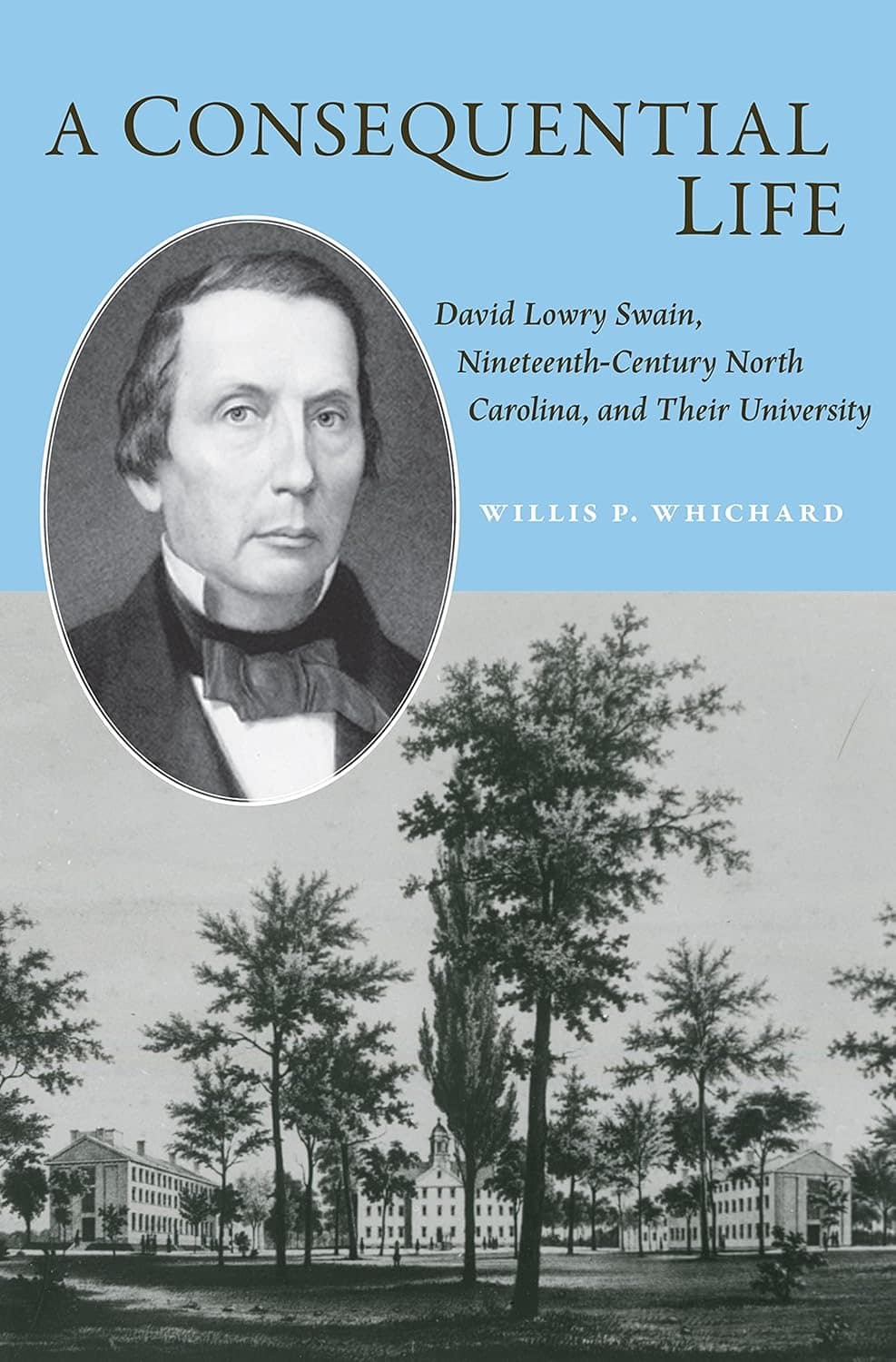 A Consequential Life: David Lowry Swain, Nineteenth-Century North Carolina, and Their University. By Willis P. Whichard. Chapel Hill: The University of North Carolina at Chapel Hill Library, 2024. Paperback, 729 pp. $30.00.
Former North Carolina Supreme Court Justice Willis P. Whichard is an admirer of his subject, David Lowry Swain, who was governor of North Carolina in the 1830s and subsequently President of Whichard’s alma mater, the University of North Carolina (now the University of North Carolina at Chapel Hill). Whichard’s admiration for Swain did not prevent him from disclosing detailed information about Swain’s faults. In fact, it doesn’t appear as if anything prevented Whichard from providing his readers with detailed information about Swain obtained from the papers of Swain, Swain’s contemporaries, and from other available sources. The result of Whichard’s meticulous study and analysis of the historical evidence is a downright doorstopper of a book.
This book will be of interest to specialists in 19th-century North Carolina history and historiography (Swain was an amateur historian), UNC alumni (like this reviewer) interested in the history of the institution from the 1830s to the 1860s (the period of Swain’s administration), and people interested in the life of Swain himself. Specialists in Civil-War-related issues will also find some important sections dealing with their topic.
Let us cut to the chase and look only at those parts of the book which deal with the Civil War era and its issues.
Swain was the Whig governor of North Carolina from 1832 to 1835. Denouncing the abolitionists, Swain wanted the state legislature to call on the North to suppress the abolitionist publications at their source. Then, from the governorship, it was on to UNC.
Swain had a personal interest in the institution of slavery. Swain bought and sold enslaved persons, and accepted them as security when he made loans. Like most of the state’s political elite, Swain saw slavery as natural and legitimate. One curious exception to this attitude among Swain’s friends was Justice William Gaston, one of the few North Carolinians (perhaps the only one) who publicly opposed slavery while keeping close connections with the proslavery elite. In 1832, a few years before Swain became President at UNC, Gaston gave an antislavery address to the students, urging them, as leaders of the coming generation, to get rid of the Peculiar Institution. But this did not sway antebellum UNC students, who remained proslavery. The professors were also proslavery, or pretended to be, with one exception.
The exception was the scientist Benjamin Hedrick, one of Swain’s former students. Swain eagerly recruited Hedrick, after graduation, as a professor. Raleigh editor William W. Holden (later Reconstruction governor but at the time militantly proslavery) revealed that Hedrick had announced his intention to vote for the Republican candidate–John C. Fremont–in 1856. Swain regretfully decided that there was nothing to be done to protect Hedrick’s academic freedom. Swain collaborated in getting Hedrick fired, allegedly because Hedrick, by responding to Holden with a defense of his (Hedrick’s) antislavery position, had meddled in politics. Hedrick’s real offense was criticizing slavery and voting for the antislavery Republicans. Hedrick seems to have borne Swain no ill will for participating in his firing, and was willing to help out his former boss after the war.
Thanks to Swain, the commencement speaker in 1859 was President James Buchanan.
Like most of his fellow Tar Heel Whigs, Swain opposed secession until after the war started. Then Swain proclaimed his allegiance to the Confederacy.
Swain tried to restrain over exuberant students from enlisting in the Confederate army before graduating–some students ignored the advice and some of these volunteers went on to die in the war. Swain also tried to protect his students–and the University’s institutional existence–from the Confederate draft.
Swain had once been in love with a young lady who ended up marrying someone else. With that someone else, the woman had a son, Zebulon Vance, who became a UNC student, a friend of Swain’s, and the wartime governor of North Carolina. Vance relied on Swain’s advice, and supported Swain’s campaign for student draft deferments, achieving some success, although the climate toward such deferments was not as good in the 1860s as in the 1960s.
At the end of the war, with Vance’s support, Swain helped arrange the peaceful surrender of the state capital, Raleigh, to Maj. Gen. William T. Sherman. Swain helped the talented Chapel Hill author Cornelia Phillips Spencer write a defense of Vance’s and Swain’s actions. Increasing Confederate hardliners’ suspicions of him, Swain’s daughter promptly married a Union general. President Andrew Johnson–whose mild Reconstruction policies Swain supported–gave Swain a brief appointment to the West Point Board of Visitors, and President Johnson was UNC’s commencement speaker in 1867.
Swain’s coup at getting President Johnson to speak at Commencement was his strongest postwar accomplishment at UNC which, like Swain himself, was growing less popular among all sides during Reconstruction. Swain’s departure from the University only briefly preceded his 1868 death in a carriage accident.
If your interest is the Civil War era and its issues, you may not want to read the whole book, just the Hedrick and slavery chapters and the part that starts with the Civil War and goes to the end. However, all is well-written.


