Book Review: Saltgrass Prairie Saga: A German American Family in Texas

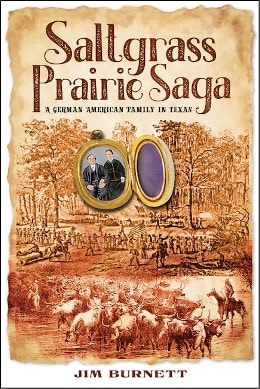
Saltgrass Prairie Saga: A German American Family in Texas. By Jim Burnett. College Station, TX: Texas A&M University Press, 2025. 308 pp. $35.00.
Reviewed by Neil P. Chatelain
The United States Civil War impacted not merely soldiers on the front lines, but their families back home. In Saltgrass Prairie Saga, Jim Burnett uses letters and diaries from one Texas immigrant family to highlight both the lives of soldiers, as well as their families, as everyone struggled against the elements, disease, enemy movements, and wartime privations.
The book follows the core family unit of John and Johanette Stengler from the time they chose to migrate to Texas from Germany through the end of the 19th century. Migration of Germans to Texas was commonplace in mid-century Texas, but most ended up in the Hill Country where many towns still bear German names. Instead, the Stenglers ultimately settled in rural Liberty County, east of Houston, where they quickly established themselves. Most family members became landowners, and many of John and Johanette’s children married into local rancher families, whose members are also examined in the book.
The first chapters focus on how the Stengler family became established in Liberty County. These chapters explore everything from Texas joining the United States to German immigration companies and their efforts to move people to Texas and the family’s acquisition of lands and marrying into other families. I appreciated this introduction on a personal level because I am also a migrant to Texas, and my wife works mere miles from where the Stengler family settled.
After these introductory explorations, the bulk of chapters focus on the Civil War. What makes the text stand out amongst others is the focus on frequent correspondence between family members. Most of the Stengler children joined Company F, Spaight’s Battalion. This was a cavalry company operating as part of a mixed battalion of infantry, artillerymen, and horse soldiers. Other family members ended up in local militia regiments as the war continued.
All the Stenglers remained in Texas and Louisiana for the war’s duration, and their combat experience was limited to small skirmishes. The largest battles they were involved in were the January 1863 Texas Maritime Department assault against the Federal blockade of Sabine Pass and the late 1863 failed Louisiana overland campaign. The rest of their war service involved garrison duty near Beaumont, herding cattle in western Louisiana, guarding railroad bridges near Houston and Galveston, collecting crops as part of the Confederacy’s tax-in-kind system, and several brutal mid-winter marches.
Since the Stenglers served relatively close to their homes, there were frequent visits, and copious letters exchanged documenting everything from wartime scarcity to spreading diseases and illnesses. Letters from home are packed with worries about loved ones serving in the army, as well as about maintaining several farms and ranches with few able hands. The question of the young and old being conscripted, as well as the use of military substitutes comes up amongst family correspondence, providing anecdotes often left unseen in other wartime family histories.
Burnett’s book is not a direct listing and transcript of family correspondence. Instead, letters and diaries are frequently quoted from, but also merged with historical background and commentary to help readers truly understand life in southeast Texas. All these anecdotes are backed up by supporting notations, some referencing family correspondence, some referencing other primary accounts, and some referencing secondary literature.
What are perhaps most insightful are the letters and notes from home. Often, especially with letters of common soldiers, only the letters sent home survive, with notes coming from home to the soldiers often becoming lost to history. Likely thanks to the relatively short distance between front lines and home, as well as their relatively quiet service, the Stengler documents contain both letters written from soldiers and from home. It makes a true family history possible and allows for substantially more insight into how everyone coped during the war.
Jim Burnett’s Saltgrass Prairie Saga contains much more than initially expected. The Stengler family’s migration journey to Texas, their assimilation into the Lone Star State, their wartime service, and their postwar lives offer valuable insights on mid-19th century Texas, German immigrants into the United States, the Confederate home front, military service on the coastline and bayous of Texas and Louisiana, and a real lens into the everyday thoughts of both soldier and civilian during the Civil War.


