Book Review: Great Battles: Gettysburg

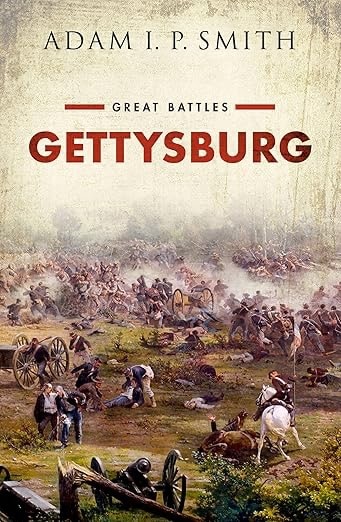 Great Battles: Gettysburg. By Adam I.P. Smith. New York: Oxford University Press, 2025. Hardcover, 297 pp. $24.99.
Reviewed by Pete Miele
I will admit–when asked to review this book, I thought, “Another survey of the Battle of Gettysburg?” I also will admit, upfront, that I have been pleasantly surprised. Adam I.P. Smith’s Gettysburg is primarily a work of synthesis: This book does not make any new major claims about the campaign, nor does it use any groundbreaking sources for the first time.
Rather, Smith effectively places the battle in a larger geographical and temporal context. Part of Oxford University Press’s Great Battles series, the author sets out to investigate why Gettysburg looms so large in American mythology. “This book,” Smith writes in his introduction, “explains why a battle came to be fought here, why it ended how it did, and what it has meant ever since.” (13) He spends most of the book on that last point, interrogating the battle’s historical and cultural significance. This is ground that has already been well-trod by historians Thomas Desjardin, Jen Murray, and Jill Titus. Smith cites these scholars’ work, coupling it with a strong understanding of the battle and its antecedents to provide a fresh look at the Gettysburg Campaign.
I strongly applaud the author’s foregrounding of slavery as a cause of the Civil War. The author does not beat around the bush; the first line in Chapter 1 is, “There were many roads to Gettysburg, but all began with slavery.” (15) Smith covers the Confederate invasion of Pennsylvania and their kidnapping of free people of color. He goes deeper, however, examining the reasons behind secession and even the protection of slavery in the United States Constitution. It is refreshing to see an author hit this subject head on, truly contextualize why the two armies ended up in Gettysburg, and what the invasion meant for the Black population of the border region.
Less than half the book covers events of 1863. Recounting the three-day battle in just shy of seventy pages naturally means Smith has to stick to a rather high level, mostly division and corps. But he does lavish deeper attention on some specific incidents, such as the 20th Maine on Little Round Top, Robert E. Lee and James Longstreet planning for Pickett’s Charge and, in his chapter on the aftermath, the November 19 dedication of the Soldiers National Cemetery. Readers looking for just a retelling of military actions may be disappointed with the overall lack of depth.
The balance of the book examines how Gettysburg has been remembered and interpreted over the last 162 years. Smith covers veterans’ reunions, other large-scale commemorations, and evolving interpretation, contextualizing these events within larger national movements, such as Reconstruction, the Lost Cause myth, and the fight for Civil Rights. The author does a masterful, if brief, job of discussing recent events in Gettysburg, such as the monument debates of the late 2010s and the Facebook hoax purporting an Antifa rally for July 4, 2020 and the resulting heavily armed “militia” counter event that occurred on that day. As we are still in this “post-sesquicentennial” phase of Gettysburg memory, we do not know how it ends. But the author has captured some of the major movements of the last decade and a half, which will be valuable to future historians.
Ultimately, the strength of this book lies in its short length and wide scope. The die-hard Gettysburg student will likely not find anything new. Those who are starting out studying the battle, however, or those who have solely studied the military aspects of the battle will find their knowledge of the causes and aftermath of the campaign widely expanded. It is an effective introduction to the battle for college students, or visitors who are looking to take home a single volume. Like any good book on Gettysburg, it is bound to lead readers to ask new questions and engage in further inquiry. And, in the end, isn’t that what studying this battle is all about?
Pete Miele is a public historian and museum administrator, currently serving as Senior Project Leader at Susquehanna National Heritage Area in Wrightsville, PA, and as an Adjunct Professor of History at York College of Pennsylvania.


