Strange Change
ECW welcomes back guest author Mike Busovicki.
Americans found interesting ways to substitute small change amidst the shortages of war.
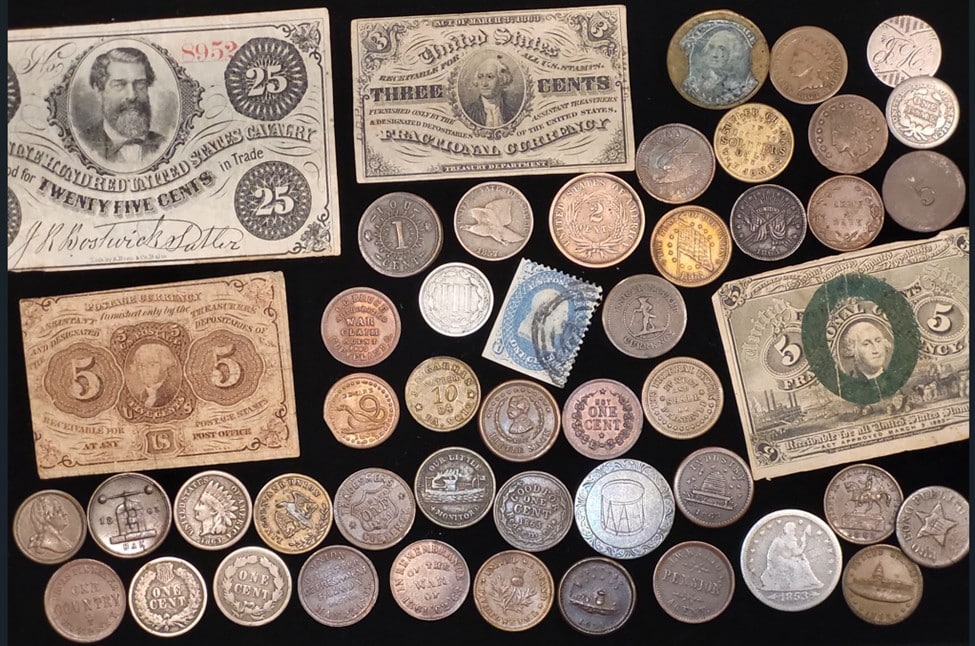
When Billy Yank jammed his hands into his pockets for change, we would hardly recognize what he pulled out. Mid-19th century currency was drastically different – private banks and the federal government issued their own notes through separate charters. There was a dizzying array of state money, foreign coinage, denominations, and the designs or sizes of paper bills changed frequently. Most surprising of all, the abnormality and variations would have seemed perfectly normal in the 1860s.
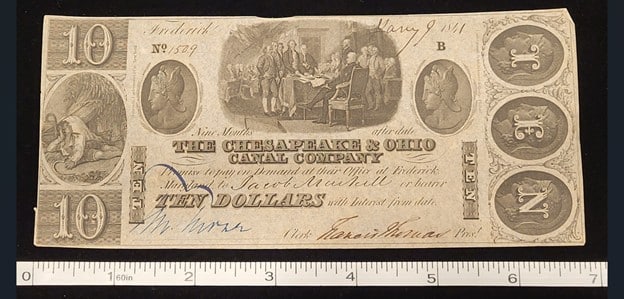
Nineteenth-century society was completely disconnected by comparison. They lacked means to move information, inventory, or themselves with modern immediacy, and therefore most every transaction was “local.” The only dollar bills were paper notes issued by the local bank. Those early notes were akin to modern paper checks – they held value because they could draw funds from an account at a particular bank – but a specific payee was not required, and the value was fixed.
Printers and engravers solicited banks directly for the right to print notes, exhibiting the quality of their paper and ink or the intricacy of their engraving. Most specialized in a particular “motif” such as allegorical or historical characters, nature scenes, or intricate geometric patterns. But they did business where it was most advantageous, and when a new printer or engraver could not replicate the former’s design, new bills had to be created.[1]
Similarly, postal operations had much less central oversight. The local post office held your mail, and postage paid either a carrier to deliver the letter to the post office or ensured there were no outstanding fees upon receipt. Some states (and even cities) issued their own provisional stamps, with varying degrees of artistic sophistication. Mailing a letter was relatively expensive, depending on both weight and the distance it travelled. Conflicting state commerce laws were common, a vestige from the days when colonies operated under separate charters from Great Britain. People identified as a “New Yorker” or a “Georgian,” rather than an American – local came first.[2] Standardized U.S. stamps did not become mandatory until 1855.[3]
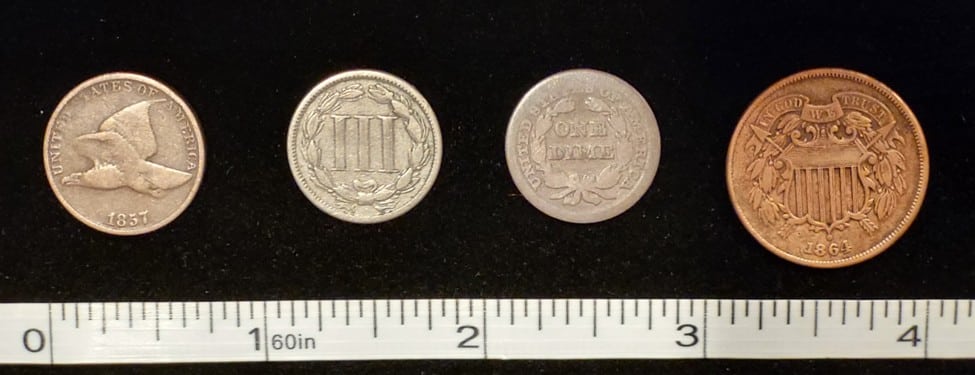
“Runs” on a bank happen when there is no belief one’s full deposit can be withdrawn. When the rebellion ripped states from the union, uncertainty gripped the country. Gold, silver, and copper coins disappeared from circulation; better to hang on to them, than promises of future payment. This meant almost 25 million dollars slipped out of circulation and into private hoards, significant when many transactions amounted to just a few cents.[4] The drop in economic traffic threatened to grind the war machine to a halt in the conflict’s first year. Soon, merchants refused to issue coins as change for purchases made in paper money or added a surcharge for the “convenience” of doing so.[5]
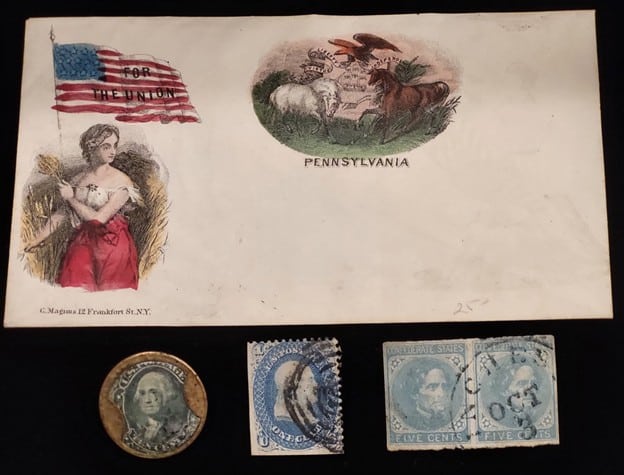
Postage stamps were an early answer. Already in circulation, an envelope full of stamps could conveniently accompany someone on day-to-day business. Postmaster General Montgomery Blair invalidated pre-war postage so the value of those held in rebel areas could not be utilized against the union. He rushed to publish a new series of stamps in 1861, and the new postage was in circulation by August.[6] However, post offices did not accept grimy, wrinkled, dirty, or torn stamps for mailing purposes. The supply of new stamps was at a premium because of the recall and new role as “change.” But the public’s zeal for convenience meant the practice hindered postal operations and better solutions were soon required.[7]
Acceptance of these alternatives was not universal. The New York Times published an amusing quarrel, arising from postage “currency”:
“… a broker refused to accept postage stamps in change from the driver of an omnibus. The pair argued and being unable to resolve the difficulty, the driver headed off in the other direction eventually pulling up in front of City Hall. The driver took his case to the City Marshall. The rider contented that since the driver had a sign posted refusing stamps for fares, the prohibition should work both ways. The Marshall took the side of the driver, and the rider took the stamps under protest. The rider threatened to sue the Marshall and demanded to be transferred to his original destination for the fare he had already paid. The driver would not allow him to reenter the stage and drove off. The broker’s loud protestations as he tried unsuccessfully to climb back into the stage drew a crowd of people in front of city hall and a reporter from the adjacent Times building.”[8]
Enterprising capitalists created small brass cases to protect the stamp, visible through a mica window on the front with an advertisement on the back. The most famous was John Gault’s, an inventor who had also submitted patents for everything from coal vault covers to sewing machines to expanding and chain-linked artillery shells.[9] The most interesting feature was the mica cover. Mica, a mineral that readily cleaves into paper-thin sheets, was the perfect solution. Hard enough to protect the stamp, mica was easier to cut into small pieces than glass and wouldn’t easily shatter. Mica was more familiar to 19th- and early 20th-century Americans, historically employed in heat-tolerant oven windows and lantern panes, later employed in insulation for wiring and homes.[10]
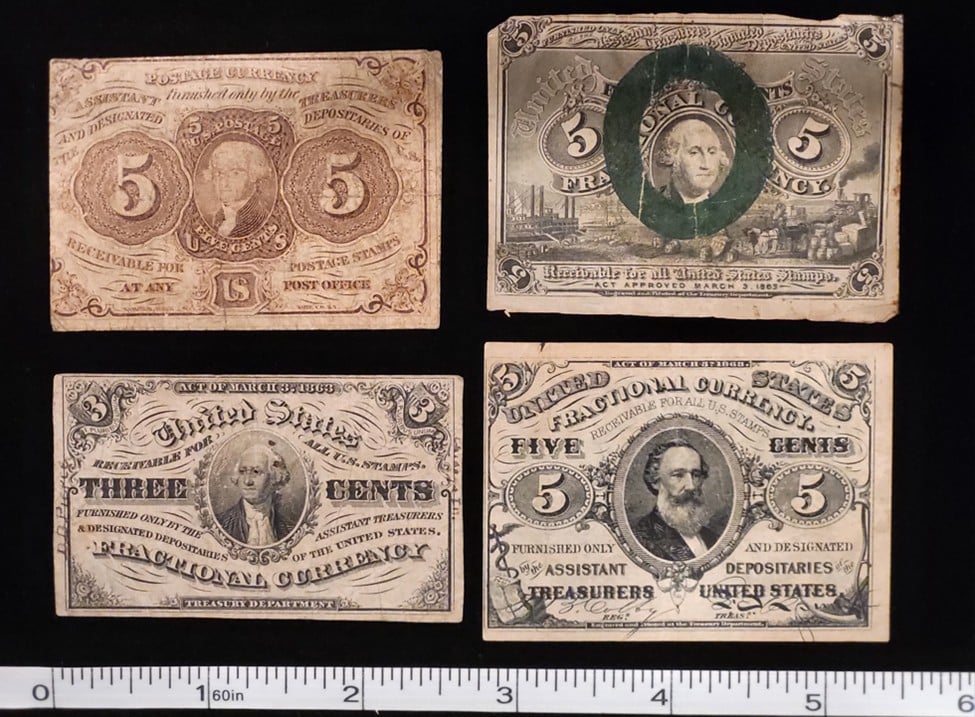
Rather than downplay the use of stamps as a substitute for legal tender, the Treasury Department supported the measure. Treasurer Francis E. Spinner authorized stamps affixed to small pieces of Treasury Department paper with his signature to circulate. The signature validated the note and helped deter counterfeiting the less elaborate stamp designs. But creating enough signed notes was impractical and 5-, 10-, 25-, and 50-cent postage currency with matching stamp designs were soon issued.”[11]
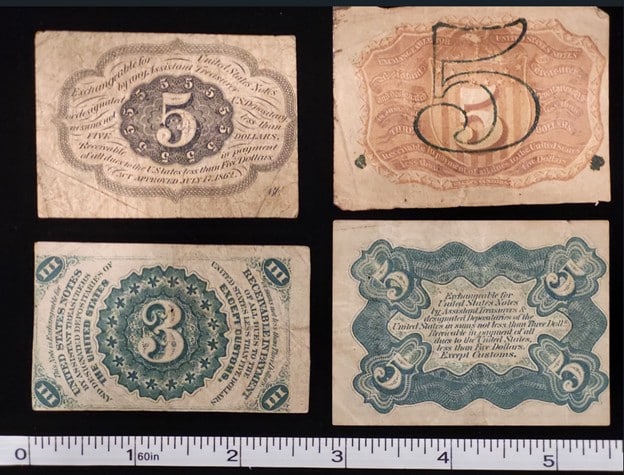
This was still insufficient to meet demand, sparking public outcry. In 1862, Cincinnati required U.S. troops to keep order; resentment from over-charges, unresolved debt, shortages, and rationing fueled the hysteria. Resolutions to issue city scrip were raised, as store tokens were already used in resolving transactions.[12] To provide relief and stay one step ahead of counterfeiters, the Treasury next issued “fractional currency” beginning in 1863. This improved on plainer stamp designs in favor of more complex inks, engravings, and faces. But rapid changes and coexisting ad-hoc substitutions added to relaxed oversight and confusion.
In 1864, newly authorized designs of the third series of fractional currency contained ambiguous language. When the artwork to honor the Lewis and Clark expedition on the five-cent note was simply identified as “Clark”, superintendent of the U.S. Bureau of Engraving and Printing, William Clark, took the liberty of putting his own face as the “Clark” to adorn the note.[13]
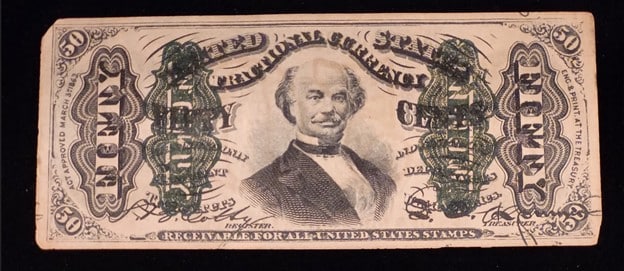
While Clark remained at the bureau throughout the war, and he was not the first or only living person to appear on legal tender (including Lincoln, his treasurer, Francis E. Spinner, and Secretary of the Treasury William Fessenden), outrage over Clark’s arrogance and self-aggrandizing was particularly acute. Clark faced consistent allegations of improprieties during his tenure, ranging from exploitation of female employees to bad decisions regarding printing presses and methods, to inconsistencies in his bookkeeping. Though not formally charged, his decision on the five-cent note led to the Thayer amendment in 1866 which henceforth forbade any living person from appearing on legal tender.[14]
The amendment didn’t make Clark’s notes illegal or even call for their removal, likely for cost savings and practical reasons. Clark resigned in 1868 amidst other investigations, and his notes were gradually phased out the following year when the fourth issue of fractional notes appeared. The U.S. Treasury continued to issue paper fractional currency until 1876, the last notes being redeemable in silver. But the U.S. would never again issue bills in denominations of less than one dollar.[15]
Mike Busovicki is an Iraq War Infantry Veteran. He evaluates disability claims for the Department of Veterans Affairs and holds a master’s degree in public and international affairs.
Endnotes:
[1] Bob McCabe, Counterfeiting and Technology (Whitman Publishing, 2016) 75-76.
[2] Francis J. Bremer, “The Thirteen Colonies.” The Gilder Lehrman Institute of American History, https://www.gilderlehrman.org/history-resources/essays/thirteen-colonies
[3] “About U.S. Stamps”, Smithsonian National Postal Museum, https://postalmuseum.si.edu/exhibition/about-us-stamps-classic-period-1847-1893-national-bank-note-company-1861-1872/1861-issues
[4] Fred L. Reed, Civil War Encased Stamps (BNR Press, 3rd edition, 1995) 41-46.
[5] Fred Renfield, The Story of Civil War Money (Sterling Publishing & Co., Inc., 1959), 40.
[6] “About U.S. Stamps”
[7] Q. David. Bowers, A Guide Book of Civil War Tokens (Whitman Publishing, 2013), 22-23.
[8] “An amusing quarrel concerning paper change”, New York Times, October 30, 1862; Reed, 58-59.
[9] Reed 33-40
[10] Reed 62-64; Reinfeld 40-41.
[11] Robert J. Kravitz, A Collector’s Guide to Postage & Fractional Currency (Coin and Currency Institute, 2nd edition, 2012) 25-28; McCabe, 238-239
[12] Reed, 52-53
[13] Blake. Stillwell, “Why American Currency Can Only Feature Images of Dead People.” Military.com, https://www.military.com/history/why-american-currency-can-only-feature-images-of-dead-people.html
[14] Kravits, 67; Waters
[15] “General Francis E. Spinner: Watchdog of the Treasury and Father of Fractional Currency”, Paper Money Guarantee® (PMG), published August 18, 2015, https://www.pmgnotes.com/news/article/4800/General-Francis-E-Spinner-Watchdog-of-the-Treasury-and-Father-of-Fractional-Currency/; Kravits, 29; Stillwell; Taylor.


My wife has an 1850s New Orleans minted trime in her coin collection. By far it is her favorite coin.
Ah yes, a pre-war trime from New Orleans is a remarkable find indeed! I didn’t mention it here, but losing New Orleans in April 1862 was a severe blow to the Confederacy, immediately affecting its economic and logistical capacity (on top of any remaining bullion at the mint that went back into Federal hands). I refer readers to Patrick Kelly-Fischer’s May 31, 2022 ECW Post, “New Orleans gone and with it the Confederacy – The Fall of New Orleans.”
ECW continues to rock. Like its previous article on horseshoes, this a great, nay [pun intended], excellent article on a non-microscoped civil war subject very important to the average soldier and citizen of the time which has no gory body count. A tangential person of interest to this sun-breaking-thru-the-clouds article is the Philadelphia man who, out of greed not loyalty, printed millions in counterfeit Confederate currency and distributed it throughout the south for personal gain, not illegal to do in Pennsylvania.
Glad you enjoyed it! Yes, Samuel Upham was a Philadelphia shopkeeper and printer who sold copies of (i.e. bogus) CSA bills as souvenirs. I understand he wasn’t prosecuted because he wasn’t printing them *for* the Confederate government or even attempting to pass them off as genuine – they had “facsimile” and his business address at the bottom… which was easily trimmed off 😉
A fascinating article. I am reminded of Tracy Prachett’s “Going Postal” where in his imaginary world, a postmaster invents stamps, which people begin to use as currency.
I hadn’t heard of Pratchett’s book before, but the reviews give it high marks as a clever and well-written read! I think the protagonist in “Going Postal” (Moist von Lipwig), despite his past, sounds like he attempts to implement many of Postmaster General Montgomery Blair’s measures. Blair might not appreciate my comparing him to the main character’s swindling ways, though! An attorney before the war, Blair was one of the lawyers representing Dred Scott. The connections between people, places, and events (“you can’t make this stuff up!”) is always one of the things that keeps me wanting to read more about history. 🙂