Book Review: Civil War Cavalry: Waging Mounted Warfare in Nineteenth-Century America

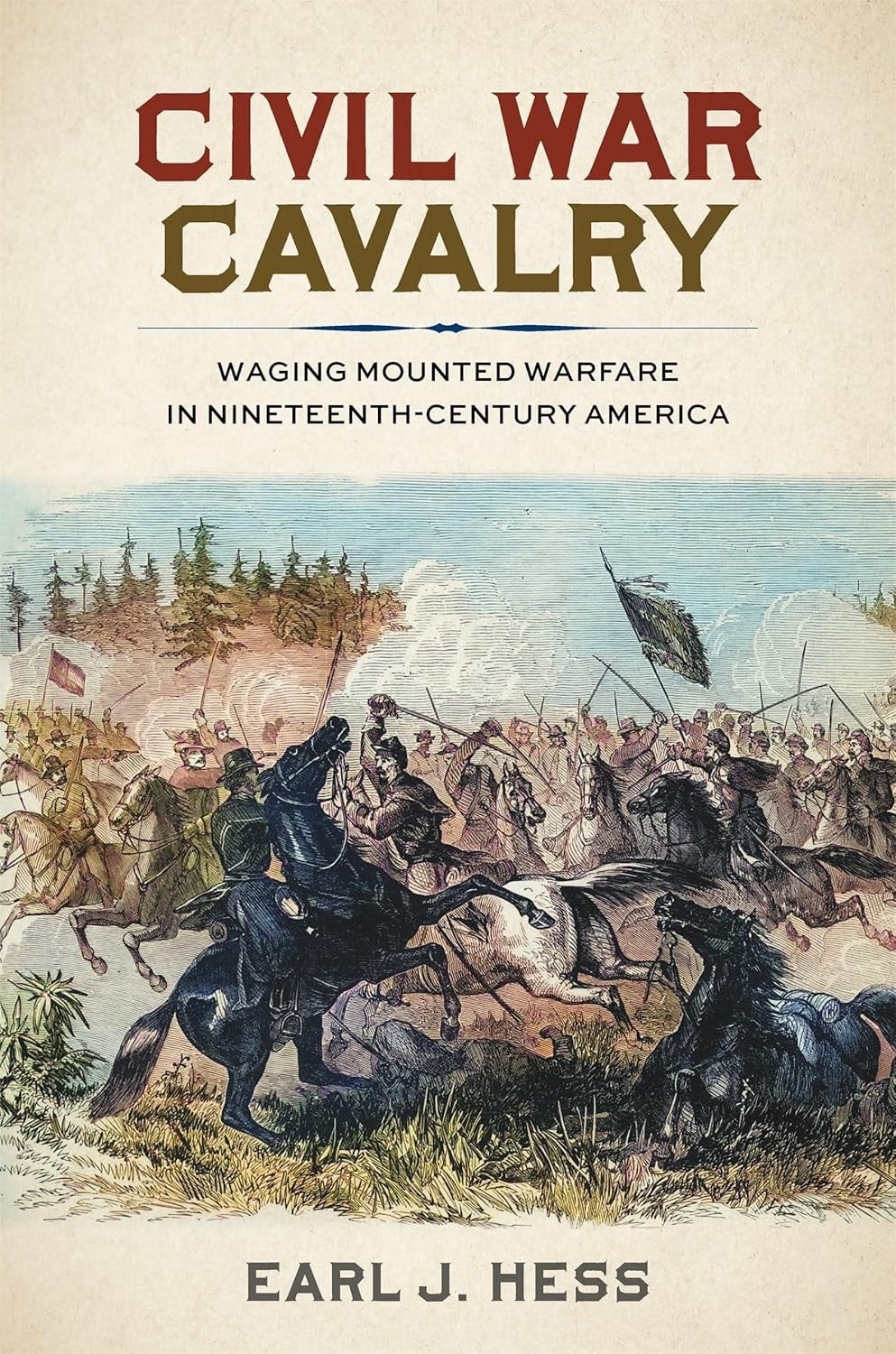
Civil War Cavalry: Waging Mounted Warfare in Nineteenth-Century America. By Earl J. Hess. Baton Rouge: Louisiana State University Press, 2025. Hardcover, 431 pp. $49.95.
Reviewed by Brian Swartz
When the Civil War erupted, the Union had only a few cavalry regiments and the Confederacy none. In his new Civil War Cavalry: Waging Mounted Warfare in Nineteenth-Century America, historian and author Earl J. Hess details how both sides expanded their mounted forces to meet military needs. Rather than focusing simply on a few large-scale cavalry battles, however, Hess delves into the mundane as well as the magnificent, and the reader rides away much the wiser.
Hess poses in his Introduction that while they had little prior experience in organizing “a large, powerful cavalry force,” both “Americans North and South had an advantage in that they could draw on a strong European tradition of mounted warfare.” (1) He reinforces this point across the book’s 15 chapters while examining how Yankees and Confederates created, trained, handled, and utilized their respective cavalries.
After reviewing “The Cavalry Heritage” in chapter 1, Hess devotes the next three chapters to how North and South created and trained their cavalry forces. Training was key for troopers and horses alike since “man and animal were a military team, and both had to be willing to obey when called on.” (80) As elsewhere in his book, Hess draws upon extensive official histories and cavalry-trooper memories to connect the reader with specific units and people, and he relies just about equally on Northern and Southern sources.
Shifting to “Mounted Operations” in chapter 5, Hess examines the cavalry’s various roles (such as picketing, scouting, and skirmishing) and interactions with friendly artillery and infantry. The next three chapters involve particular types of fighting. The reader immediately learns that “for most cavalrymen in blue or gray, the ultimate experience of their war service was participating in a mounted charge on the enemy.” (128) The reader then rides along in such charges, joins in the “Dismounted Fighting” (chapter 7), and goes “Raiding” (chapter 8).
Hess shifts saddles to discuss “Weapons and Equipment” in chapter 9. After highlighting sabers and pistols, he compares various carbines. Troopers add their pros and cons to the commentary. I found the eight “Saddles” pages informative, particularly about the McClellan saddle. Humor emerges in the short “Lances” discussion when Hess refers to a 28-page “lancer’s manual” published in New Orleans when the war began. Although the manual extolled lances as a “more formidable” weapon, “very few Confederate soldiers ever read this book because the South failed to create any appreciable number of lancer units,” Hess observes (206).
He details in chapter 10 the different policies the North and South developed to keep their cavalry mounted. The U.S. War Department supplied replacement mounts for Yankee troopers, and here and elsewhere Hess cites reliable sources as to the high wastage of horses by Yankee cavalry. As for the Richmond-dictated policy, “no one praised the self-mounting system” in the South (226).
Devoting lengthy chapter 11 to “Cavalry Horses,” Hess pays proper attention to the historically overlooked four-legged component of Civil War cavalry warfare. He views the horse as a living being with its own personality, an animal requiring “the right care to survive the rigors of field service.” (244) Of course, the other half of the cavalry weapon was “Cavalrymen,” covered in Chapter 12.
The next chapter examines how and why the Union shifted from dispersing to concentrating cavalry forces as the war continued—and why the Confederacy could not respond accordingly. Chapter 14 studies the challenges involved in making cavalry effective. Hess looks back “After the War” (chapter 15) and evaluates the lessons learned and how far into the future that America and European nations continued to field horse-mounted cavalry units.
Hess did his due diligence while writing Civil War Cavalry. After summarizing key points in the Conclusion, he wraps up with 32 pages of footnotes and a 27-page bibliography.
Where another author might have crafted a dry textbook on Civil War cavalry history, Hess splendidly weaves together historical minutiae to create a compelling tale that simultaneously educates and entertains the reader interested in Civil War cavalry.


Thanks for the excellent review, Brian. I’m looking forward to reading this as much as I was to his books on artillery and infantry.