Book Review: A Forest of Granite: Union Monuments at Gettysburg, 1863—1913

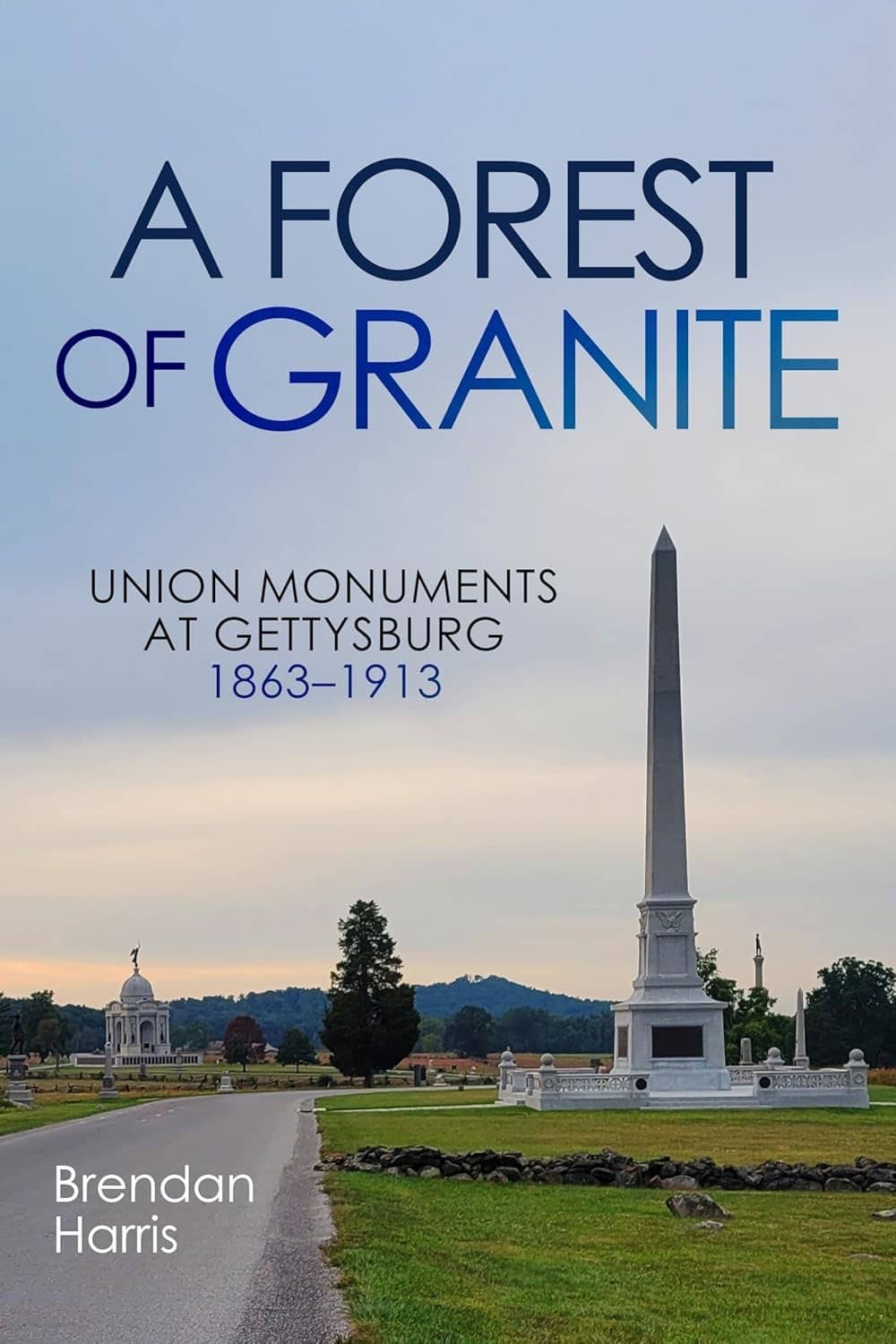
A Forest of Granite: Union Monuments at Gettysburg, 1863—1913. By Brendan Harris. Havertown, Pennsylvania: Brookline Books, 2025. Hardcover, 235 pp. $34.95.
Reviewed by John G. Selby
Have you ever driven on the many roads of the Gettysburg battlefield and wondered,“Why are there so many Union monuments here?” A new book by Brendan Harris providesan answer and a chronological history of the first 50 years of monument building.
An effort to memorialize the scene of the largest battle of the Civil War began as early as November 1863, when President Lincoln dedicated the new Soldier’s Cemetery in what became his most famous address. Two years later the cornerstone of the first Union monument at Gettysburg, the Soldier’s National Monument, was dedicated before a crowd as large as that which had seen Lincoln. Meanwhile, two prominent local lawyers, David Wills and David McConaughy, had been leading the efforts to memorialize the fallen and the battlefield, including the purchase of much of the battlefield land by McConaughy and the creation of the Gettysburg Battlefield Memorial Association (GBMA). The initial land purchases and preservation guidelines established by the GBMA would provide the space and the rules for building monuments and markers that still influence the national park today.
The first Union monument erected on the battlefield honored a commander of a brigade, Colonel Strong Vincent. He was mortally wounded on Little Round Top on July 2, 1863. The monument was dedicated on July 25, 1878, and would initiate almost 40 years of construction of monuments to regiments, individuals, and eventually entire states. But the movement to erect monuments got off to a slow start. The next year saw the first monument dedicated to a regiment installed on Culp’s Hill by the 2nd Massachusetts, which had lost over a third of its roster in fierce fighting on July 3. In 1885 the most controversial monument built was dedicated to the Confederacy’s 2nd Maryland. It was the first Confederate monument on the battlefield, and it was built despite strong objections from many Northern veterans who wanted only Union monuments on the field. It would be the only Confederate monument built on the field in the 19th century.
The pace of monument construction accelerated in the mid-1880’s as states began providing money for the memorials. Between 1885—1887 seven states appropriated money for the erection of monuments. The 12th Massachusetts established the custom of dedicating a monument for each position it had on the field, which meant three separate monuments for a unit that fought on July 1, 2, and 3, 1863.
The two largest states, New York and Pennsylvania, decided to make the biggest impression. Combined they had contributed over half of the Union men in the battle and suffered proportional losses. In just three years, 1887—1889, the two states would build 170 monuments, including unique statues such as the fireman on the 73rd New York monument (the regiment was raised from New York City firefighters). Besides the building of many regimental monuments, Pennsylvania wanted the largest structure on the battlefield, and in 1913 it finally completed the massive memorial that dominates Cemetery Ridge, with its granite terrace at 100 feet high and bronze tablets on its lower exterior walls with the rosters of each Pennsylvania unit present at the battle.
The remaining seven states that participated in the battle erected monuments in what the author calls the “golden age of monumentation” between 1887—1894. These included unusual monuments like the granite “minie ball” shape for the 7th New Jersey and the soldier in a prone position hiding behind rocks in the monument of the 1st Maryland Eastern Shore.
The process of monument building slowed dramatically in 1895 when Congress passed a bill that ceded the battlefield to the federal government and created Gettysburg National Military Park. The next turning point occurred in 1917, when the positive feelings engendered by the well-attended 50th anniversary in 1913 allowed Confederate memorials to be built (starting with the enormous Virginia State monument). The passage of time had softened the hard feelings of the remaining Union veterans, who for most of the late 19th century sought only to commemorate their valor and sacrifice alone.
In terms of historiography, Harris’s book delves deeper into the history of the Gettysburg monument building movement than Frederick Hawthorne’s excellent but out-of-print book, Gettysburg: Stories of Men and Monuments (1988). It does not, however, have the detail of Tom Huntington’s incredibly useful Guide to Gettysburg Battlefield Monuments (2013), which has photos, brief histories, and locations of 846 monuments and tablets. By contrast, Harris has the same information for 67 monuments and tablets. As with many quasi-guidebooks, Harris has brief descriptions of how to reach each monument and what they look like today. Harris uses speeches, newspapers, and organizational records for his primary sources, and does not wrestle with the extensive debate among scholars about the process of memorialization. All three authors provide helpful maps and indexes.
John G. Selby is a Professor Emeritus of history at Roanoke College and the former holder of the John R. Turbyfill Chair in History. A Civil War scholar, Selby wrote: Meade the Price of Command, 1863-1865; Virginians at War: The Civil War Experiences of Seven Young Confederates; and coedited Civil War Talks: Further Reminiscences of George S. Bernard and His Fellow Veterans.


