For want of a nail, a shoe was lost…
 Emerging Civil War welcomes back guest writer Bill Miller
Last summer, the editors of Emerging Civil War posed the following “Question of the Week: Who is your favorite historical person from the Civil War era?”
The responses, for the most part, were predictable. They ranged from political and military leaders, both North and South, to a few respondent references to personal ancestors.
My choice may have been considered to be of a contrarian nature. I selected John Harman.
So, who, you may ask, was John Harman? Perhaps a few of my Civil War colleagues will connect the title of this post to the identity of Maj. John Harman.
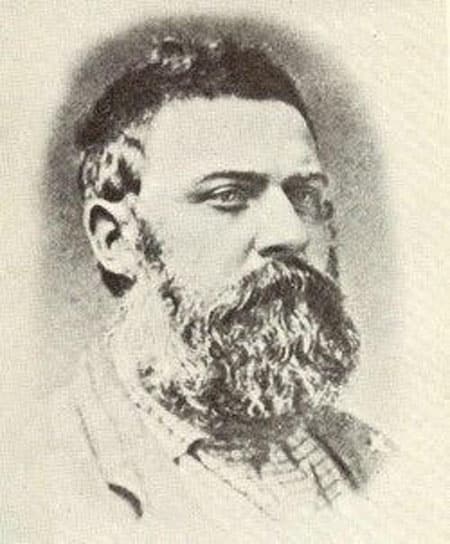
Major John Harman was the first and only quartermaster to serve under Stonewall Jackson’s command, and that infantry force evolved from company size in May of 1861 to that of a corps comprising approximately half of the manpower of the Army of Northern Virginia in the spring of 1863. Major Harman’s task throughout that two-year period of exponential growth was to keep Stonewall Jackson’s forces supplied with the beans and bullets necessary to assure Old Jack’s military successes.
During Maj. Harman’s tenure as Stonewall Jackson’s quartermaster, he cobbled together a supply chain of wagons, teamsters, horses and mules from nothing in order to convey a continuous supply of food and fodder as well as the ammunition and military supplies to support Jackson’s growing command. This charge to provide all of the impedimenta to support an active military campaign had to occur every day and at every location where Jackson’s forces were engaged. Perhaps a sidebar comment would be appropriate to note that the fortunes of war enabled Maj. Harman’s quartermaster team to benefit from the acquisition of copious supplies grudgingly provided by Jackson’s Yankee adversaries. This sidebar notwithstanding, Maj. Harman’s logistical successes may serve as a progenitor to the modern-day influences of Amazon.
Now the chroniclers of the period, as well as those of our modern era, have expounded upon Stonewall Jackson’s unique personality and traits. In short, he was pious, secretive, and a stern taskmaster driven by an overriding devotion to duty. West Point-educated, a Mexican War veteran, and a professor at the Virginia Military Institute, he was well qualified for military command as an officer in the fledgling Confederate Army.
With the appointment of John Harman on his staff as a quartermaster, Jackson was accepting a large, boisterous, short-tempered, and incredibly profane individual, who on paper appeared to be diametrically opposed to Old Jack’s personality. And so it was that the disparate personality traits of these two individuals did, in fact, create leadership challenges.
Major Harman felt no compunction to curb his profanity when it was necessitated to “inspire” the teamsters and the mules to “move along.” His management style, admittedly rough, was very effective. While the stern and pious general frowned upon the major’s methods, he grudgingly accepted the results. And why, as you may ask? Because it benefited the mission of that particular day. Moreover, as a result of Harman’s frustrations to maintain pace with Jackson’s relentless offensive actions, the major threatened resignation on a couple of occasions, only to defer such action after intervention with his commanding officer. In summary, theirs was a tenuous but enormously successful relationship between the general and his logistics manager.
So, let’s fast forward to the present in order to analyze how effective leadership resolved this dichotomy of personalities. Both Stonewall and his quartermaster were imbued with an overriding sense of duty. They recognized the necessity to set aside their personal beliefs and idiosyncrasies to achieve their mutual goals. General Jackson understood that Maj. Harman would promulgate his orders to the best of his ability, even though it may run counter to Old Jack’s personal beliefs.
Now many of my Civil War readers are aware that I’m a board member of the Civil War Round Table Congress. The mission of the CWRT Congress is centered around the promotion of growth and sustainability of local Civil War Round Tables. We emphasize effective leadership of local Round Tables as a key element toward the fulfillment of our mission.
My intention of relating this story of the relationship between Maj. John Harman and Stonewall Jackson is intended to serve as a teachable moment for our local Round Table leaders to focus upon the individual talents of their members while accepting the peculiarities of personalities in order to promote the growth and sustainability of their organizations.
————
Bill Miller is president of the Williamsburg Civil War Round Table and is the secretary/treasurer of the CWRT Congress.


Interesting article. I find it noteworthy of all the presidents’ of the many Round Tables scattered across the country and indeed around the world you mentioned Bill Miller. I personally know Bill, I deem him a good friend and leader of our local Round Table, to which I am a member. To close out the analogy of this post, which personality and or traits does Bill most closely resemble, that of Stonewall Jackson or Major John Harmon?
Harman is one of my favorite members of Jackson’s circle. That man could swear a blue streak, but he was so good at his job, Jackson “pretended” not to hear his profanity! LOL
Thank you for this article. There is indeed something to be learned from the working relationship of Jackson & Harman when it comes to our CWRTs. In the comments on this article from Facebook, someone noted that he’d asked James I Robertson, Jackson’s biographer, what soldier in his opinion most deserved a book, and Robertson said without hesitation “Major John Harman”!
As former member of the USAR Transportation Corps, I enjoy stories about successful logisticians from earlier times.