Book Review: Texan in Blue: Captain Francis Asbury Vaughan of the First Texas Cavalry, USA

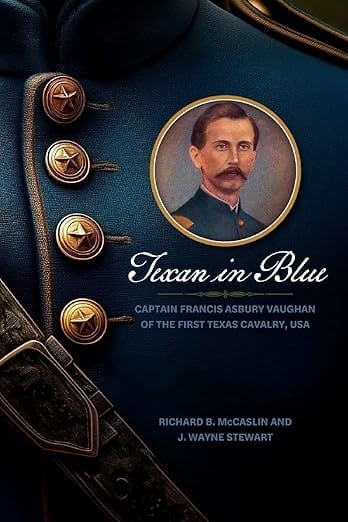
Texan in Blue: Captain Francis Asbury Vaughan of the First Texas Cavalry, USA. By Richard B. McCaslin and J. Wayne Stewart. Austin: Texas State Historical Commission, 2025. Paperback, 181 pp. $29.97.
Reviewed by Riley Sullivan
During the course of the American Civil War, over 60,000 Texans answered the call to serve in the Confederate armed forces. However, not all Texans were infatuated with the Confederate cause. Some 2,000 Texans ultimately joined Union forces to reclaim their state from the secessionists. While their story is riveting, little is known about them as few Texas Unionists left any documentation of their experience. One of the few writings that does provide insight into the Texas Unionists soldiers’ perspective is that of a memorandum left by Capt. Francis Asbury Vaughan of the 1st Texas Cavalry (Union). Using this source, Richard B. McCaslin–former Texas History Professor at the University of North Texas–and Vaughan’s great-great grandson, J. Wayne Stewart, teamed up to produce Texan in Blue to contextualize the experience of Texas Unionists during and after the Civil War.
Challenging previous conclusions drawn on Texans during the Civil War, Texan in Blue largely is in dialogue with the arguments put forth by historian Charles D. Grear. In particular, the authors challenge Grear’s claim that slavery was the primary factor that pushed Texans to the Confederate cause. While the authors do not disagree that defending the institution of slavery was a motivating factor for Texas Confederates, they assert that figures like Vaughan, who supported the Union and were tied to the institution, complicate this argument. Therefore, through Vaughan, the authors seek to demonstrate the complex motivations of Texas Unionists that have often been overlooked in the historical record.
Constructing their work chronologically, the authors divide it into five chapters, each dealing with a different phase of Vaughan’s life. Given that Vaughan was a lesser-known figure, the first chapter, which covers his early childhood and life prior to the outbreak of hostilities, was presented primarily as a genealogical study. Through the examination of census records, the authors rebuilt his family’s history in an effort to understand the environment in which he was raised and ultimately why, unlike many of his relatives, he chose not to support the Confederacy. While there is a lack of primary source documentation from Vaughan in the antebellum period, the authors speculated that his choice to support the Union rather than the Confederacy may have stemmed from class tensions. Writing that Vaughan “who raised livestock in a booming economy dominated by cotton, was thus a pragmatic Unionist who clearly recognized a divergence between his interests and those of the slaveowners.” (25)
While initially Vaughan had attempted to keep a low profile with his views, the implementation of martial law in Texas to enforce conscription in the spring of 1862 proved to be the final straw. On July 4, 1862, Vaughan began a months-long journey that would take him first across the Texas border into the Mexican town of Matamoros, then travel by Union vessels to New Orleans.
It was during this time that he began to write his memorandum that largely documented his experiences in his travels to New Orleans and his early service in the 1st Texas Cavalry (Union). While his memorandum provided rich detail of this period, by the summer of 1863, he stopped writing in it.
With the lack of documentation during the remaining years of the conflict from Vaughan, the authors largely document the service of his unit, the 1st Texas Cavalry. Focusing on individuals like Col. Edmund J. Davis, the authors demonstrated in later chapters how Vaughan’s wartime connections would continue into the period of Reconstruction. Due to the close relationship he developed with Davis, it came as no surprise that Vaughan would become a member of the Republican Party, serve at the state Constitutional Convention, and support Davis when he was elected governor of Texas after the war.
While many of his family members and neighbors might have seen him as a traitor for joining the Union and promoting the policies of the Republican Party after the war, few showed any malice towards him. The authors speculate that “the lack of family rancor may have been because most of his relatives in Texas did not join the Confederate army, and he did not serve in the same regions as his other siblings.” (65) With the lack of animosity towards him, Vaughan continued to be affiliated with the Republican Party and would go on to live a respectable post-war life, ultimately dying in 1896.
Throughout Texan in Blue, McCaslin and Stewart were able to produce a quality micro-historical work that documented one of the more underrepresented voices in Civil War literature. While the work centers around the memorandum produced by Vaughan, the authors effectively made use of contemporary newspapers, census records, and available correspondence to convey their argument. By challenging arguments presented by Charles D. Grear, the authors contributed greatly to the historical record by highlighting an often-neglected voice in the Texas Union soldiers.
Riley Sullivan earned his MA in History at Sam Houston State University and is a Professor of History at San Jacinto College in Pasadena, TX. He has published works on Civil War Memory that have appeared in the Tennessee Historical Quarterly. He is also a doctoral student in the Department of History at the University of Houston.


Stopped reading the review when the words “infatuated” and “reclaimed” were thrown out. Whatever one’s view of the Confederacy in Texas, we aren’t talking about it’s adherents being googley eyed schoolgirls, no more so than the German’s in Texas were doey eyed about the Union. These were hard headed practical individuals who were risking everything. And Texas wasn’t reclaimed by the Union, it was hammered into obedience.
“We [Texas] hold as undeniable truths that the governments of the various States, and of the confederacy itself, were established exclusively by the white race, for themselves and their posterity; that the African race had no agency in their establishment; that they were rightfully held and regarded as an inferior and dependent race, and in that condition only could their existence in this country be rendered beneficial or tolerable.” -A Declaration of the Causes which Impel the State of Texas to Secede from the Federal Union, February, 1861
This is the cause that 2,000 Texans were not “infatuated” with. Not sure why we are being offended by accurate words that represent Southern Unionists, Mr. Pryor.