“A Famous Battery:” James Smith’s 4th New York Independent Battery
ECW welcomes guest author Nancy Jill Hale.
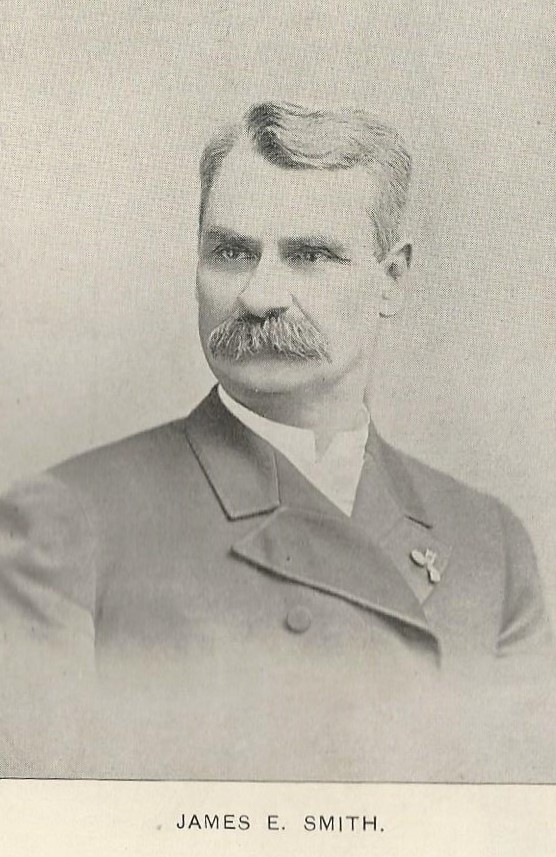
On the afternoon of July 2, 1863, Capt. James E. Smith ran to the infantrymen near his battery and, with tears in his eyes, pleaded, “For God’s sake, men, don’t let them take my guns away from me!”[1] III Corps Chief of Artillery Capt. George Randolph had ordered Smith to place his 4th New York Independent Battery on Houck’s Ridge near Devil’s Den to anchor the far left of the Union line. Although Smith had requested infantry support, his left flank remained unprotected throughout the afternoon and was vulnerable to attacks from Confederate Maj. Gen. John Bell Hood’s division. As Union Chief of Artillery Henry Hunt watched Hood’s Texans advance from the Emmitsburg Road, he told Smith he would probably lose his battery.
Smith’s men managed to slow the Confederate advance, but it was hard work. The position of his guns on the narrow ridge left no room for the limbers, and the artillerists had to unload the chests at the base of the ridge and carry each round to the guns by hand. According to Maj. Thomas Bradley of the 124th New York, Smith’s artillerists were “working as I never saw gunners work before or since, [and] tore gap after gap through the ranks of the advancing foe.”[2]
But as the Texans got closer to Smith’s 10-pounder Parrott rifles, they found that the large rocks in their path provided shelter from Smith’s canister and protection for sharpshooters as they picked off members of Smith’s crew.[3] As the enemy lines slowly climbed the hill, Smith recognized his precarious predicament and called on the 124th New York, which was to his immediate right, to help man his guns. J. Harvey Hanford, second sergeant of Co. B of the 124th New York, recalled that when Smith “had not men enough left to man the guns, he would come to us and ask and beg of us to help him fire them. Then he would run back to the guns, do what he could, and then back to us,” tearfully pleading for help.[4]
When the 40th New York arrived in the Plum Run valley in the rear of the battery, Smith approached Col. Thomas Egan and asked him “in beseeching terms to save his battery” on the ridge.[5] But the 40th quickly became engaged with the superior number of Confederates in their front and could offer no assistance. In their last push up the ridge, the Texans were able to overrun and capture three of Smith’s guns (the fourth had been disabled and removed earlier).
Most battery commanders would consider the loss of his guns a disgrace. But Smith had an investment in his battery that perhaps exacerbated his anxiety as the Confederates drew closer to the ridge and Gen. Hunt’s prediction seemed closer to coming true.
Smith began his military career in April 1861 as a lieutenant in Capt. Joshua M. Varian’s battery, a three-month unit attached to the 8th New York Militia. At the end of their term of enlistment, Smith was the only member of the battery to vote against being mustered out, and perhaps in appreciation for his loyalty, he received notice that a position on the staff of Gen. Erasmus Keyes was a possibility.
Instead, he was offered command of Varian’s Battery, but he declined because of his friendship with Varian and his lack of confidence in being able to command a battery. Smith did not realize that Keyes had arranged this promotion, and by turning it down, he lost a chance to serve on the general’s staff and was forced to muster out with the rest of the battery.
When Smith returned to New York, “very much dissatisfied with the manner in which my brief military career had terminated,” he resolved to organize a new battery.[6] By October 1861, the battery received the designation of the 4th New York Independent Battery. While in camp near Washington, Smith worked hard to train his men, whom he admitted were “lamentably deficient in knowledge of our duties.”[7] He spent much time studying artillery tactics and resolved never to give an order that he did not fully understand or could not explain to his men.
The battery participated in all the campaigns of the Union III Corps from the Peninsula to Gettysburg. While encamped at Falmouth in January 1863, various transfers and resignations made Smith, who was the ranking artillery officer of the III Corps, the corps’ artillery chief, which “compelled me to relinquish control of and sever my connection with the Battery.”[8]
Command of the battery devolved on a lieutenant who Smith believed was “totally unfitted for the position.”[9] This, combined with a transfer of the battery to a new division, caused demoralization among the artillerists. Smith reported that “much of the interest and pride usually felt by those who had shared hardships and dangers together was, to a certain extent, diminished and their ardor dampened. The men were despondent and became lax in their duties.”[10]
These problems in the battery that he had formed, trained, and led through many hard campaigns greatly affected Smith. He wrote, “If I had remained blind to all that concerned my old Battery, my personal interests would have been benefited, my position as chief of Corps Artillery, with ten batteries to control [was] one of the most desirable commands in the army.”
But his heart was with his men, and on April 26, 1863 Smith resigned his position as chief of artillery and received an honorable discharge. He met with New York Gov. Horatio Seymour to explain his actions and request reassignment to command of the battery, which he quickly received. He returned to Falmouth, where the battery was resting after the battle of Chancellorsville, was mustered in by mid-June, and led his battery toward Gettysburg where, in a few days, he saw his beloved battery overrun by Confederate troops.
Smith understood that “Round Top was the key to our position,” and “Devil’s Den was surely the key to Little Round Top, covering as it did the approaches up the Valley of Plum Run.”[11] Thus, he believed it was critical that his guns remain in position: “It had not occurred to me to save the Battery; indeed, I could not see how I was to do it without abandoning the defense of the valley and Little Round Top.”[12] He later wrote: “Had the guns been run to the rear when it was possible to save them the enemy would have been encouraged, and very likely would have made a more vigorous charge, which we were not in condition to repel.”[13]
Neither Gen. Hunt nor Capt. Randolph reprimanded Smith for the loss of his guns. In fact, Randolph offered a glowing report: “I regret the loss, but from my knowledge of the position and of the gallantry displayed by Captain Smith, I am convinced that it was one of those very unpleasant, but yet unavoidable, results that sometimes attend the efforts of the most meritorious officers.”[14]
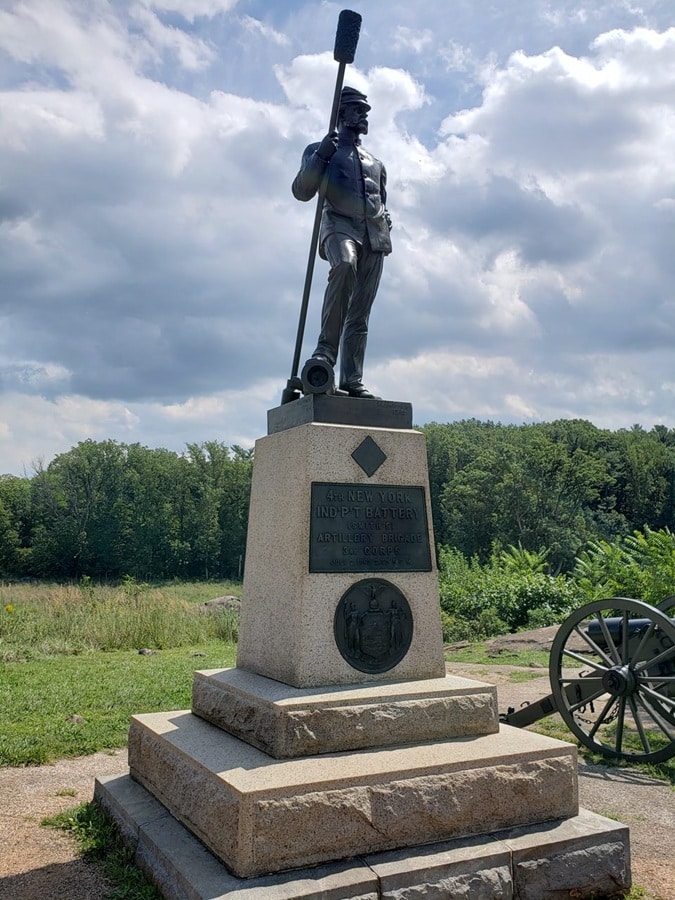
After the war, Smith was unhappy with the position of the battery’s monument and petitioned the New York Board of State Commissioners of Gettysburg Monuments to have it moved to the correct location. At the 25th anniversary of the battle, as Smith and Gen. Henry Hunt stood where the battery had actually been positioned, which was to the right and further up the hill from the monument. Hunt remarked, “Captain, get a painter and have painted upon this rock the fact that your left piece rested within a few feet, and to the north, of this point, and you will have a historical monument located upon the ground occupied by your guns on this ridge. If you had placed your pieces down where the monument stands, I would have placed you in arrest for incompetency.”[15] Unfortunately, neither the painted mark nor the repositioning of the monument ever took place.
————
The Rev. Dr. Nancy Jill Hale is a United Methodist pastor and Licensed Battlefield Guide at Gettysburg. She is the author of the book A Sight Never to Be Forgotten: Eyewitness Accounts of Union Chaplains at Gettysburg.
Endnotes:
[1] Letter to the editor, The National Tribune, Sept. 24, 1885.
[2] Major Thomas Bradley, “The Splendid Work Done by Smith’s Battery,” The National Tribune, February 4, 1886.
[3] There was room on the ridge for only four of Smith’s six guns. The other two were positioned at the northern end of the Plum Run valley.
[4] Letter to the editor, The National Tribune, Sept. 24, 1885.
[5] Egan to Piatt, August 1, 1863, The War of the Rebellion: The Official Records of the Union and Confederate Armies, Series 1, Vol 27, Part 1, 526.
[6] James E Smith, A Famous Battery and Its Campaigns, 1861-64 (Washington: W. H. Lowdermilk and Co., 1892), 33.
[7] Smith, A Famous Battery, 41.
[8] Smith, A Famous Battery, 95.
[9] Smith, A Famous Battery, 95.
[10] Smith, A Famous Battery, 96.
[11] Smith, “The Devil’s Den. Its Defense at Gettysburg by Smith’s Battery and Its Supports.” The National Tribune: Washington, D. C., Thursday, March 1, 1886.
[12] Smith, A Famous Battery, 106.
[13] Smith, “The Devil’s Den.”
[14] Randolph to Hill, September 2, 1863, OR, Series 1, Vol. 27, Part 1, 582.
[15] Smith, A Famous Battery, p. 149.


Great read!
Very interesting read. Whenever visiting Gettysburg I always stop at Smith’s Battery overlooking the triangular field. Glad to know the history of the battery and the controversy surrounding the placement of the monument.
Thanks for this excellent article. I was laser-focused on the portions regarding the battery’s positioning and exposure, as well as Hunt’s remark 25 years later. If one reads Hunt’s September 12, 1862 “directions” and their 1864 expansion, the positioning of the battery defied that guidance. Of course, sometimes “you have to do what you have to do what you have to do.”