Book Review: The Day They Hanged Old Brown: The Making of Celebrity and Martyrdom in the Civil War Era

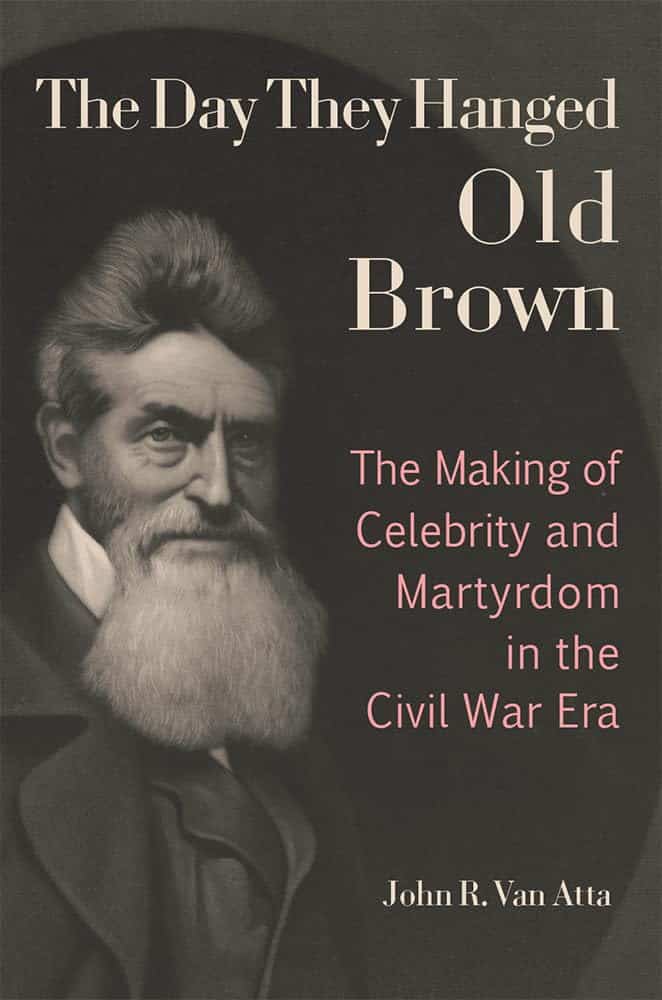
The Day They Hanged Old Brown: The Making of Celebrity and Martyrdom in the Civil War Era. By John R. Van Atta. Columbia, MO: University of Missouri Press, 2025. Hardcover, 344 pp., $48.00.
Reviewed by Tim Talbott
Who exactly was John Brown? Just about everyone has an opinion. A popular one is that he was a crazy man, a monomaniac. Others might posit that he was a resolute egalitarian, unbending in his hatred of caste and oppression. Many would agree that he was one of the most polarizing figures of the nineteenth century. Those less committed to a partisan perspective sometimes offer up something like, well, “one man’s terrorist is another man’s freedom fighter.” On one hand, this type of statement is quite cliché and can serve its user as a way to avoid or curtail a discussion that otherwise may quickly become uncomfortable and force one to think beyond their normal belief system. On the other hand, the idea that one person can be different things to different people is an intriguing consideration, an opportunity for mental stimulation, and one begging for extended and reasoned intellectual debate. This complicated duality often found in “spotlight” individuals, is, after all, something that we’ve become quite familiar with during own lifetimes.
John R. Van Atta’s The Day They Hanged Old Brown: The Making of Celebrity and Martyrdom in the Civil War Era is not a John Brown biography per se, although it certainly contains information about Brown’s life and the famous event that began the end of his life. In the book’s introduction, the author contends, “My approach is much more thematic than biographical. This is . . . not as much a book about the life of John Brown as it is one about what Americans living in his time and shortly thereafter made of him and the concepts for which he was (and still is) so well known.” (5)
As the book’s subtitle suggests, this study is particularly interested in “the creation of celebrity in Brown’s time and how it differed from our perception of the concept today and, with that, as part of the process of celebrity making, the conceptualizing of heroism on one side and villainy on the other.” The idea of martyrdom also receives a good deal of attention by exploring “the cultural understanding of martyrdom both before and during the Civil War and how it, too, intertwined with celebrity making and, at times, overlapped with concepts of hero and villain.” Of course, all of this also involves memory, including “the ways in which Americans chose to remember Brown in the first decades after his death, before modern historians began to deliberate him.” In other words, and as Van Atta states, “the pages that follow explore the huge difference that emerged between what we might call John Brown, the actual man, and John Brown, the celebrity, or legend as conceived in the minds of others.” (5-6)
To accomplish this admirable objective, Van Atta offers readers a prologue that takes them back to December 2, 1859, the day Brown was hanged in Charles Town, Virginia (now West Virginia). That event—well covered in newspapers across the country—along with Brown’s attempted raid on Harpers Ferry, his capture, and dramatic court trial a month and a half earlier, as well as his extensive letter writing campaign while imprisoned and awaiting execution, all enhanced perceptions of the man. In the North, and in Europe, many came to see Brown as a “celebrity-hero,” someone exhibiting masculine courage in his willingness to risk his life for the oppressed. Conversely, in the South, Brown became the “celebrity-villain,” which reinvigorated “a dominant southern style of honor and sense of manhood that compared to—though in some ways diverged significantly from—its northern counterpart.” (28)
In the book’s five chapters, titled: Celebrity, Hero, Villain, Martyr, and Memory, Van Atta explores each of these nuanced perspectives thoroughly explaining that Brown’s deeds and words, spread by advances in technology like the telegraph and steam printing press, expanded and solidified his image (positively or negatively) depending on whose eyes, ears, and brains received and processed the news. Some of Brown’s admirers were able to overlook unfavorable parts of Brown’s past, like the Pottawatomie Creek, Kansas killings, while his detractors only viewed those unsavory parts of his history as further evidence of his villainy. Readers willing to truly think about the ideas that the author offers in each chapter will find their efforts justly rewarded.
The book concludes with an epilogue titled, “Storer College, May 30, 1881,” in which Van Atta explores the significance of this Harpers Ferry African American school’s commencement address, offered that year by none other than Frederick Douglass. An abolitionist associate of Brown, who had the opportunity to participate in the Harpers Ferry raid but wisely declined, Douglass combined thoughts about his friend with words of inspiration for the graduates, sharing Brown’s idealism that “many will live for a principle; few will sacrifice heavily, let alone die for one.” (264)
The Day They Hanged Old Brown is extremely well-researched and written. The notes section and bibliographic essay, which span more than a combined 50 pages, are impressive evidence of Van Atta’s familiarity with the subject’s primary and secondary sources. Those who have a genuine fondness for seeing history’s relevance to the present, and who are interested in John Brown and Civil War memory, will find this book particularly enlightening.


John Brown, change agent.
For those who assert, “The Civil War was about slavery,” the existence of John Brown is inconvenient. Instead of being able to concentrate on ‘a gentlemen’s war’ that decided the question of ‘Slave or Free?’ the operations of Brown, pronounced by some as The Meteor of the Civil War… do not fit the narrative. Thus, John Brown is relegated to mere footnote: impossible to ignore, but too nebulous to explain. Best to set the guardrails at April 1861 and April 1865 and continue to pretend that “John Brown is not part of Civil War History.”
I enjoyed the straight-forward review of the book, particularly the reviewer Tim Talbott’s use of the quote “This is . . . not as much a book about the life of John Brown as it is one about what Americans living in his time and shortly thereafter made of him and the concepts for which he was (and still is) so well known.”