Book Review: Voices of the Formerly Enslaved in Louisiana: The WPA Narratives

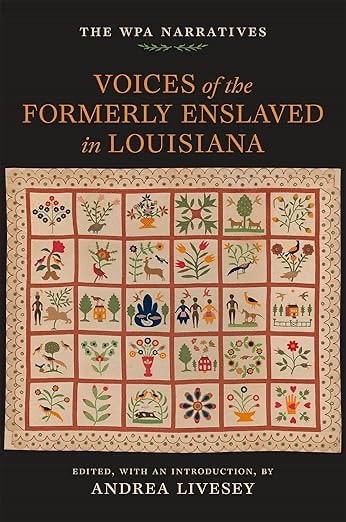
Voices of the Formerly Enslaved in Louisiana: The WPA Narratives. Edited by Andrea Livesey. Baton Rouge, LA: LSU Press, 2025. 552 pp. $65.00.
Reviewed by Neil P. Chatelain
Under President Franklin D. Roosevelt’s New Deal, the Works Progress Administration (WPA) famously hired people across the country to conduct interviews of elderly Black Americans who either were formerly enslaved or grew up during or immediately after emancipation. These oral histories were taken and shipped to Washington D.C., where they were compiled into a series of documents for all to access in the Library of Congress.
Seventeen volumes comprising 34 books were completed and are now freely available on the Library of Congress online database. These interviews were made in all former Confederate States, several border states, and several midwestern states. There remained one notable exception to this compilation until now: Louisiana. Voices of the Formerly Enslaved in Louisiana: The WPA Narratives provides the first completed and accessible collection of the Pelican State’s WPA oral histories of formerly enslaved persons.
Louisiana was like the other states in that it sent out people to interview formerly enslaved individuals. The issue was that those interviews were never forwarded to Washington and thus remained scattered across Louisiana in individual archives. Andrea Livesey, a British-based historian, has spent years collecting, cataloging, and transcribing these oral histories so they can now be used in conjunction with the other WPA narratives in the Library of Congress.
This is not a book specifically about the Civil War era. The Black Americans being interviewed lived before, during, or immediately after the Civil War, true, but the interviews often span much more of their lives. You can find anecdotes about World War One, the New Deal, and thoughts on President Roosevelt running for a potential third term. You will also find significant space in many interviews dedicated to famed New Orleans Voodoo practitioner Marie Leveau.
However, there is much to see in these interviews related to the Civil War era. Common themes regarding the treatment of enslaved persons pervade, including a recurring remembrance from many people on how overseers would dig a small pit and make pregnant enslaved women lie face down with their stomach in the pit so they could whip the woman without danger of harming the impregnated child. I saw many references to Federal soldiers appearing at plantations and commandeering food and cattle, as well as a host of references to Port Hudson and the Federal attacks on New Orleans in 1862. There are even a plethora of interviews focusing on postwar Reconstruction and the transition from enslavement to freedom.
These narratives, just like the other oral histories from other states, have their shortcomings. Those being interviewed are elderly, and many have difficulty remembering things from decades past. Many of the interviewers were White and thus likely put many people being interviewed on their guard and prone to saying things they perceived the interviewer wanted to hear. Added to these are challenges faced by readers. Several of the oral histories are written in French or Creole and contain no English translations. The largest challenge to accessing these oral histories in the book’s cost. There is no paperback version as of yet, and the $60 hardback cost may be prohibitive; however, an e-book version is also available for a reduced cost of $20.
The other WPA narratives in the Library of Congress are organized by state, then by last name of the person being interviewed. In Voices of the Formerly Enslaved in Louisiana, Livesey instead organizes the book by interviewer. This different organizational approach allows for contextual continuity regarding location, style, and format of interviews, which provides some clarity that the other volumes lack. Brief biographies of each interviewer start each section, adding more context to the interviews. A bibliography of sources worth utilizing in companion adds value to the collection itself.
Voices of the Formerly Enslaved in Louisiana is not a book exclusively about the Civil War, but anyone researching the Civil War era or late 19th century in Louisiana will find it quite useful and full of treasure troves of anecdotes that will give agency and voice back to those who were formerly enslaved in the Pelican State.


We can only look back on the WPA and other organizations at work in the 1930s-40s with extreme gratitude and relief at the work they did, because they both captured history like this, and also folk, blues and “hillbilly” music that might otherwise have been lost to the ages – like those languages that vanish from Earth before they can be recorded and a lexicon constructed – but they created art as well. My hometown was one of several – though not a huge amount – of places throughout the country where artists were commissioned to paint beautiful murals on the walls of post offices, depicting local and regional history. We have several here that we consider priceless, though we fear that the idiots that run our local towns and county will wantonly destroy them someday when the buildings become too old for use.
But without this government effort to record personal histories, music, etc. we would be so much poorer. I could be wrong, but I believe Woody Guthrie made recordings for the WPA; as well, I believe Don Law, who was one of the gentlemen who recorded Robert Johnson in the three sessions where he laid down the greatest blues music in history, also did many of these WPA recordings. In fact, some of the missing metal masters from the Johnson recordings were eventually found amongst Law’s WPA work.
Closer to the topic of this website, at least two historical societies, both in Virginia, I believe, managed to make recordings of the Rebel Yell as performed by aging veterans. I am fortunate to own copies of both and for those who may have never heard the real thing – it is unlike anything you have ever heard – or want to hear. What is fascinating is that these recordings were made by different groups recording different men in different times and places, yet the yells they rendered are identical, so this confirms that what was captured was authentic. Priceless.
Neil, thank you for this reminder of the debt we owe to the WPA and its Depression-era work to preserve history. Results of its work still pop up in strange places. When researching my spouse’s Civil War ancestor, M.J.L. Hoye, 39th Mississippi Infantry, I stumbled across a WPA project entitled “Tree Survey,” which oddly enough addressed trees in Newton County, MS. The report of that survey included this gem that enriches my spouse’s family’s understanding of their ancestor:
“Sixty-five years ago, M.J.L. Hoye, a prominent merchant in Decatur, set out eight young oaks in front of his house to grow into shade trees. The trees were not cut or trimmed but allowed to grow. The property was sold to the late G.M. Gallaspy whom during his lifetime refused to have the trees marred with an axe. His widow, Mrs. Viola Gallaspy, who lives in the home today loves her eight big oaks which have grown to the height of nearly a hundred feet and shade the entire spacious lawn. She states her trees will not be cut as long as she lives and she hopes her successor will prize the trees as highly as she does.”
Source: Minnie Nichols & Mary R. Loper, Historical Research Project, Newton County History, Assignment No. 25 (Tree Survey), May 24, 1937, pp. 5-6, from Works Progress Administration for Mississippi, Source Material for Mississippi History, Preliminary Manuscript, Newton County, Volume LI, Complied by State-Wide Historical Research Project, Susie V. Powell, State Supervisor.