Flour Power: Richmond’s Gallego Mills
Much has been made about the importance of Richmond, Virginia, as the seat of Confederate government and as a source of industrial might. Installations around the capital armed, clothed, and treated countless Confederate soldiers, and its fall to Union forces essentially guaranteed the hasty end of the war.
For all that has been published concerning Richmond’s transportation systems, hospitals, and manufactories of weapons and equipment, comparatively little has been compiled about some of the other plants fueling the war effort. Indeed, in many cases, little information exists. Three flour mills produced an immense quantity of high-quality foodstuff, with the Gallego Mill claiming to be the largest of its kind in the world.[1] What follows is a brief compilation detailing this installation’s history and its strategic value.
Joseph Gallego, a Spaniard living in Richmond, established the first iteration of this mill in 1795. Little is known about this first building apart from an account in the journal of François de La Rochefoucauld, who visited several flour mills throughout the young United States in 1795-1797. By his description, it contained twelve millstones rotated powerfully by the falls, but the craftsmanship of the stones themselves left much to be desired.[2]
The mill plant moved a few times since its establishment, but was always located along the James River and Kanawha Canal. This provided a source of water power relatively immune from floods and droughts.[3
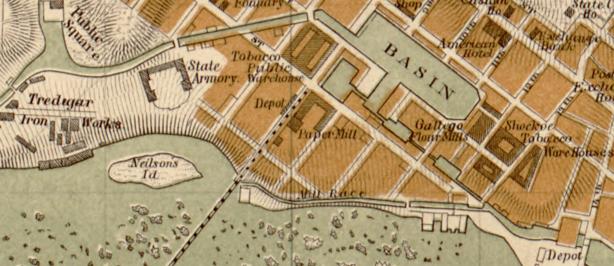
By 1810, the brand name became known in London and word of its quality spread quickly.[4] It was the only company whose flour could be transported across the equator while maintaining its freshness, remaining sweet during long journeys at high temperatures.[5] This attribute gave it a massive customer base in Central and South America. The Gallego Mill’s location right along the port of Richmond further facilitated this commerce.[6] It attained particular favor in Brazil and Australia, being able to charge a dollar more per barrel than any other variety made in the U.S.[7]
In 1832, the site was relocated to the foot of the canal in Richmond, where it burned down twelve years later.[8] Construction of the building used during the Civil War began in 1854; eventually this twelve-story building contained 200,000 square feet of space.[9] By the very next year, this facility produced nearly 200,000 barrels a year.[10]
According to the U.S. Department of Agriculture in 1864, the Gallego Mills had slipped to second-place in American production, trailing a facility in Oswego, New York. At that time, to the Federal government’s knowledge, the Richmond mill contained 31 pairs of stones driven by three waterwheels 32 feet high and another trifecta 18 feet high, producing 190,000 barrels a year.[11] Assuredly, this is based on prewar information and production declined during the conflict, but the factory stayed open throughout.
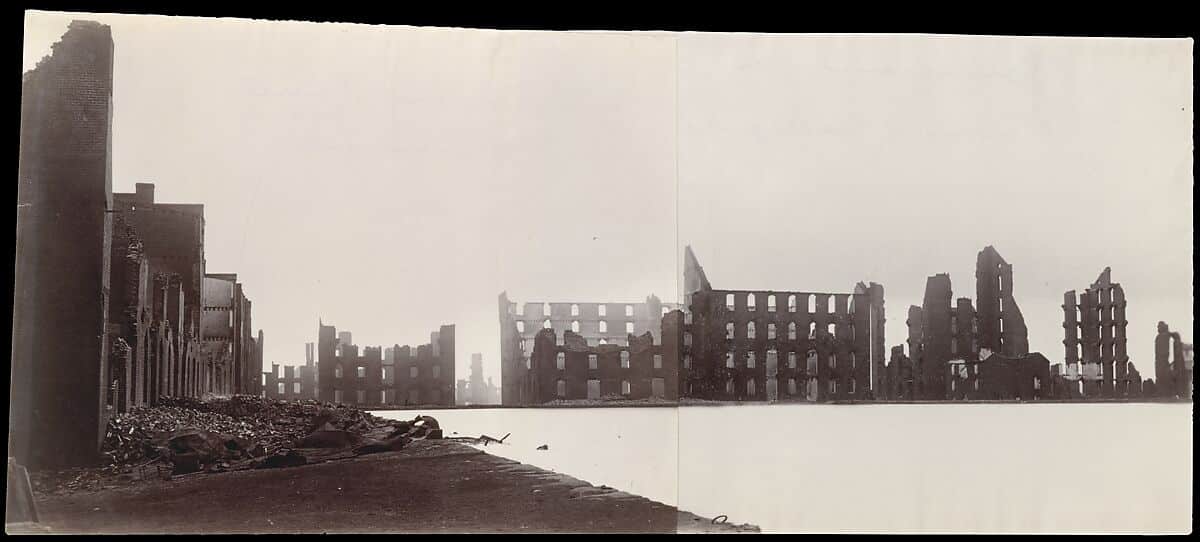
Operations continued until April 2, 1865, when the Gallego Mills burned during Richmond’s evacuation fire. Indeed, Shockhoe Warehouse, a major tobacco warehouse adjoining the Gallego complex, was directly set alight by order of Richard Ewell.[12] By 1867 the factory was rebuilt and running, continuing operations into the mid-twentieth century.[13] The James Center Plaza sits upon the site today, and original blocks from the canal lie in the park.[14]
[1] “The Gallego Mills” Richmond Whig (Richmond, VA), Apr. 25, 1865.
[2] Robert Lundegard, “Country and City Mills in Early American Flour Manufacture and Export,” (Colvin Run Mill Historic Site, Great Falls, VA, 2007), 3. https://spoommidatlantic.org/uploads/editor/files/Mid-Atlantic_Mills/Country_and_City_Mills-September_2007.pdf
[3] Lundegard, 6.
[4] “Keeping Pace with the U.S.A.,” American Miller 50, (Apr 1 1922), 355. https://books.google.com/books?id=JpZFAQAAMAAJ
[5] Arthur G. Peterson, “Flour and Grist Milling in Virginia: A Brief History,” The Virginia Magazine of History and Biography 43, no. 2 (Apr 1935): 105-106. https://www.jstor.org/stable/4244636
[6] Myrtle Elizabeth Callahan, “History of Richmond as a port city” (Master’s thesis, University of Richmond, 1959), 45-46. https://scholarship.richmond.edu/cgi/viewcontent.cgi?article=1067&context=masters-theses
[7] “The Gallego Mills”
[8] “Keeping Pace with the U.S.A.”
[9] “The Gallego Mills”
[10] Lundegard, 7.
[11] Arthur G. Peterson, 105-106.
[12] “The Evacuation – The Conflagration – The Surrender – Scenes,” Richmond Whig (Richmond, VA), Apr. 6, 1865.
[13] “Keeping Pace with the U.S.A.”
[14] Robert M. Dunkerly and Doug Crenshaw, Embattled Capital: A Guide to Richmond During the Civil War (El Dorado Hills, CA: Savas Beatie, 2021), 115.


Very interesting article on a neglected subject.
Thanks Michael! I appreciate it.
Aaron, quite interesting. Question – “It was the only company whose flour could be transported across the equator while maintaining its freshness, remaining sweet during long journeys at high temperatures.” Any idea why/how this particular flour had this unique favorable quality?
Hi Kevin, from my understanding it is because the flour produced was refined to become super fine. The flour was automatically transferred from the wheels to sifters that removed all but the smallest grains. Virginia also had strong inspection laws ensuring quality before shipment. Finally, I would expect the multiple transportation routes, from the canal to eventually the railroads to allow the plant access to very fresh wheat.
Very interesting article. Well Done
Glad you enjoyed it!