A Splendid Poem: Richard Garland’s Epic Fight
ECW welcomes guest author James Marten.
On a pleasant evening in July 1892, the members of Wilson Colwell Post #38, Grand Army of the Republic in La Crosse, Wisconsin listened as their commander, Milo J. Pitkin, read a story entitled “The return of a Private Soldier.” It was “a very entertaining subject,” the adjutant (a kind of post secretary) reported in the minutes, “showing how a soldier who served three years in the army and met with no reception in his return.”[1]
The story was almost certainly “The Return of a Private,” published two years earlier by the well-known author Hamlin Garland. It was a slightly fictionalized version of his father Richard’s homecoming when the writer was only five years old, which also appeared in the first chapter of his 1917 autobiography.[2]
The Garlands lived on a small homestead near La Crosse when, in 1863, Richard joined the 14th Wisconsin. He survived the Atlanta Campaign and Sherman’s March, and when the regiment was mustered out in Alabama in October 1865, Richard and some of his comrades made the long journey home to La Crosse. No one greeted the few soldiers when they got off the train, and they simply walked to their respective farms.
The tension in both the autobiographical and the fictional version of the story is the disappointing reception the private receives at home; his wife and daughter rush into his arms, but his sons—a five-year-old and a toddler born about the time he had left for the army—hold back. The bone-tired soldier is nearly heartbroken, but eventually he lures the boys to him with kind words and an apple. The family, reunited, go into their rather run-down house to listen to war stories and dare to dream of better days ahead.
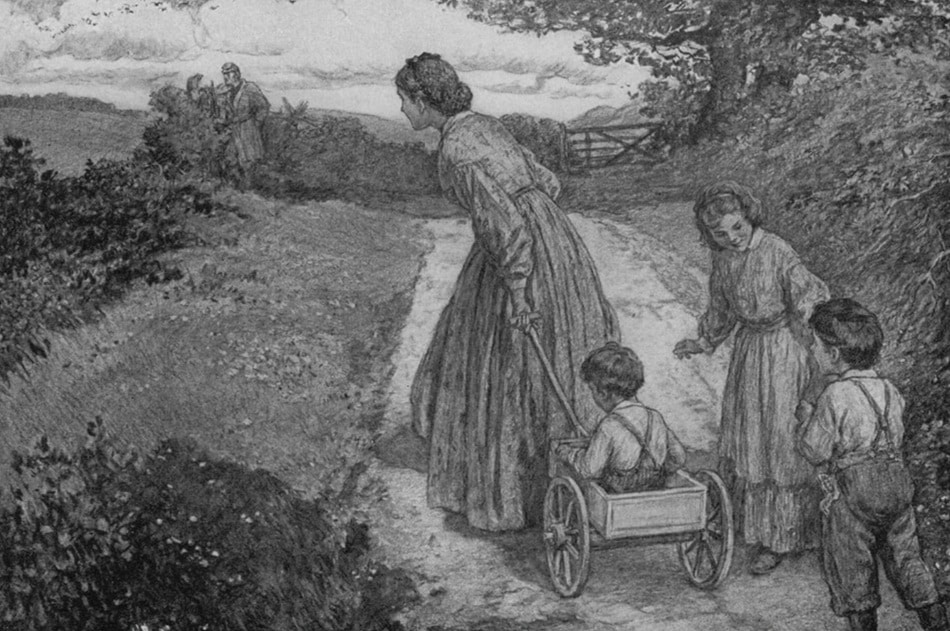
Yet in the short story Garland foreshadows a stark future: “His farm was weedy and encumbered. . . . The years were coming upon him, he was sick and emaciated.” But “his heroic soul did not quail. With the same courage with which he had faced his Southern march he entered upon a still more hazardous future.”
The compulsion to succeed, to defeat obstacles that had no doubt served him well in wartime, continued into peacetime. “The common soldier of the American volunteer army had returned. His war with the South was over, and his fight, his daily running fight with nature and against the injustice of his fellow-men, was begun again.”[3]
Richard Garland is unique in that his return home is so well-documented, but also in his son’s fiercely honest portrayal of the ambiguity of the Union’s victory for the common soldiers who had won it. Of course, most Civil War veterans did not have Pulitzer Prize-winning children. Garland would return to this theme time and again, expanding it to include the effects of his father’s decision to go to war and his decision to continue that “fight with nature and against . . . injustice” on his wife Charlotte Isabelle—called simply “Belle.”
That fight led Garland to Iowa, where he became one of the founders of the state’s Grange movement. But insects destroyed his crops and, in the early 1880s, he moved his family to a homestead in Dakota Territory, dozens of miles past the nearest railroad terminus in what is now north central South Dakota.[4]
Many Union veterans homesteaded in the plains states and territories, from Dakota south through Nebraska and Kansas. Indeed, at about the same time the Garlands arrived, over two hundred Union veterans settled the town of Gettysburg—named after the famous battle—about a hundred miles south of the Garlands’ little town of Ordway. Hamlin wrote about his years working with his father and grandfather when he was in his late teens and early twenties as they tried to make a go of it in the harsh environment of the northern plains.[5]
Hamlin focused on the literal fight against the elements: blizzards, drought, and the never-ending wind. Richard maintained his farm and opened a store and seems to have taken on something of a leadership role in the community. But Hamlin believed that his mother suffered more from the harsh pioneer life than her more ambitious husband and deserved better. Although Garland discovered fairly quickly that the frontier life held no interest for him, he visited his parents fairly often and much of his early writing, especially, explored his ambivalence toward his father’s choices.
Richard’s war and the years of dogged, head-down hard work that followed it came to represent, at least to Hamlin, the same impulse of stubborn duty verging on selfishness that had driven him into the army. “I have heard my mother say that this was one of the darkest moments of her life,” Hamlin wrote of Richard’s decision to enlist on “the very day” he paid off the mortgage on his farm. She had begged him not to go, “broken hearted at the thought of the long separation, and scared by visions of battle.” Despite her pleas, “for thirteen dollars a month he marched and fought while his plow rusted in the shed and his cattle called to him from their stalls.”
Of course, since he was only three when his father left, Hamlin’s “conscious memory holds nothing of my mother’s agony of waiting, nothing of the dark days when the baby was ill and the doctor far away,” but he did absorb something of the drama of getting weeks-old war news and the way in which the war filtered into the lives of the entire rural neighborhood. “I shared dimly in every emotional utterance of the neighbors who came to call and a large part of what I am is due to the impressions of these deeply passionate and poetic years.”[6]
They no doubt shaped Belle Garland, too, but in very different ways. At the time Hamlin was not aware of the stress the moves to ever more challenging situations caused for his mother. But he wrote after she died, “I suspect now that each new migration was a greater hardship than those which preceded it. My father’s adventurous and restless spirit was never satisfied. The sunset land always allured him, and my mother, being of those who follow their husbands’ feet without complaining word, seemed always ready to take up the trail.” Hamlin admitted that “I now see that she must have suffered each time the bitter pangs of doubt and unrest which strike through the woman’s heart when called upon to leave her snug, safe fire for a ruder cabin in strange lands.”[7]
Hamlin’s beloved mother died a few years after he bought his parents a house in West Salem, near La Crosse, in 1893. Richard remarried, and Hamlin and his family spent many happy summers visiting the old soldier. The house has since been restored and is maintained as a historic site.
When Richard died in 1914, Hamlin wrote a eulogy that any veteran would have been proud of. Perhaps he had come to terms with what by then he had realized was his father’s single-minded thoughtlessness, driven, perhaps, by an extension of the patriotism and a certain kind of ambition that had inspired his military service. He told of “a natural pioneer and explorer,” who was “clean-cut in thought and vivid in phrase.” His father “loved the unpeopled spaces and no rigor of winter weather, or heat of summer sun could daunt or dismay him.” His father’s two years as a soldier had been “his epic, a splendid poem upon which he dwelt with ever deepening emotion up to the moment when he was summoned to join the Grand Army beyond the silent river.”[8]
Richard had joined Colwell Post when he moved to La Crosse. At least nineteen members of his old company from the 14th Wisconsin also belonged. Perhaps some had stepped off that same train on that long-ago homecoming. Perhaps the bittersweet ending spoke to their own lives as farmers, peddlers, teamsters, clerks, and craftsmen. Hard times had hit the United States and Wisconsin in the 1870s and would again only a year or two after that summer evening when a room full of old soldiers listened to a comrade read a story of the war that had ended not with trumpets, but with the inevitable challenges of making their way—and their families’ ways—in peacetime.[9]
————
James Marten is professor emeritus of history at Marquette University and a former president of the Society of Civil War Historians. His most recent book is The Sixth Wisconsin and the Long Civil War: The Biography of a Regiment (Chapel Hill: University of North Carolina Press, 2025).
Endnotes:
[1] July 14, 1892, MSS 088 Grand Army of the Republic, Wilson Colwell Post Number 38 of La Crosse, Minutes, 1891, La Crosse Public Library Archives.
[2] “The Return of the Private,” Main-Traveled Roads: Six Mississippi Valley Stories (Boston: Arena Publishing, 1891), 186-216; Son of the Middle Border (New York: P. F. Collier & Son, 917), 1-13.
[3] Garland, “The Return of the Private,” 215.
[4] Quad-City Times, October 29, 1914.
[5] Robert F. Gish, “Hamlin Garland’s Dakota History and Story,” South Dakota History 9 (July 1979): 193-209.
[6] Garland, Son of the Middle Border, 5-6.
[7] Garland, A Pioneer Mother (Chicago: The Bookfellows, 1922), 9.
[8] La Crosse Tribune, October 23, 1914
[9] Records Copied from Descriptive Book, Wilson Colwell Post No. 38, Grand Army of the Republic, Margaret MacDonald Papers, La Crosse Public Library Archives.


This was a really interesting anecdote. I appreciate you sharing it.