Military Government vs. Smallpox: Alexandria’s Claremont Hospital
When a smallpox epidemic broke out in Union-occupied Alexandria in September 1862, the city was unprepared. White citizenry and military officials pointed to the influx of around 8,000 Contrabands, self-emancipating persons fleeing slavery for safety behind Union lines, as the cause of the spread. Protocol dictated that the afflicted be sent to hospitals across the river in Washington. The situation engulfed the city to the point of thousands infected, prompting the medical authorities to call for the establishment of a designated smallpox treatment center.
Alexandria should have been more prepared. In response to the battle of Antietam, the medical network doubled with the creation of a three-divisional system. This new organization triggered the confiscation and seizure of additional private property for use as Union Army hospitals. The city averaged 30 hospitals and 6,500 beds by war’s end. We must, however, keep in mind the era’s narrow understanding of disease and how Civil War hospitals were, at times, deadlier than a battlefield – no matter how many locations pop-up or beds are available.
The lack of proper care for Contrabands, however, escalated the epidemic. Alexandria was already home to the lucrative slave trade and a free Black population prior to the onset of the Civil War. There were limited medical options for citizens and few accommodations available for special cases – let alone refugees. This demographic received the least attention, delegated to neighborhoods with a measly amount of supplies, until White advocates pushed the military government for proper care. If authorities had provided more preventative and adequate treatment, it may have altered the onset of the epidemic. It was not until 1864 that the first hospitals were established for this vulnerable population: L’Ouverture, Contraband School, Grace Church (White soldiers relocated), and Claremont.
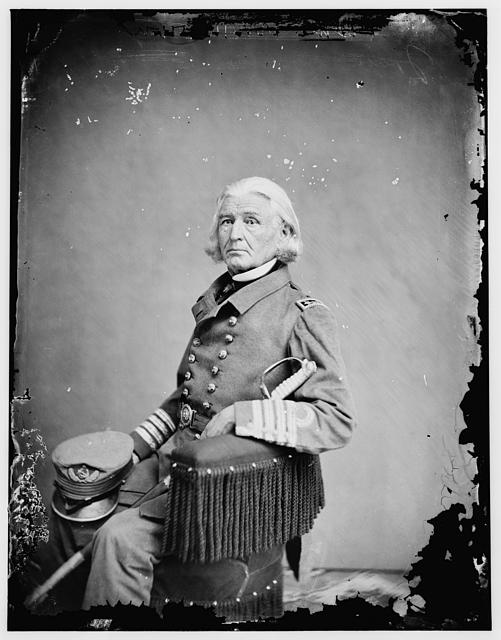
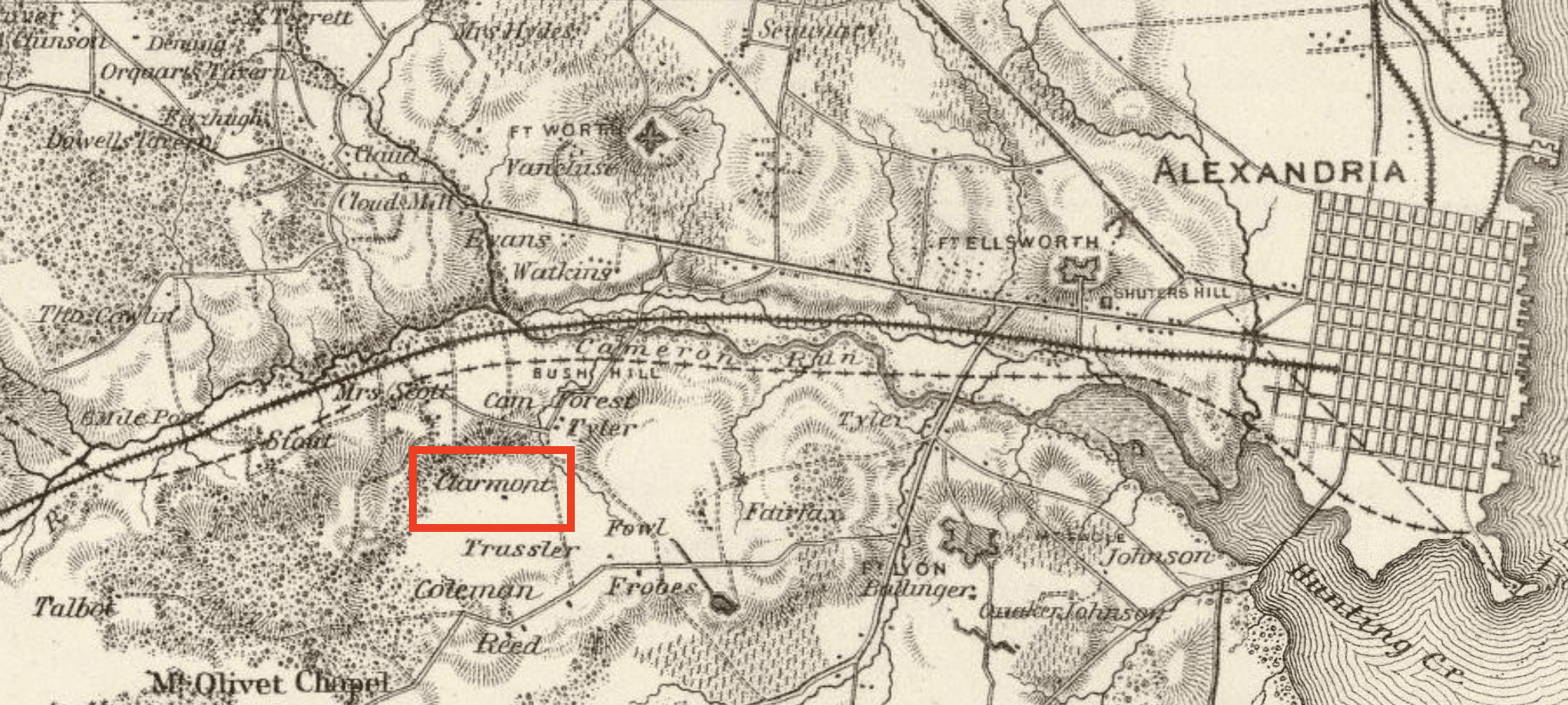
“Clermont House” was a 1771 estate originally built by Daniel French. It stood less than three miles outside of Alexandria along the Orange & Alexandria rail lines. It passed to grandson French Forrest, who seceded with Virginia. He joined the Confederate Navy two weeks before Alexandria would be captured by Union forces. Forrest’s wife abandoned the home in advance of the incoming federal troops. Clermont was subsequently seized due to the 1861-62 Confiscation Acts or invalid tax payment on the part of the owners.*
Military Governor Slough authorized the conversion of Clermont into a smallpox hospital. Renamed “Claremont” due to spelling errors by transient soldiers and workers, the history of Claremont Hospital is preserved and documented thanks to the work of Tim Dennée of the Friends of the Freedmen’s Cemetery. Please view his original research report and transcribed medical ledgers here. The hospital cared for a capacity of about 200 people, admitting both civilians and soldiers starting in March 1864. Public opinion of Claremont varied. Some viewed its founding as heaven-sent, while others disdained that it did not halt the spread of smallpox or that it caused more extensive suffering for patients. Due to the highly-contagious nature of the disease – with its ability to transmit via clothing – hospital workers unknowingly brought smallpox with them back to Alexandria. It is reported that 28% of patients at Claremont died of both smallpox and other diseases contracted while receiving treatment.
Surgeon John Bigelow, universally disliked by many in the city, was discharged from his duties as hospital superintendent in February 1864. The crime? According to Dennée’s findings, he was accused of misallocating hospital funds but no charges were pursued. Surgeon Edwin Bentley, opposingly well-liked by almost everyone, took control of Claremont thereafter. Bentley was a true friend to the Contraband community: supporting the creation of the Contraband School, serving as the Head Surgeon for L’Ouverture Hospital, and advocating for their vaccinations.
Like similar practices in the 19th Century, occupied Alexandria attempted to quarantine and buried diseased corpses away from densely-population urban areas. One pauper cemetery, “Penny Hill,” stood in the outskirts of Alexandria. Until 1803, most Alexandrians were buried within the city limits in churchyards. When a yellow fever wave struck the region, diseased burials were not permitted in-town. One by one, the city’s churches established auxiliary burial grounds out by Penny Hill. It grew to become a 13-cemetery community, known today as the Wilkes Street Cemetery Complex. The Alexandria National Cemetery, first of its kind in the country, is also situated here – far enough away from “downtown” Alexandria to bury sick, fallen soldiers.
Governor Slough appointed Albert Gladwin as the Superintendent of Contrabands, whose duties included burial oversight. Gladwin hired freeman Randall Ward to act as gravedigger for several cemetery sites around Alexandria, including Claremont.[1] In 1867, the Quartermaster’s Office exhumed 121 graves from the “Claremont Eruptive Fever General Hospital,” and reinterred them in Section 27 at Arlington National Cemetery.[2] Most of those burials were African American nurses, stewards, and other workers from Claremont.
The story of Claremont and the difficulty containing smallpox speak to the layered history of the Civil War. Disease management transcended medical strife: affecting military operations, straining control under martial law, scapegoating minorities, and leading to in-fighting among surgical staff. Occupation of a locale did not mean continued and complete control, as evidenced in Alexandria’s scramble for a remedy to their extensive smallpox situation.
Madeline Feierstein is an Alexandria, VA historian and founder of the educational and historical consulting company Rooted in Place, LLC. A native of Washington, D.C., her work has been showcased across the Capital Region. Madeline is a writer for Emerging Revolutionary War, Emerging Civil War, and the National Museum of Civil War Medicine. She leads significant projects to document the sick, injured, and imprisoned soldiers that passed through Alexandria and Washington, D.C. Madeline holds a Bachelor of Science in Criminology from George Mason University and a Master’s in American History from Southern New Hampshire University. Explore her research at www.madelinefeierstein.com.
* Alexandrians who fled to the Confederacy and were in active rebellion against the United States could not pay property taxes from Dixie. Payment must be paid in-person, in U.S. dollars, and once the owner had taken the Oath of Loyalty. Since all three rarely occurred to Secessionists who had abandoned their homes and businesses, the military government of Alexandria seized their properties for nonpayment of taxes, as well as under the authorization of the 1861 & 1862 Confiscations Acts.
[1] “A Brief History of Alexandria’s Freed People and of Freedmen’s Cemetery,” Friends of the Freedmen’s Cemetery, 29 April 2007, https://www.freedmenscemetery.org/history/history.shtml.
[2] “The Freedpeople of Section 27,” History Education Series, Arlington National Cemetery, n.d., https://education.arlingtoncemetery.mil/Portals/0/Education%20Materials/Freedpeople%20of%20Section%2027_Reading.pdf?ver=2020-07-14-081016-660.


