Eyewitness to the 1862-1863 Dakota Wars: The Letters of John Wesley Moore (Part I)
John Wesley Moore, of Company B, 7th Regiment, Minnesota Volunteers, experienced aspects of the Civil War period few others would. Caught up in the 1862-1863 Dakota Wars against Native Americans,[1] Moore witnessed the immediate aftermath of civilian massacres at the start of the conflict. He then protected indigenous captives from vengeance-minded whites, while fervently expressing the hope that his charges would soon be hanged (as many were).
Moore subsequently participated in the 1863 punitive campaign against those still resisting U.S. authority. In the process Moore was witness to several of the most historic aspects of the war against the Dakotas, a campaign usually remembered, if at all, for the largest mass hanging in American history. Moore recorded his experiences in a series of letters to family, providing a window into events far from the “glory” of much better-known Civil War campaigns.
Moore was born on February 10, 1840 in Elmira, New York. In 1858 his family moved to Winona County, Minnesota.[2] On August 17, 1862, Moore enlisted in the 7th Minnesota,[3] part of an enthusiastic response of the sparsely populated new state (admitted 1858) to Abraham Lincoln’s call for fresh troops.[4] As one recruit observed, “The call of President Lincoln came to these men in the midst of harvest—they left the field or the workshop to enlist.” [5]
This was not hyperbole. A historian of the regiment recounted that the newly enlisted men had been promised ten days leave to wrap up their affairs, but then came news of the “Sioux [Dakota] outbreak.” The men were immediately summoned to duty. One man, J. T. Ramer of Company B, related that “I was raking grain off a four-horse McCormick reaper in my father’s wheat field. I stepped off, telling my brother Charles to take the rake, for I was going to enlist; others joined, making eight that left the harvest field to volunteer.”[6] Moore was one of the many who answered the call, not to fight Confederates, but Native Americans.
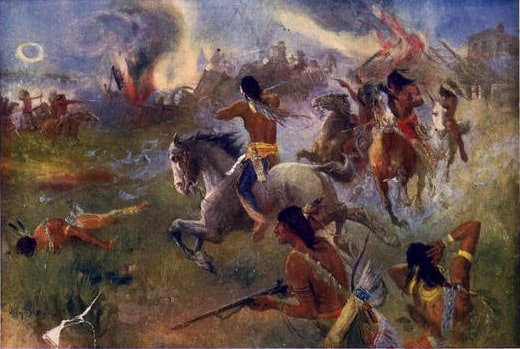
In an August 25, 1862 letter written from Minnesota’s Fort Snelling, Moore described how whites were thronging into the fort to escape slaughter. One man whose family was killed reported that “he took one child with him but had to drop it for the Indians. They chased him 17 miles one day.”[7]
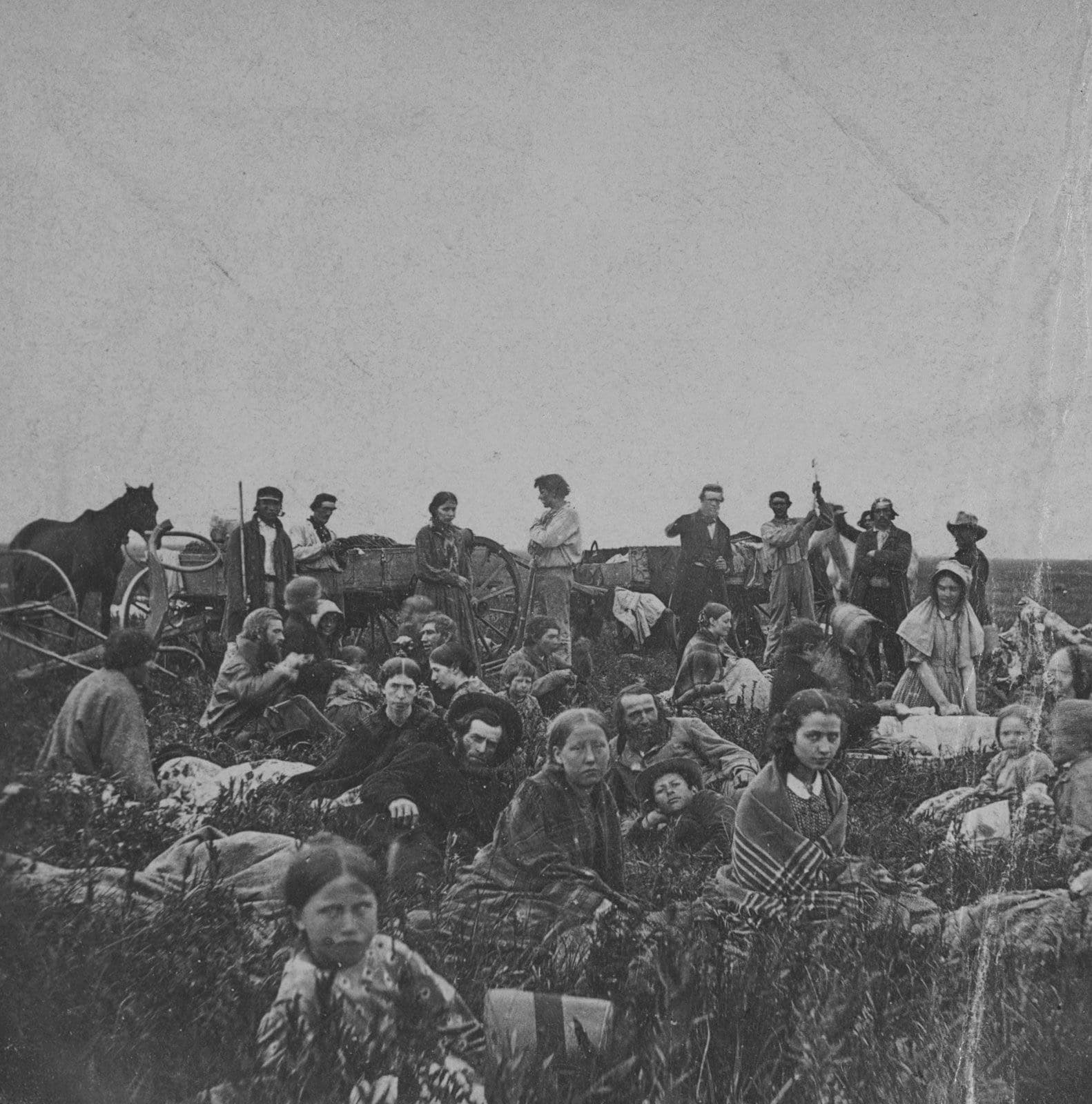
At Fort Snelling, Moore and his comrades, all raw troops with no training whatsoever, received uniforms and arms (apparently Austrian rifles, which Moore later described as worthless). Only after leaving the fort would they be issued “sixteen rounds of ammunition.” On August 27 they started out to confront the foe.[8]
In an October 22 letter to his father, Moore described his role in the ensuing successful 1862 campaign against the “Redskins.” [9] “Our Company with two others just returned from 8 days journey after the Redskins away out in the Dacota [sic] Territory.” Moore described the forced marches, and how the cavalry had gone ahead and captured 150, including 40 “bucks.” Moore added that the “squaws” had followed behind the men under guard, the woman “crying & singing.” He described the summary trials that then were held, including 30 in one day, with only one cleared. As for the rest, Moore wrote, “I don’t know if they will be hung or shot or what. When I hear I will let you know.”
But with the advent of prisoners came what seemed to be the more difficult part: preserving the lives of the captives until they could be properly hanged. Moore wrote that on November 9, while escorting prisoners “we had quite a battle the Norway & Dutch women came in with knives axes & clubs and attacked the indians. The stones flew like hail & knocked one out of the wagon he being chained was dragged 5 or 6 rods & severely bruised. another’s jaw was broken & another’s arm was broken and others were badly hurt about the head.”[10] In a subsequent letter, Moore wrote of the continued need to protect the native captives from vengeful whites: “a fellow (a farmer) has been here & says that he expects to be called on to go and help kill them prisoners. We have heard the citizens are going to raise against the Red prisoners & we are to be ready to protect them.”[11]
Moore’s company earlier had passed by scenes of carnage provoking such attempts at vengeance. At one site they “found two dead bodies and buried them. The house on this farm is deserted & in it is blood all over the floor.” Two settlers, brothers, recognized a prisoner whom they said “had killed their family, killed their father and mother and sister, they saw him cut off their sister’s head.” [12] The brothers attacked the man; the soldiers had to intervene, although Moore laconically observed, “He will get his neck strung I guess.”[13]
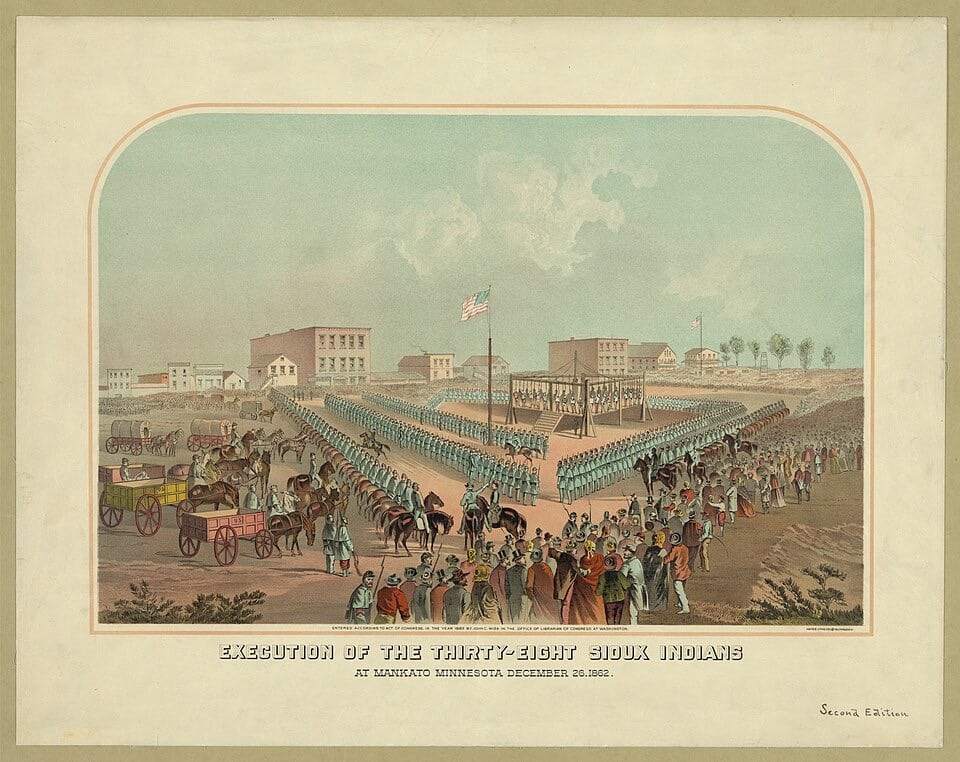
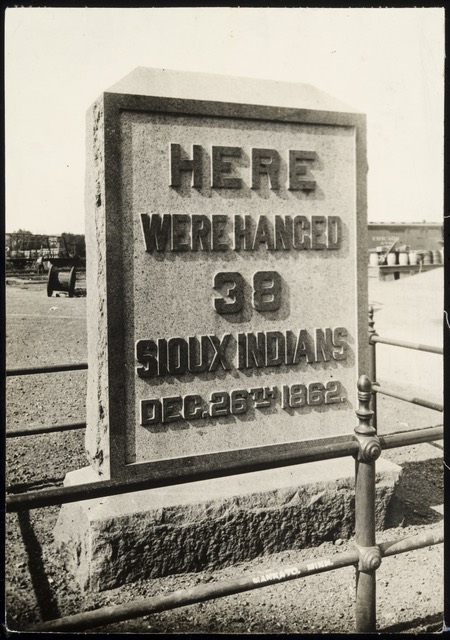
Indeed, hanging was frequently on Moore’s mind. In several letters Moore noted that they were waiting for approval from President Abraham Lincoln to start hanging over 300 captive natives who had been condemned by military commission,[14] some of whom were already dying from the measles. Moore added confidently that in either case, “I do not think that they will get away from here alive.” Moore expected to assist in their final disposition: “The Colonel says if they are to be executed we shall have a hand in too.” Indeed, Moore repeatedly complanied that an expected furlough was being postponed due to that coming duty.[15] While Moore’s extant letters do not record if he in fact participated in the executions, 38 Dakota were hanged on December 26, 1862.[16]
But the hangings did not end the conflict, nor the killing. Rather, the war broke out again in 1863. In April of that year Moore reported, “The Indians have been committing their depredations again this spring.”[17] Moore became part of the punitive expedition sent out to end the native threat once and for all. Starting from Camp Pope in Southwest Minnesota on June 16,[18] Moore became part of a ten-week campaign against the hostiles that he described in detail in an August 16 letter to a sister that reads as if Moore had been keeping a contemporaneous journal.[19] Moore’s experiences during that campaign will be described in Part II of this post.
[1] Overviews of the war, which began in August 1862 and extended into the Punitive Expeditions of 1863-1864, can be found in “Sibley and the U.S.-Dakota War of 1862,” Dakota County Historical Society, https://www.dakotahistory.org/sibley-1862?highlight=WyJ1Il0= , and “The US-Dakota War of 1862,” Historic Fort Snelling, https://www.mnhs.org/fortsnelling/learn/us-dakota-war.
[2] “History of the Moore Family,” Box 1, Folder 5, “Papers Related to Collection,” Moore Brothers Civil War Letters and Papers, Identifier: MSS 16441, Albert and Shirley Small Special Collections Library, University of Virginia. All of the Moore correspondence cited herein is from this collection. Original spelling and punctuation have been preserved.
[3] Minnesota. Board of commissioners on publication of history of Minnesota in civil and Indian wars. (189199). Minnesota in the civil and Indian wars 1861-1865. 2d ed. St. Paul, Minn.: Printed for the state by the Pioneer press company, p. 373 (Roster of Company B), https://babel.hathitrust.org/cgi/pt?id=mdp.39015027068017&seq=413.
[4] In 1860 Minnesota had only 172,000 residents. “Minnesota Now, Then, When…
An Overview of Demographic Change,” Minnesota State Demographic Center (April 2015), pp. 1, 3. The state already had raised “five infantry regiments, three cavalry companies and two batteries.” Minnesota in the civil and Indian wars, p. 347. As a historian of the regiment observed, “It seemed as if the last man who could had volunteered; yet in one month, August, 1862, five full infantry regiments were enlisted. Of these the Seventh was the second organized.” Minnesota in the civil and Indian wars, p. 347.
[5] Minnesota in the civil and Indian wars, p. 347.
[6] Minnesota in the civil and Indian wars, p. 347.
[7] August 25, 1862 letter to “Dear Father.” Moore did not reveal what happened to the child.
[8] August 25, 1862 letter to “Dear Father”; Minnesota in the civil and Indian wars, p. 350.
[9] October 22, 1862 letter to “Dear Father.”
[10] November 11, 1862 letter to “Dear Father.”
[11] November 28, 1862 letter (addressee unknown).
[12] November 11, 1862 letter to “Dear Father.”
[13] November 11, 1862 letter to “Dear Father.”
[14] The military commission tried 392 Dakota for killing and assaulting civilians. A total of 307 men were sentenced to death, a number reduced to 303 after a local review. The number was further reduced to 39 by President Lincoln, who personally examined the court records (which provided instances of an absence of due process). A last-minute reprieve saved another man. The remaining 38 men were hanged in Mankato, Minnesota on Dec. 26, 1862 in the largest mass execution in U.S. history. Still, Lincoln was much criticized in Minnesota for not executing far more. “Sibley and the U.S.-Dakota War of 1862,” Dakota County Historical Society, https://www.dakotahistory.org/sibley-1862?highlight=WyJ1Il0=; William Lee Miller, President Lincoln: The Duty of A Statesman (Alfred A. Knopf, New York, NY, 2008), pp. 322-325.
[15] November 11, 1862 letter to “Dear Father”; November 17, 1862 letter to “Dear Sister”; November 28, 1862 letter (addressee unknown); December 14, 1862 letter to “Dear Sister”; December 18, 1862 letter to “Dear Sister.”
[16] See note 14.
[17] April 24, 1863 letter to “Dear Sister.”
[18] June 24, 1863 letter to “Dear Sister”; 7th Regiment, Minnesota Infantry, National Park Service, https://www.nps.gov/civilwar/search-battle-units-detail.htm?battleUnitCode=UMN0007RI.
[19] August 16, 1863 letter from “Camp Stevens, Dacota [sic] plains” to “Dear Sister Mary.”


Thanks for covering a topic that is often overlooked.