Encountering John C. Frémont Yet Again – This Time at Fort Mason in San Francisco
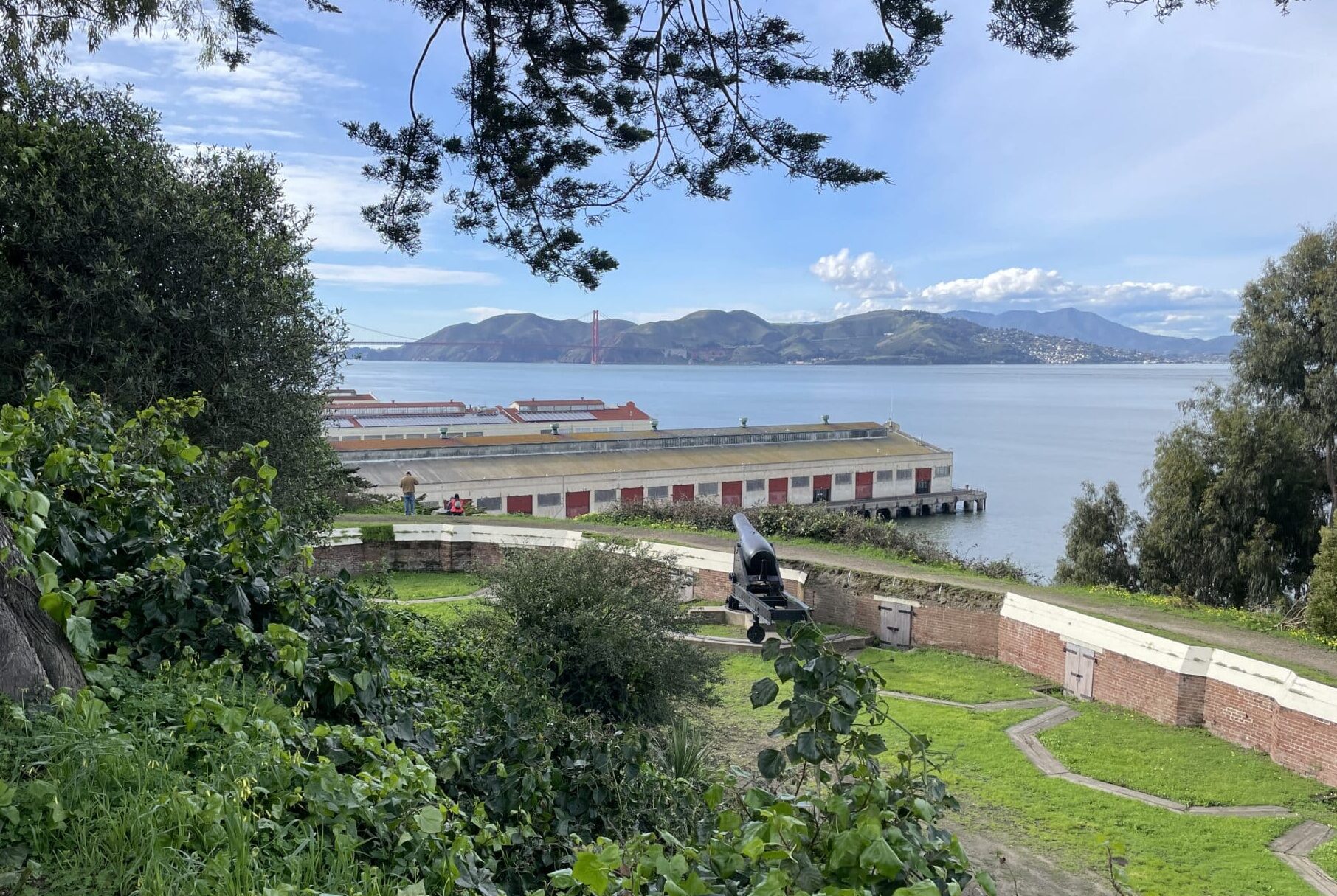
I thought after the three-part series I wrote on John C. Frémont that ran in late February, I had said what I needed to say about this important figure in both Civil War and Western history. Then, last week, I visited Fort Mason in San Francisco, where Frémont lived with his wife Jessie Benton Frémont during the years 1860-1861, and I decided one more post was in order.
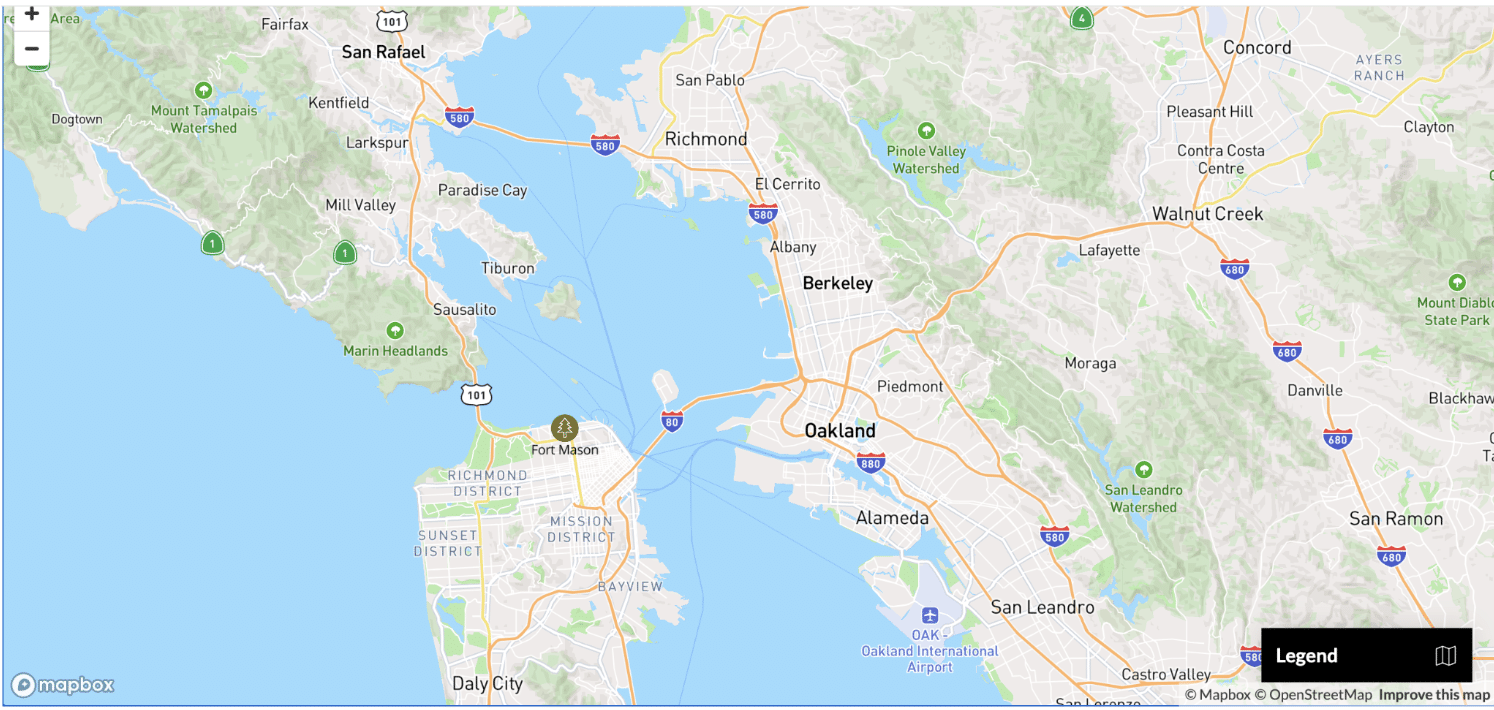
The Golden Gate National Recreation Area stretches across 80,000 acres north and south of the Golden Gate Bridge. It features 37 distinct park sites, among them Muir Woods National Monument, Fort Point National Historic Site, Alcatraz, and the Presidio of San Francisco. When I was there recently on a sunny afternoon, many families and individuals were out for walks, lounging on the Great Meadow, and taking in the gorgeous views. I met one young man who was sitting on a bench, his rented bike lying beside him, who said to me, “I can’t believe more people aren’t up here!”
When the Frémonts lived here, theirs was one of at least five large, privately-owned, civilian houses on the bluff, all occupied by prominent citizens. These houses were constructed in the 1850’s, facing the bay in order to enjoy the amazing panoramic views. Officially at the time named Point San Jose, locals called the bluff “Black Point” because of the bluff’s dark laurel trees and vegetation that contrasted with the surrounding lighter coastal scrub and sand dunes.
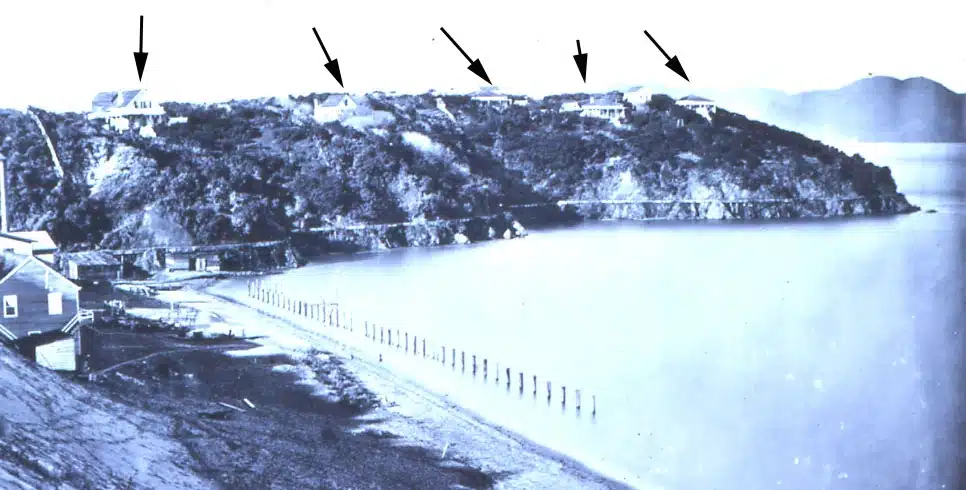
San Francisco’s population was bursting in the early 1850’s due to the Gold Rush, and housing was in short supply. As a result, “opportunistic real estate developers” saw the Point San Jose property as “scenic and underutilized … [and] exceptionally desirable,” and they soon began encouraging civilians to “[move] in and [claim] the land for their own.” [4]
By 1855, five large residences had been constructed, and “some of San Francisco’s most influential citizens moved into these elegant homes,” leading to Black Point becoming “a prestigious community of well-educated bankers, merchants, and literary figures,” many of whom were strongly committed to the anti-slavery movement. [5] One of those citizens was Leonidas Haskell, whose friend, the anti-slavery U.S. Senator David Broderick, died at his house after Broderick’s duel with pro-slavery Justice David Terry in 1859, just months before the Frémonts moved to San Francisco (see this June 2018 post by Meg Groeling).
Frémont was not the first owner of his house at Black Point. Following his defeat in the 1856 presidential campaign, he and his family had retreated to their ranch in Las Mariposas, near Yosemite in California (see Part III in my series on Fremont). By early 1860, however, Frémont “acced[ed] to Jessie’s request for more civilized surroundings … and purchased, in her name, a handsome house and thirteen acres at the tip of Black Point, an idyllic finger of land – more radiant, Jessie, said, than anything conjured by Tennyson – overlooking Alcatraz Island, on San Francisco Bay.” [6]
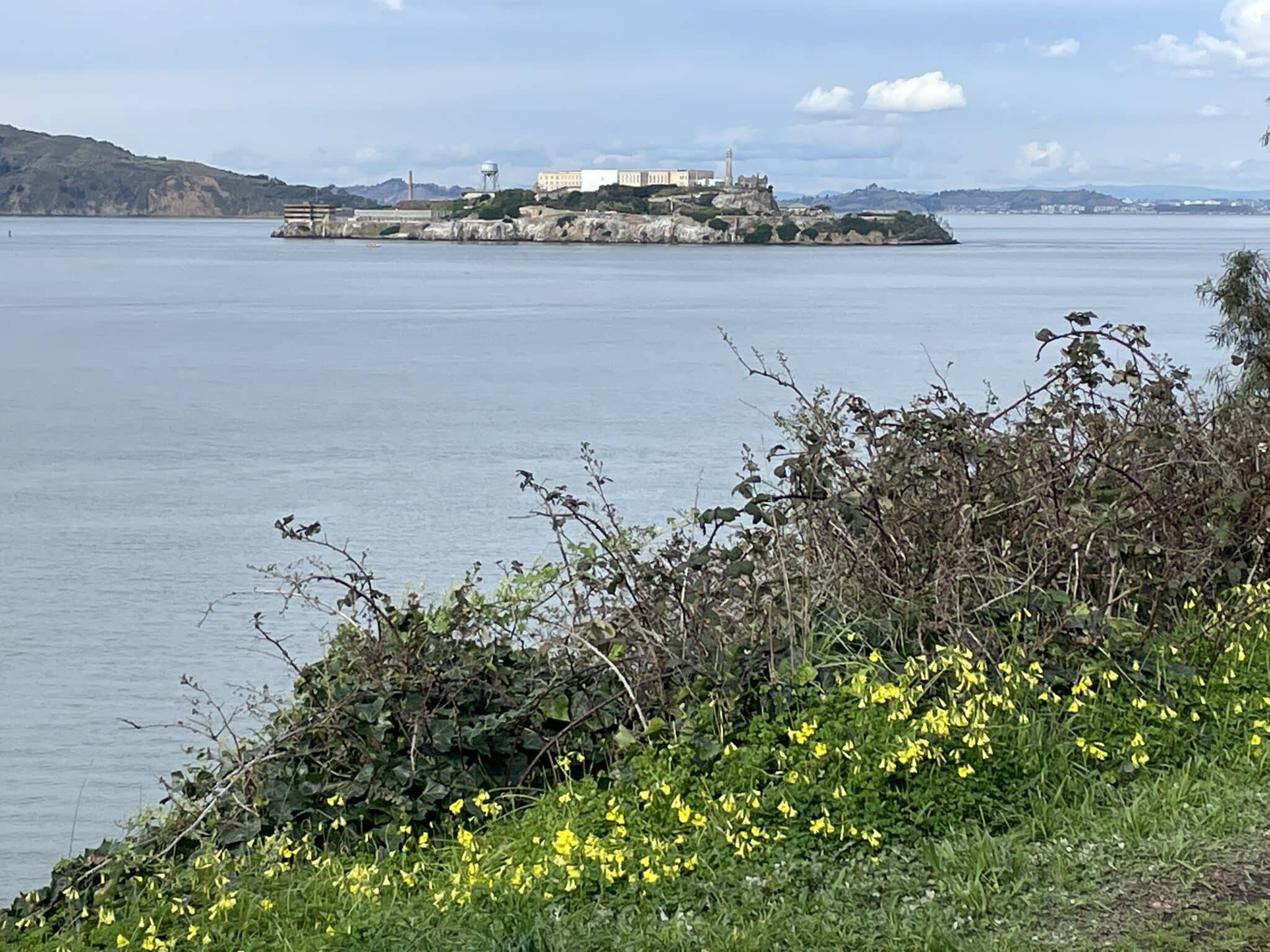
There, John and Jessie Frémont and their three surviving children settled into a brief period of domestic stability, with Frémont devoting more time to being a husband and father. Their house, nicknamed Porter’s Lodge, sat on the edge of the bluff, surrounded by rose bushes, fuschias, and garden paths. With her house at the tip of the point, surrounded on three sides by water and the sounds of crashing waves and fog horns, Jessie described it as “like being on the bow of a ship.” Alcatraz was so close, she reportedly called the lighthouse on the island her “nightlight.” [7]
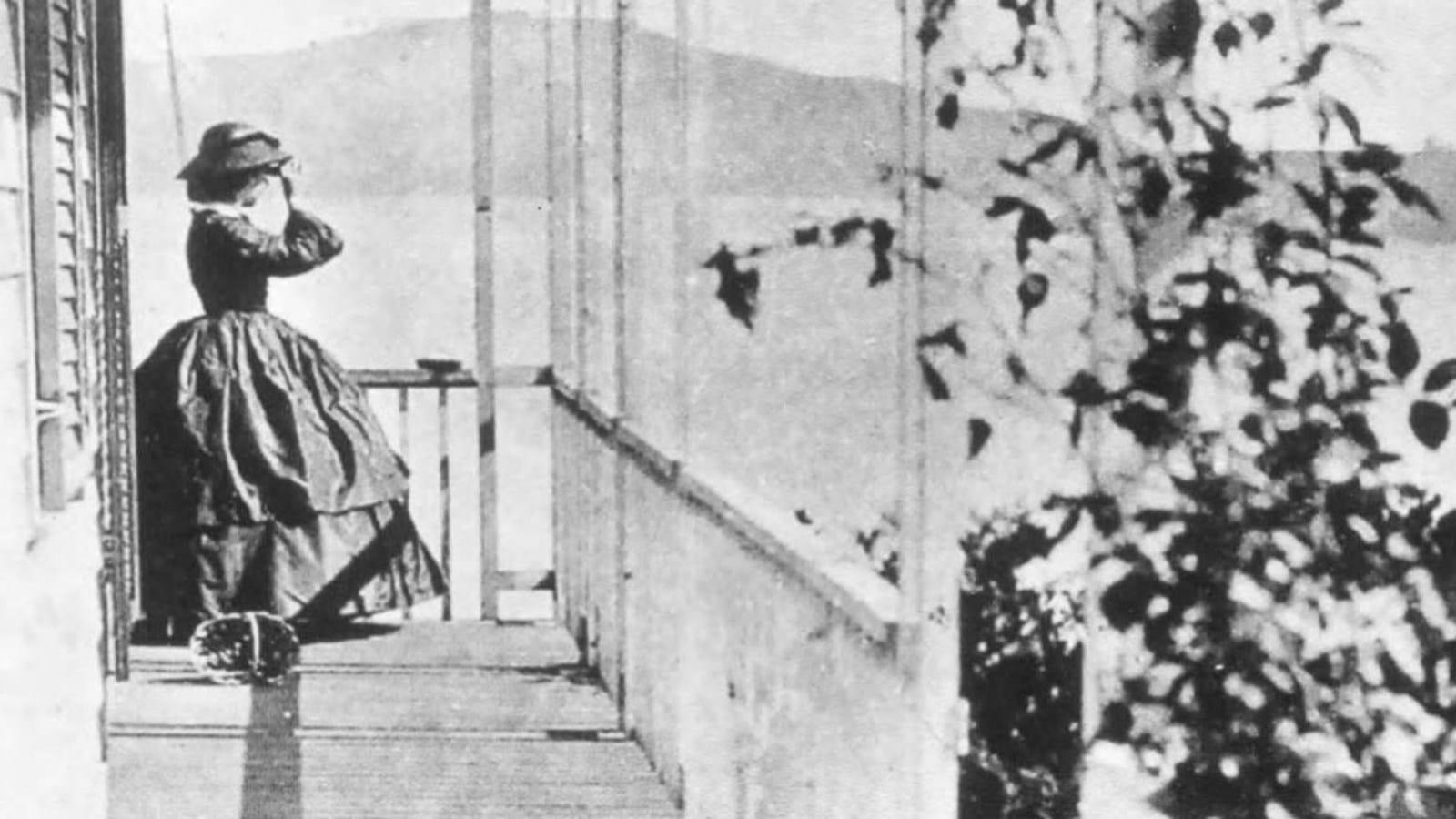
Photo circa 1860’s. NPS.
The couple had a clear view of the Golden Gate, which had been so named by Frémont when he first viewed it in July 1846. Gazing on the narrow strait that separates San Francisco Bay from the Pacific Ocean, two years before the discovery of gold in California, he said it was “a golden gate to trade with the Orient,” and later wrote, “To this Gate I gave the name of ‘Chrysopylae’ or ‘Golden Gate’ for the same reasons that the harbor of Byzantium was called Chrysoceras, or Golden Horn.” [8]
The Frémonts quickly became “the premier couple of California’s growing Anglo society,” savoring San Francisco’s opera life and exciting social scene. [9] They hosted a constant stream of writers, spiritual leaders, and artists to their home for lively, salon-style conversations that became the center of San Francisco’s intellectual life. [10]. Guests included authors Richard Henry Dana, Herman Melville, and Bret Harte; Unitarian and Universalist minister Thomas Starr King; Yosemite photographer Carleton Watkins; landscape architect and journalist Frederick Law Olmsted; newspaper editor Horace Greeley; politician Edward Baker; and Captain Israel Ward Raymond.
Often, since Frémont had to leave to attend to his property at Las Mariposas or other business, Jessie hosted these salons on her own, but she seemed to relish the opportunity. She “carved out her own special recognition as a bright, courageous, and ambitious woman at a time when these attributes were discouraged in women.” [11] Earlier, she had helped Frémont write his best-selling travel books about his expeditions, campaigned alongside him in 1856, advised him on many occasions, lobbied hard to eliminate slavery, and even gone to Washington, D.C. to argue on her husband’s behalf to President Lincoln in support of Frémont’s controversial Emancipation Proclamation (see Part II). Now, she pursued her own causes.
As mentioned above, Thomas Starr King was a regular visitor, and he was extremely influential in California politics during the Civil War. He “spoke zealously in favor of the Union and was credited by Abraham Lincoln with preventing California from becoming a separate republic. In addition, he organized the Pacific Branch of the United States Sanitary Commission, which cared for wounded soldiers and was the predecessor to the American Red Cross. A fiery orator, he raised more than $1.5 million for the Sanitary Commission headquarters in New York, one-fifth of the total contributions from all the states in the Union.” [12]
Jessie invited King to write many of his fiery abolitionist speeches in her home study, and the two of them sometimes hosted her salons together. [13] He preached against slavery, segregation, and the mistreatment of free blacks. Even after the Frémonts moved east, he and Jessie kept up a correspondence.
However, Jessie’s efforts went beyond abolition: “With this influential group of admirers and backers [including King, Watkins, Olmstead, and Raymond], Jessie formed what was to become one of the first and most effective conservation organizations in the country. Following Jessie’s lead, their lobbying efforts to Congress and President Lincoln resulted in the Yosemite Land Grant that preserved her beloved Yosemite Valley and Mariposa Grove of Big Trees from the encroachment and development. Jessie typically took little credit for this magnificent accomplishment, content to stay out of the glare of publicity,” with her role being “that of a catalyst and muse, prodding and encouraging (them) to write and speak.” [14]
The Yosemite Grant Act, signed by Lincoln on June 30, 1864, marked “the first time in history parkland was set aside by the federal government specifically for preservation and public use, creating a legacy for California and the nation.” [15]
The outbreak of the Civil War sparked significant changes at Black Point. The Frémonts moved to St. Louis, Missouri, where Frémont took on the role of Commander of the Department of the West (see Part II). Their neighbor and longtime friend, Leonidas Haskell, accompanied them to serve as Frémont’s chief of staff. During their absence, and amidst “worrisome rumors of Confederate warships lurking in Pacific waters, preying on California gold shipments,” the military laid claim to Point San Jose for defense purposes.
Soon, “Army officials called for construction of a new fortification at Black Point, to supplement the two recently completed fortresses at Alcatraz Island and Fort Point. On October 13, 1863, the military took formal possession of Black Point, reestablishing the area’s original name, Point San Jose. The army constructed two batteries at the northern tip of the point, destroying Frémont’s house in the process. By May of 1864, construction was complete and soon the West Battery mounted six 10-inch Rodman cannons, while the East Battery held six 42-pound rifles. To accommodate the new officers and soldiers, the military constructed a post headquarters, hospital and barracks, clustered around a rectangular main parade ground.” [16]
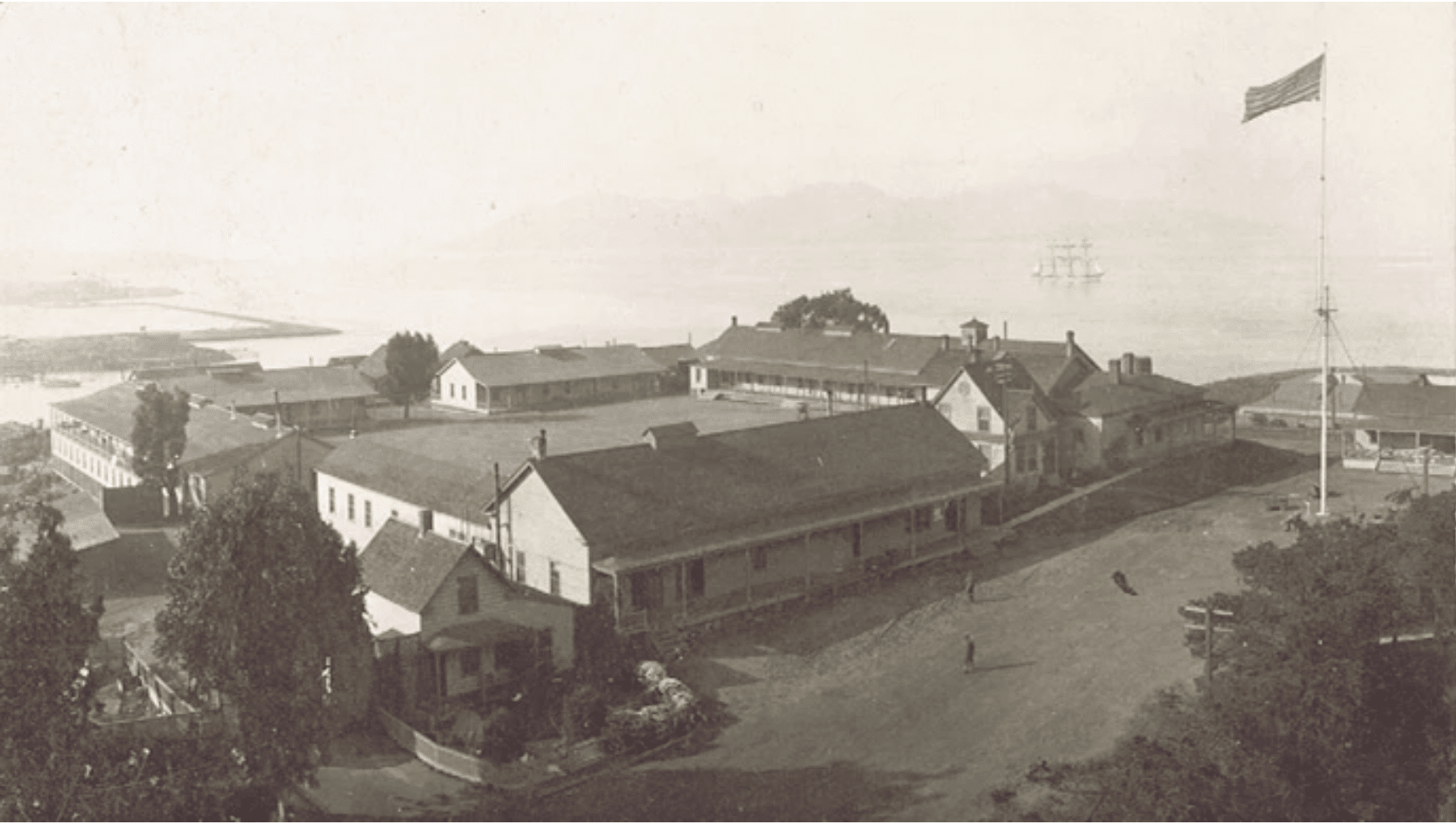
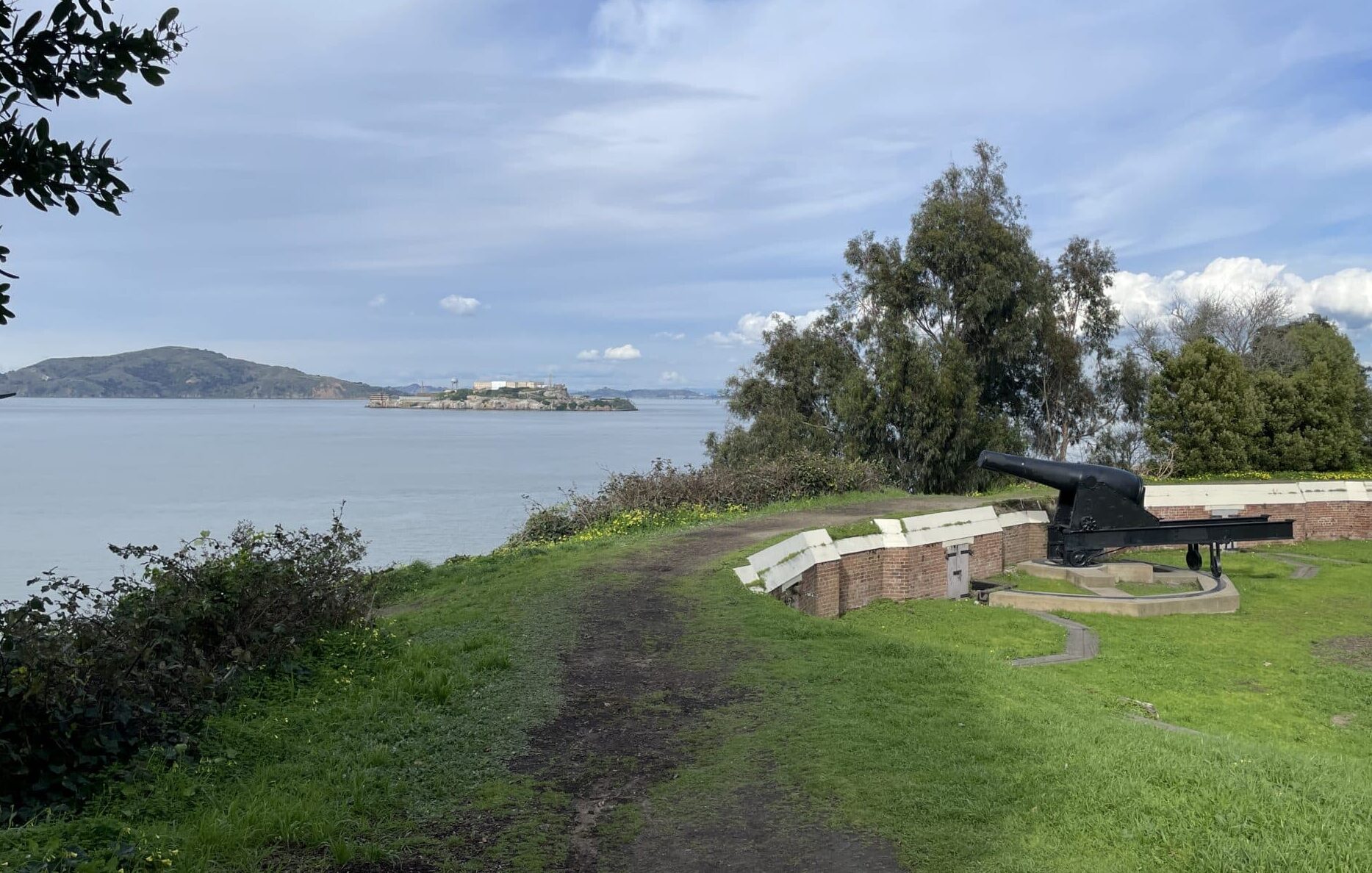
Seeing Halleck’s name surprised me. I knew Frémont and Halleck had clashed in Missouri over both policies and leadership styles, and that Halleck had replaced Frémont as Commander of the Department of the West in Missouri after Frémont had been “relieved of his command” by Lincoln due to alleged incompetence. But what must Frémont have thought when he learned Halleck had ordered his house to be demolished?
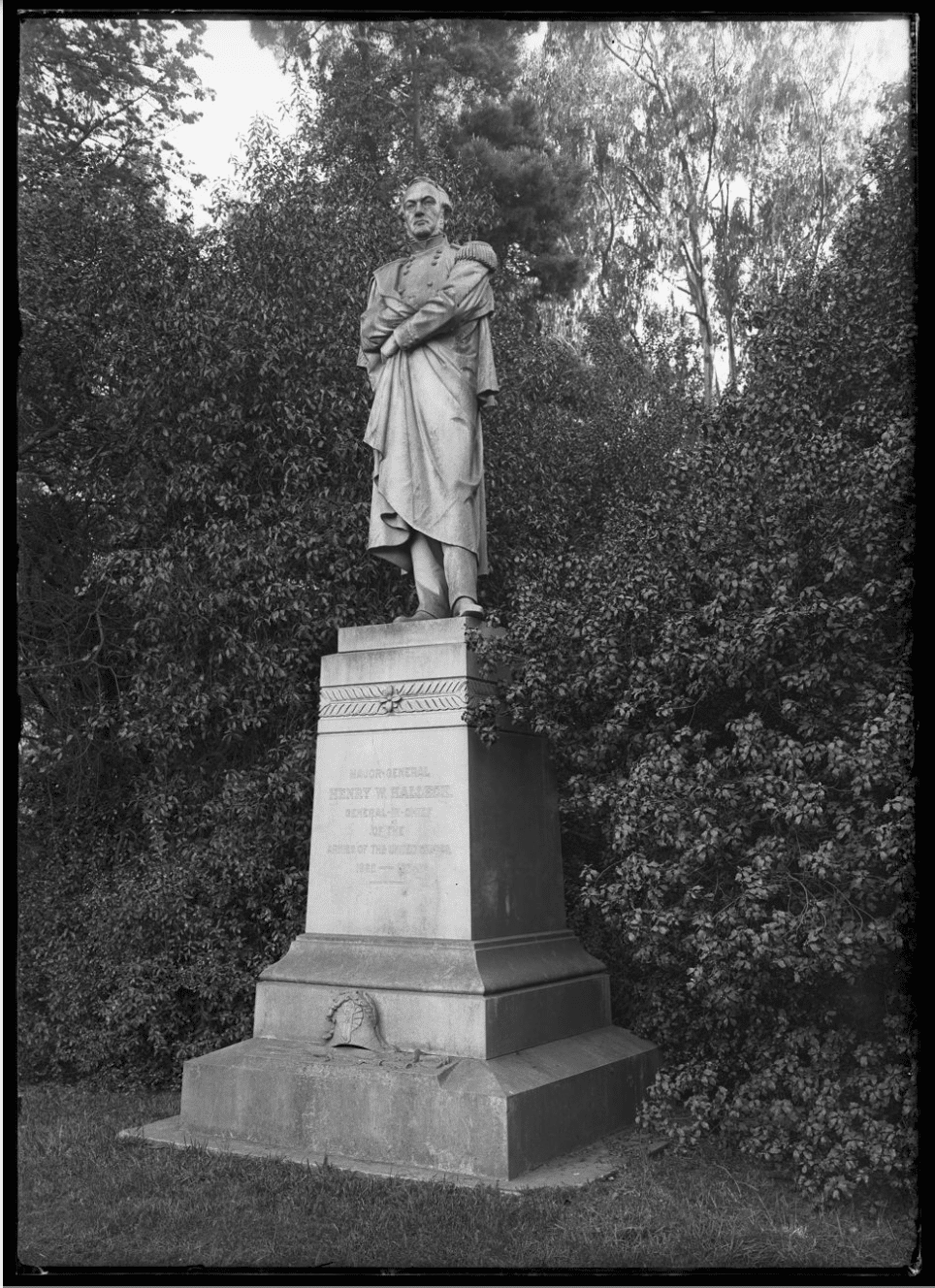
Previously, I did not know the role Halleck had played in California’s history. Following the Mexican-American War, Halleck “became secretary of state of newly-annexed California, helped draft the state’s constitution, and established a law firm in San Francisco. Halleck married Elizabeth Hamilton – Alexander Hamilton’s granddaughter – in 1854 and resigned from the army to devote himself full-time to his lucrative legal activities. Halleck, Peachy and Billings was one of the most prominent law partnerships in the state, and Halleck further added to his personal fortune through land speculation and a stint as president of the Atlantic & Pacific Railroad. He was also a major general of the California militia.” [19] His statue now stands across from the Conservatory of Flowers in Golden Gate Park in San Francisco. For all the times I’ve been there, I’m not sure I’ve ever noticed it. I’ll have to check it out the next time I’m there.
At Fort Mason today, three of those 1850’s civilian, pre-Civil War homes still stand. Haskell’s house is one of them. Confiscated by the Union Army in 1863 to serve as officer housing, it continued to be used as a residence for high-ranking military officials for decades. It also served as part of the post headquarters and was used for military social functions. Today it is used as a private residence, but is still considered part of the Golden Gate National Recreation Area.
I didn’t have to search long before I found a signboard telling me about John and Jessie Frémont, whose house stood on the bluff below. The sign was intentionally scratched up, perhaps because it specifically noted Frémont’s treatment of indigenous people in California. As the sign points out, the nation’s “Manifest Destiny” fervor, seeking a coast-to-coast empire, resulted in the eradication of the lives and cultures of indigenous peoples across this continent. Frémont played a big role in that tragic reality, both in his role as “The Pathfinder,” exploring and mapping the Oregon Trail that brought hundreds of thousands of settlers west, as well as through his direct actions: “During his expeditions, Frémont was responsible for the brutal killing of native peoples, including the slaughter of up to 1,000 Wintu people in the Sacramento area in 1846.” [22]
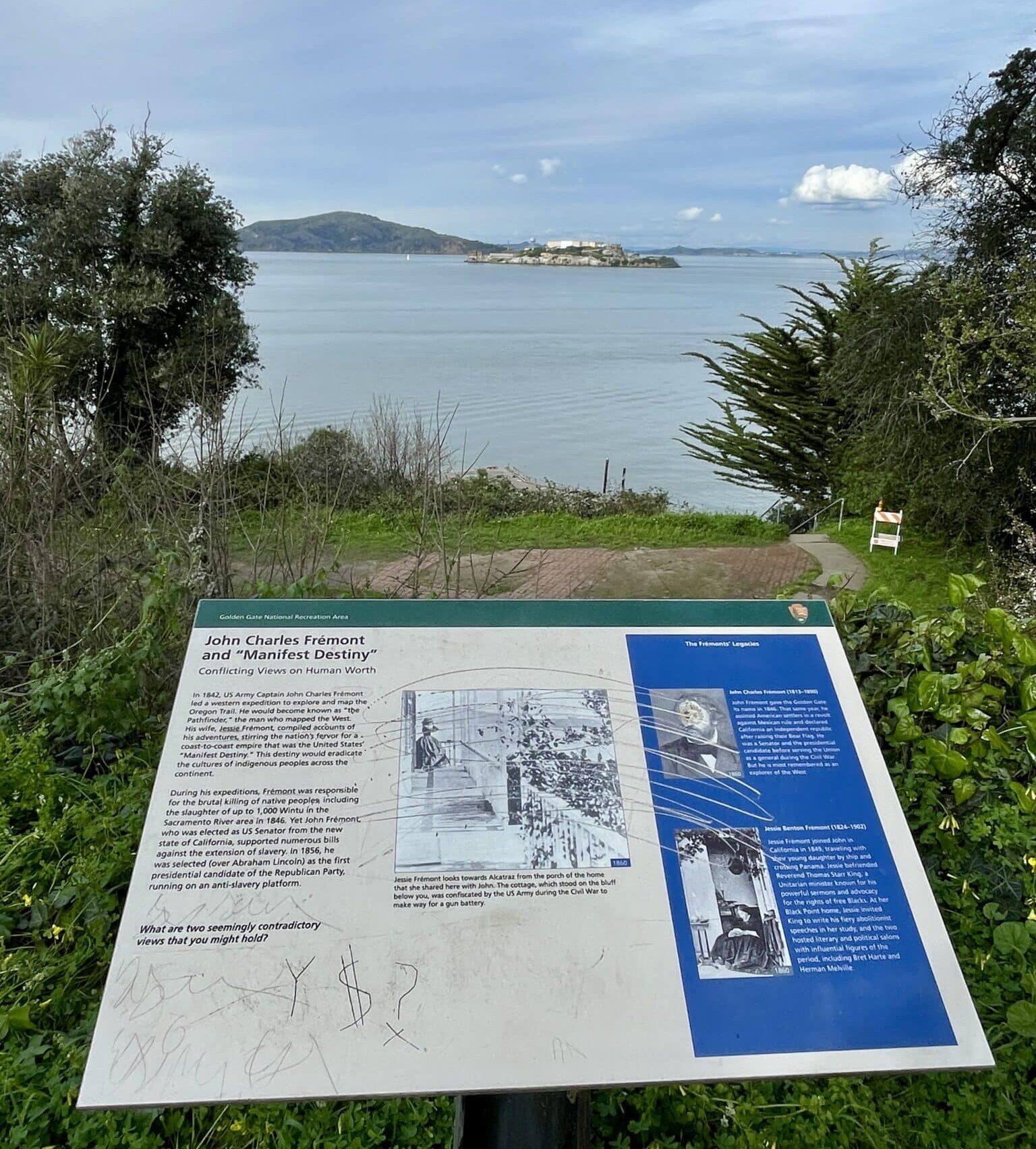
I find Frémont’s treatment of Native Americans hard to reconcile with his anti-slavery views; but then again, many officers from the Union Army who helped bring an end to slavery in this country later participated in the brutal Indian Wars of the later 1800s. Living in California, THAT is a history that is impossible to ignore – and, it should not be ignored. Fort Mason itself sits on land that once belonged to the Ramaytush Ohlone and Coast Miwok peoples, who lived in small independent villages across the San Francisco Bay Area. It was the arrival of the Spaniards that first disturbed that lifestyle.
Prior to the European takeover of the area, “the San Francisco coast was a wetland ecosystem, stewarded by the Ramaytush Ohlone people. Their land management practices significantly shaped the Bay’s ecosystems. The Ramaytush Ohlone used wetlands to harvest fish and shellfish, hunt waterfowl, collect medicine, and build shelter while ensuring ecological diversity and systems continued to thrive. Through cultural burning, the Ramaytush Ohlone managed wetlands to create open spaces for hunting, promote vegetation growth, and reduce the risk of severe wildfires. They also supported the natural salt ponds in the Bay which they utilized for salt collection and trade.” [23]
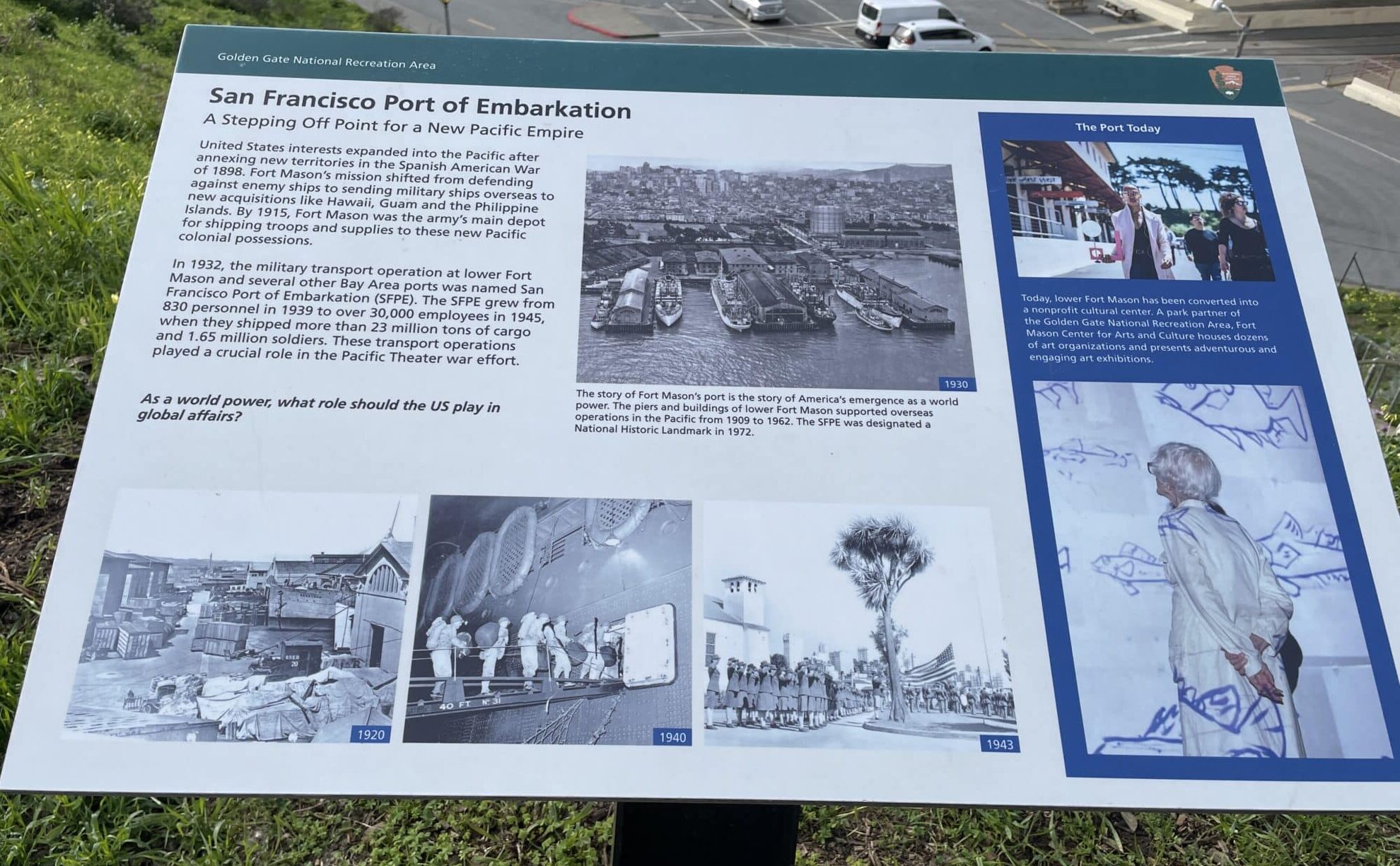
It was not until 1882 that the fortification at Point San Jose was christened “Fort Mason,” named after Col. Richard Barnes Mason, a former military governor of California. The fort took on increasing importance in the ensuing years. As explained on this sign: “United States interests expanded into the Pacific after annexing new territories in the Spanish American War of 1898. Fort Mason’s mission shifted from defending against enemy ships to sending military ships overseas to new acquisitions like Hawaii, Guam, and the Philippine Islands. By 1915, Fort Mason was the army’s main depot for shipping troops and supplies to these new Pacific colonial possessions. In 1932, the military transport operation at lower Fort Mason and several other Bay area ports was named San Francisco Port of Embarkation (SFPE). The SFPE grew from 830 personnel in 1939 to over 30,000 employees in 1945, when they shipped more than 23 million tons of cargo and 1.65 million soldiers. These transport operations played a crucial role in the Pacific Theater war effort.” [24]
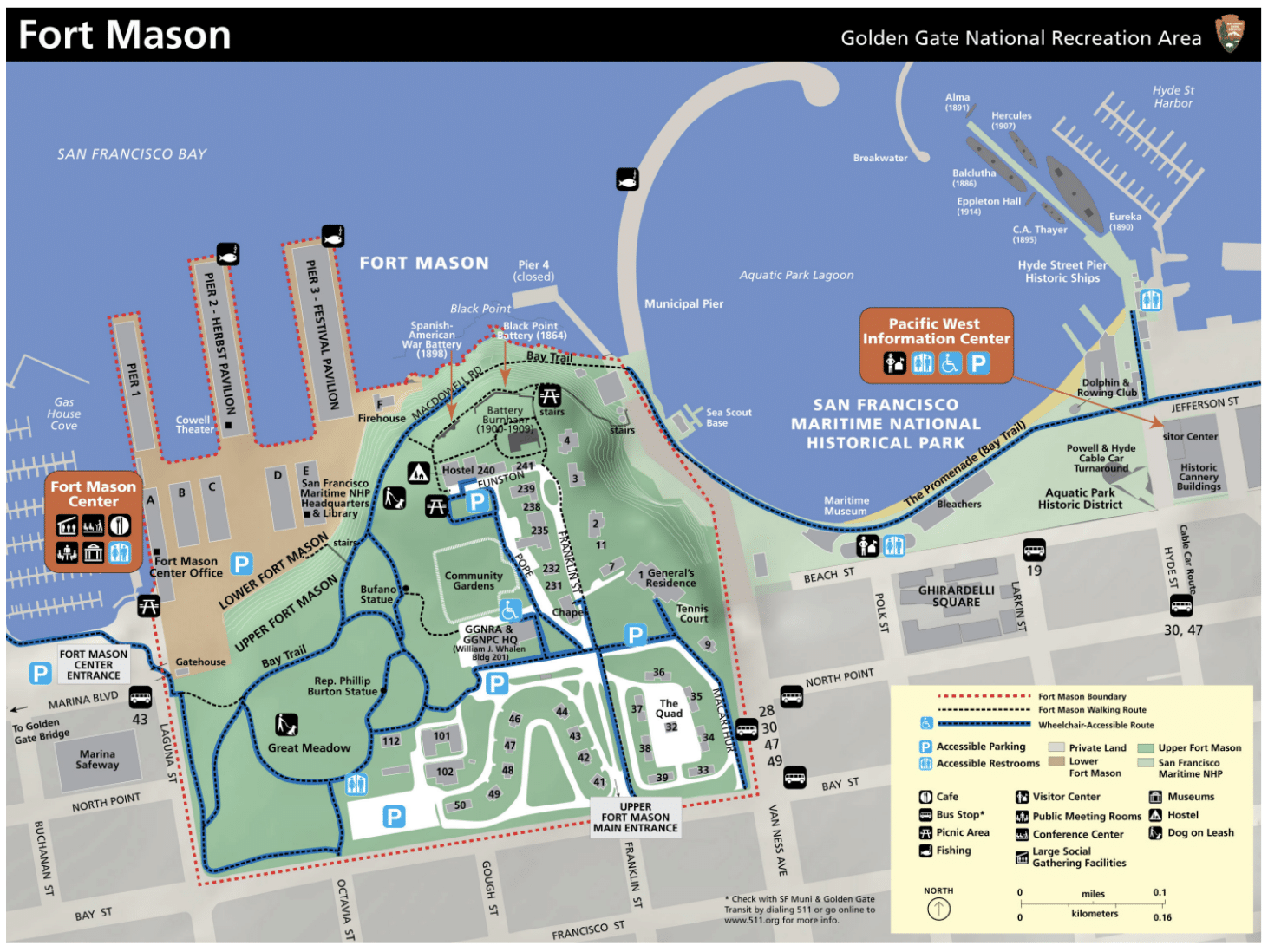
The map below shows modern-day Fort Mason. The Lower Fort Mason section, now known as the Fort Mason Center for Arts & Culture, houses theaters, museums, restaurants, and non-profit organizations. Black Point appears in the Upper section. The arrow pointing to the “Black Point Battery” is pointing to the bluff on which the Fremonts lived. The San Francisco Bay Trail that now runs through the property includes 350 miles of trails that circle the Bay, accessible to hikers, joggers, bicyclists, skaters and wheelchair users. The old military buildings on the west side have been removed, making way for the Great Meadow, which many visitors use for picnicking, sunbathing, walking, or sports activities.
San Francisco is a city with a lot to offer, and I’m glad I finally got the opportunity to explore Fort Mason. During the short time John and Jessie Frémont lived here, they enjoyed their life together, made some interesting and influential friends, and played a role in helping to keep California in the Union, to fight for abolition, and to preserve the beauty of Yosemite for future generations.
End Notes
- “Fort Mason.” Gold Gate National Parks Conservancy, California, 2026, https://www.parksconservancy.org/parks/fort-mason.
- Fort Mason – Civilian Neighborhood at Black Point.” Golden Gate National Recreation Area, California, National Park Service, https://www.nps.gov/goga/learn/historyculture/fort-mason.htm.
- “Civil War at Fort Mason – Point San Jose.” Golden Gate National Recreation Area, California, National Park Service, https://www.nps.gov/goga/learn/historyculture/civil-war-at-fort-mason.htm
- “Black Point: A Civilian Neighborhood in Military Land.” Golden Gate National Recreation Area, California, National Park Service, https://www.nps.gov/places/000/-black-point-a-civilian-neighborhood-on-military-land.htm
- Ibid.
- Chaffin, Tom. Pathfinder: John Charles Frémont and the Course of American Empire. Hill and Wang, 2002, pg. 452.
- “The Frémonts at Black Point.” Rosamund Press, 11 Sept 2011, https://rosamondpress.com/2011/09/11/the-fremonts-at-black-point/.
- “What’s In a Name – The Golden Gate? – Statistics & Data | Golden Gate.” Golden Gate Bridge, Highway and Transportation District, https://www.goldengate.org/bridge/history-research/statistics-data/whats-in-a-name/.
- Chaffin, Tom. Pathfinder: John Charles Frémont and the Course of American Empire. Hill and Wang, 2002, pg. 453
- “Jessie Benton Frémont.” Golden Gate National Recreation Area, California, National Park Service, https://www.nps.gov/places/000/jessie-benton-fremont.htm.
- NPS (need to find)
- “Jessie Benton Frémont Papers, 1860-1861.” The Society of California Pioneers, Online Archive of California, University of California, https://oac.cdlib.org/findaid/static/ark:/13030/c800048r.
- “Jessie Benton Frémont (1824-1902).” Display Board, Fort Mason, Golden Gate National Recreation Area, San Francisco, CA.
- Duree, Richard Duree. “Jesse Benton Frémont.” Phantomranch.net, https://www.phantomranch.net/bwestern/DureeArticles/jesse_benton_freemont_duree.htm.
- “Walking in the Footsteps of Presidents in California’s State Parks.” California State Parks, 14 Feb 2025, https://castateparks.wordpress.com/2025/02/14/walking-in-the-footsteps-of-presidents-in-californias-state-parks/.
- “Civil War at Fort Mason – Point San Jose.” Golden Gate National Recreation Area, California, National Park Service, https://www.nps.gov/goga/learn/historyculture/civil-war-at-fort-mason.htm.
- Ibid.
- “Black Point Fortifications (1797-1909): Defending from an Enemy that Never Came.” Photo by Tonya McQuade, Golden Gate National Recreation Area, San Francisco, CA. 20 Feb 2026.
- “Henry W. Halleck.” American Battlefield Trust, https://www.battlefields.org/learn/biographies/henry-w-halleck.
- “Statue of General Henry Wager Halleck, Golden Gate Park, San Francisco.” California Revealed, City of Richmond Photographic Collection, 2023, https://californiarevealed.org/do/04cf2153-e628-4f1e-a85e-1bca1b615574#page/1.
- “The Frémonts at Black Point.” Rosamund Press, 11 Sept 2011, https://rosamondpress.com/2011/09/11/the-fremonts-at-black-point/.
- “John Charles Frémont and Manifest Destiny: Conflicting Views on Human Worth.” Photo by Tonya McQuade, Display Board, Fort Mason, Golden Gate National Recreation Area, San Francisco, CA. 20 Feb 2026.
- Hanley, Morgane. “A Brief History of Fort Mason.” Environment for the Americas, 6 July 2024, https://environmentamericas.org/2024/07/06/a-brief-history-of-fort-mason/.
- “San Francisco Port of Embarkation: A Stepping Off Point for a New Pacific Empire.” Photo by Tonya McQuade, Fort Mason, Golden Gate National Recreation Area, San Francisco, CA. 20 Feb 2026.
- “Map of Fort Mason Area.” Golden Gate National Recreation Area, California, National Park Service, https://www.nps.gov/goga/planyourvisit/upload/foma-map-2017-508.pdf.


As the most exhaustive exposé in recent memory regarding California icon John C. Frémont comes to its conclusion, there is only one question remaining to be answered: “Did he surf?”
Lol. Now THAT I have not found any evidence of in my travels or research.
Surfing aside, it seems to me that our boy John received strong support and motivation from Jessie. They certainly led a highly active life. Your series was most interesting and informative.
Thanks! Glad you enjoyed it. It was certainly interesting doing the research.