Eyewitness to the 1862-1863 Dakota Wars: The Letters of John Wesley Moore (Part II)
Part I of this post recounted the experiences of John Wesley Moore, 7th Minnesota Regiment, as he participated in the 1862 fighting against the Natives Americans known as the Dakotas, including its bloody aftermath of mass executions. This post picks up with Moore’s participation in the 1863 punitive expedition launched after fighting resumed in the new year.[1]
Moore begins the story of his new experiences by stating that after picking up supplies and the regiment’s Company D from Fort Abercombie (in what is now North Dakata),[2] “we took up our line of march to find our savage foe.” Marching 6-7 hours a day for an average of 15 miles daily, on July 13 his force camped by three small lakes “with any amount of large frogs which we had a meal or two of.” Moore did not comment on the taste of frog, but described a pretty country, with many lakes and “quite a show of animals & birds” (“Elks. Eagles. Wolves. Cranes. Swans”). Some of his comrades caught a grey wolf. Moore saw his first buffalo. While he apparently did not manage to dine on that animal, he reported eating elk meat.
Excitement followed only days later with the capture of Wowinape, the 14-year-old son of Chief Little Crow, who recently had been killed during a raid into Minnesota. Moore wrote that Wowinape had been wounded in the same raid, then injured again when a wolf “bit his heel that made him lame.” The boy had his father’s gun, and “says he wants to kill one more white man in revenge for the killing of his father then he don’t care what they do with him… He says he knows what we are going to do with him that is to take him to St. Paul and hang him.”[3]
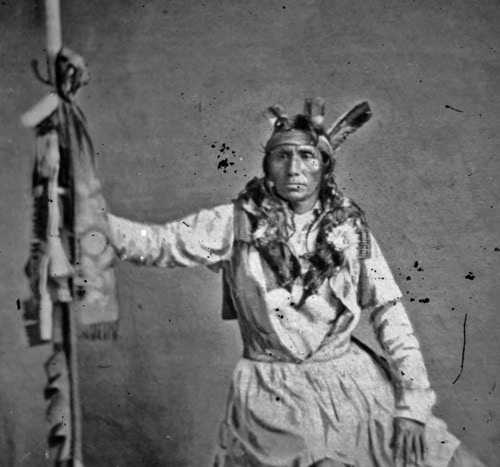
On July 20, Moore described camping near a “half breeds camp,” commenting “They are almost as white as we are (especially the females, and some are pretty considering).” Moore also reported seeing “the little boy who Little crow took & the priest who bought him of Little crow.”
That boy, George Washington Ingalls, was 9 years old when taken captive. Ingalls later claimed that he was not killed due to his red hair, “because the warrior who took him was fascinated with it. And that the color was sacred to the Dakota.”[4]
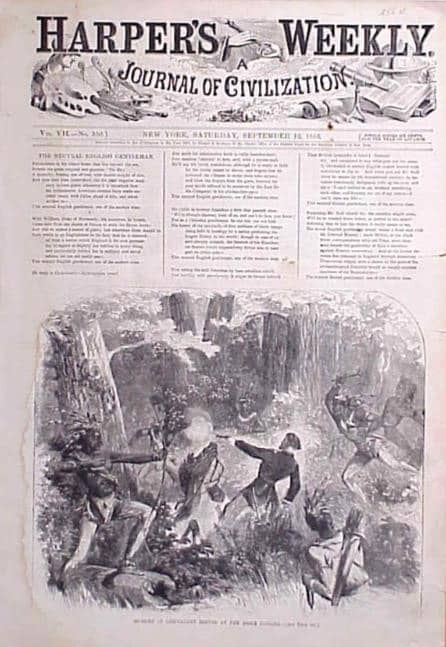
On July 26 Moore’s column caught sight of an “Indian train ahead,” but could not catch them. That same night, however, “the Redskins made a bold charge” in an attempt to cut off an isolated group of soldiers. Fortunately, “a Co of cavalry was in a small ravine between they fronted them & drove them back supported by part of the 6th Regt.”
The victory was not without price. Moore recounted that “one of our men was wounded who has since died and was buried one cold stormy night just after dark. Twas mournful to hear the long roll of the muffled drums and the clear whistle of the sharp toned fifes. Such is a soldiers life.”
Two days later, the natives again attacked in the morning, but again were driven off, the U.S. soldiers “killing 5 or 6 & captured one” with no loss to themselves. Later that evening, a “scout killed two who were skulking in the grass after dark.”
Moore’s brief description only captured a small part of the fighting on the 28th. Perhaps after hearing of others’ knowledge of the overall engagement, he elaborated on the day’s events in another part of his letter that appears to be labeled “2nd 28th.”
“We halted about 11 the Scouts brought news that Indians camp was ahead. We kraaled our train and intrenched. Our scouts said indians would be ready in a little while. They soon attacked us we deployed skirmishers & chased after them till 10 oclock at night. Cavalry & artillery went further. I don[’t] not know how many of the Redskins were killed. 4 of our men were killed. 1 surgeon of 10th Regt. 1 Lieut of cavalry. 1 private of cavalry & 1 killed by lightning. I believe 7 bodies of Indians were found & they carried a great many off in their retreat.” Cannon fire caused the Indians to drop much dried buffalo meat, which the soldiers appreciated since they had had nothing since breakfast.
Moore’s force had advanced well beyond the camp that had been established by the rest of the expedition. They started back in darkness. His description of the difficulties of finding their way is interesting in that Moore mentions that the base force was equipped with signal rockets.
“Well we started back for camp at ½ past 10 twas very dark…” They became lost. The men fired a cannon three times; no reply. “[S]o we kept traveling and about daylight we saw 2 rockets go up a way to our left. We followed in the direction and arrived in camp about 7 oclock next morning.”
With the force reunited the pursuit resumed. The pressing U.S. troops fired at natives in the distance. On the 29th, Moore’s column reached the Missouri River, overtaking the hostiles and in the process forcing them to abandon their wagons, an observation that belies the stereotype of Native Americans travelng fast with minimal baggage. Moore described how the Dakota were forced from their supply wagons. “The artillery fired a few shots at them which made them skedaddle up the Bluff. The Indians fired a few shots but did us no damage. Some fell short. Our boys returned the fire which made them leave the bushes along the shore.”
The next night the Dakota struck back with fire, literally: “Long role was beat in night. Men turned out… the indians tried to burn us out by setting the old grass afire.” The attempt failed to cause any harm.
That does not mean that the Dakota did not draw blood. In his July 30 entry, Moore began with: “Shelling the woods so we can find Lieut Beaver volunteer aid to Gen Sibley a rich Englishman and a private of Co K 6 Regt who are missing. This Englishman was traveling for pleasure and did not want any pay. He has been all over the world & on a great many expeditions but is now lost.”
Indeed, 2nd Lieutenant Frederick J. Holt Beaver’s world-wide travels ended in the North Dakota wilderness. Moore added the distressing news to his July 30 record. “Troops returned after dark with the 2 bodies. Beaver was shot with two arrows & a bullet. His horse also was shot.” The next day, “[t]he 2 bodies were buried with military honors.”
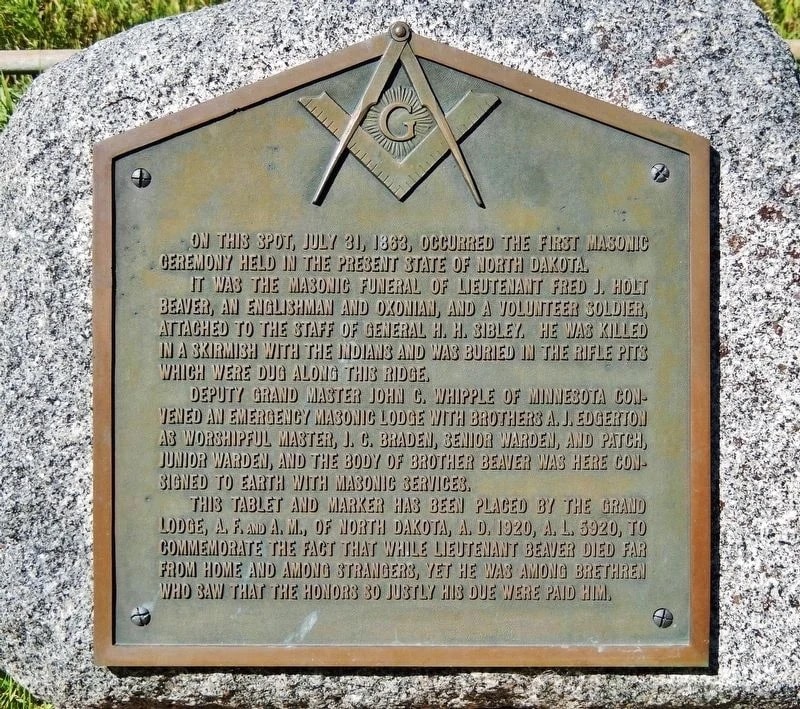
Moore did not mention one interesting aspect of Beaver’s interment. Beaver was a Mason, as were several other members of the expedition. These conducted for Beaver the first Masonic Ceremony held in the territory. The site of the burial and ceremony, near modern-day Bismark, is commemorated by a Masonic tablet.[5]
That same day, the Punitive Expedition came to a close. Moore explained, “We could not follow them any further twas dangerous to cross the river,” but declared the mission a success. “[W]e had killed from 120 to 150 had found 44 of the bodies. We have lost about 6 killed & 4 or 5 wounded on our side.”
Before departing, the troops destroyed the Dakota’s supply train. “The pioneer guards broke and cut up about 125 or 130 carts and wagons some almost new worth as high as $75 or $80. Every spoke was out.” That night brought a last attempt against the column, a volley that “hurt no one [but] killed a mule.”
Clearly happy to end the campaign, Moore wrote, “August 1st 1863. Homeward Bound Started for Camp Atchison” (emphasis in original).[6] Shrugging off a final Dakota display of defiance—“Indians crossed river & fired into rear of our train but done no damage”—Moore and his comrades reached the camp on August 10.
Moore’s last entry in his long August 16 letter to his sister is dated August 12. Moore had heard that the government was offering “402 dollars bounty for men to reenlist.” Moore concludes with “all the boys talk of reenlisting again which probably I will do too.”
Moore did reenlist. His subsequent service would be marked not only with fighting, but a variety of novel experiences the inveterate letter writer would describe in further correspondence. These included enjoying Laura Keene on stage (Abraham Lincoln would watch her at Ford’s Theatre in Our American Cousin), seeing P.T. Barnum’s famous Tom Thumb, attending a circus (“saw a Gorilla and 2 large kangaroos”), and eating lots of oysters. But, these incidents must await a future blog post.
[1] The following descriptions and quotes all are from Moore’s August 16, 1863 letter from “Camp Stevens, Dacota [sic] plains” to “Dear Sister Mary.” All of the Moore correspondence cited in these Posts is from Moore Brothers Civil War Letters and Papers, Identifier: MSS 16441, Albert and Shirley Small Special Collections Library, University of Virginia. Original spelling and punctuation have been preserved.
[2] Fort Abercombie State Historic Site, State Historical Society of North Dakota, https://www.history.nd.gov/historicsites/abercrombie/index.html.
Moore’s reference in his letter to “Fort” presumably meant Fort Abercrombie, as Company D was stationed there until July 1863. See Union Minnesota Volunteers, 7th Regiment, Minnesota Infantry, National Park Service, https://www.nps.gov/civilwar/search-battle-units-detail.htm?battleUnitCode=UMN0007RI.
[3] Wowinape survived. Changing his name to Thomas Wakeman, in 1879 he organized the first Sioux Indian YMCA. The History of the General Convention of Sioux YMCAs, https://web.archive.org/web/20080128033154/http://www.siouxymca.org/history.htm; Famous Native Minnesotans, Little Crow, https://web.archive.org/web/20090126230952/http://www.mnsu.edu/emuseum/history/mncultures/littlecrow.html.
[4] R. Sjolseth, “Blood Relatives on Both Sides – Another Ingalls,” The U.S.-Dakota War of 1862, Minnesota Historical Society, https://www.usdakotawar.org/stories/share-your-story/2763.
[5] “2nd LT Frederick J. Holt Beaver; First Masonic Ceremony Held in the Present State of North Dakota, July 31, 1863,” The Historical Marker Database, https://www.hmdb.org/m.asp?m=234899; Find-A-Grave, Rev. Frederick John Holt Beever, https://www.findagrave.com/memorial/34220335/frederick-john_holt-beever.
[6] Camp Atchison, two and one-half miles south of Binford, North Dakota, served as a base for the 1863 expedition. Camp Atchison State Historic Site, State Historical Society of North Dakota, https://www.history.nd.gov/historicsites/sibleysully/atchison.html.


