Book Review: The Buried Cause: Unearthing Hidden History in the Lee Monument Cornerstone

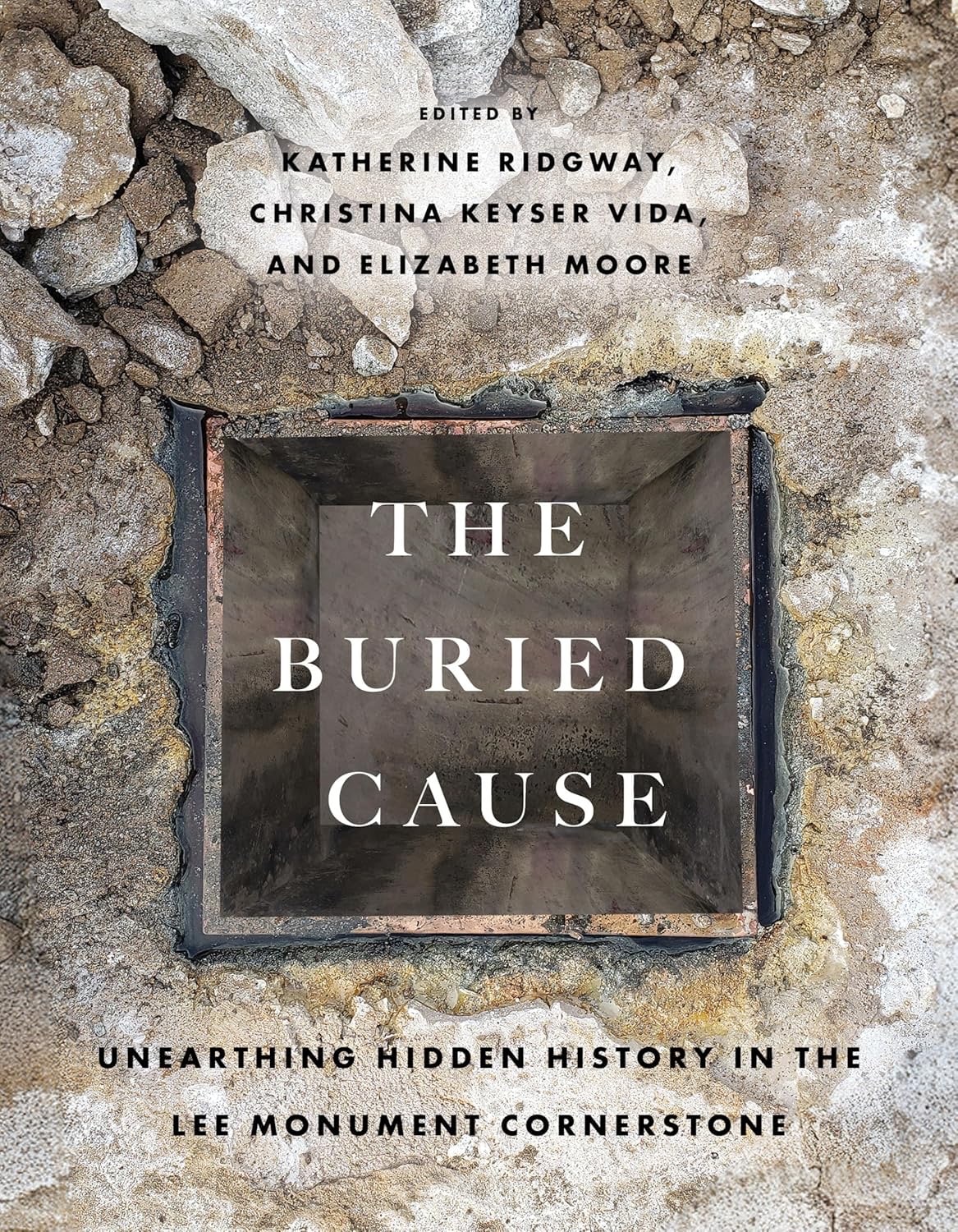
The Buried Cause: Unearthing Hidden History in the Lee Monument Cornerstone. Edited by Katherine Ridgway, Christina Keyser Vida, and Elizabeth Moore. Charlottesville: University of Virginia Press, 2026. Softcover, 238 pp. $24.95.
Reviewed by M. A. Kleen
The 12-ton, 60-foot-tall bronze equestrian statue of Robert E. Lee on Monument Avenue in Richmond, Virginia, was sculpted by French artist Jean Antonin Mercié and unveiled in 1890 as the city’s first and largest Confederate monument. Following a series of legal battles, the state removed it on September 8, 2021 after extensive vandalism during the 2020 protests. It was the last major Confederate monument to come down on the avenue.
After construction workers removed the 131-year-old monument’s cornerstone, they uncovered a large time capsule containing 71 waterlogged objects that had lain undisturbed since 1887. Conservators from Virginia’s Department of Historic Resources carefully removed and cataloged the contents. While the existence of the time capsule had been known, the box and its contents were unexpectedly different from what contemporary newspapers described.
The Buried Cause is part autopsy (of Lee, his legacy, the Confederacy, its monuments, and the “Lost Cause”) and part polemic, as well as an attempt to explain the context surrounding Monument Avenue, the Lee statue, and the items placed in its cornerstone. Most chapters are self-contained essays on a single object selected for inclusion in the time capsule, written by an archaeologist, archivist, or professor. Others examine the history and context of the monument itself.
The work is divided into three sections: General Monument Avenue, Life and Times, and Militariana. The first covers the history and background of the Lee monument. The second examines civilian items such as photos, books, and newspapers. The third focuses on military artifacts, including buttons, badges, and muster rolls.
Hidden behind the authors’ thinly veiled contempt for their subject are genuinely interesting snapshots of turn-of-the-century Richmond and a public coming to grips with the aftermath of a cataclysmic war.
The chapter titled “Where Are the Women?” offers a thought-provoking perspective on the capsule’s contents, examining the role women’s associations played in erecting the monument. The author speculates that a bitter rivalry between former Confederate general Jubal Early and the Ladies’ Lee Monument Committee (LLMC) led to the lack of female representation among the items placed inside.
In this case, it is what is missing that draws attention, and the resulting history is as fascinating as it is essential to understanding the Lee monument’s very existence. It was the LLMC, after all, that selected the sculptor Mercié and his design over the bitter objections of Early himself.
Militariana is this reviewer’s favorite section because it contains, for the most part, unvarnished military history and the least amount of pontification. The chapter on the Confederate naval button, in particular, stands out as a fine example of what the book might have been had it adopted a more straightforward, less judgmental tone.
The introductory author’s assertion that “monuments do not teach history” (6), in a book devoted to all the things we can learn from the Lee monument, is just one example of the tension between the objective of the work and its controversial subject.
I found the contributors’ framing and use of academic jargon in the first two sections a distraction that obscures what might otherwise have been an interesting exploration of the artifacts and their context. Like the post-mortem prosecutors of Pope Formosus, some of them seem a little too eager to make their deep hostility toward Robert E. Lee known.
That aside, the book’s design is appealing, with dozens of photographs and illustrations, both historical and of the objects themselves. Each chapter includes extensive endnotes. Three appendixes list the contents of the Stonewall Jackson, Jefferson Davis, and Robert E. Lee monument cornerstone boxes.
There are no major revelations here. Even the rumored rare photograph of Abraham Lincoln proved not to be in the box. Copies of most of its contents have already been preserved elsewhere—scanned into internet archives or held in museum collections. Yet when examined in context, these objects still have a compelling story to tell, and there are authors in this book who tell it very well.
Statues do teach us about history. More than that, they reveal much about who we are, where we came from, and perhaps where we are going. If nothing else, The Buried Cause makes that abundantly clear.


Thanks for the review. I can’t say I’m surprised that these academics are disdainful of Lee. It fits the demographic. The faculty lounge left will never have to face the kind of brutal life decision Lee had to make after VA seceded. Nor will they ever have to shoulder the immense responsibilities that he did. Or face the crushing defeat he did and deciding how to guide his men–and provide an example to them and the country–in the wake of it. When your biggest challenge is preventing intellectual diversity on your campus and in your field, you can’t begin to relate to men like Lee. Instead, you just revel in your self-appointed superiority. Sadly, there are not many Gary Gallaghers left in academic history.
I think Lee deserves scrutiny as much as any historical figure. And, to be fair, the people who put this book together would probably tell you, “Yes, we have an agenda.” If you take the introduction as a mission statement, as I certainly do, that’s abundantly clear. But they should realize that if they take that approach, it’s going to alienate a lot of readers. Even people like me who just don’t like contemporary politics mixed with historical studies.
The Lee statue in Richmond was illegally removed by a tiny percentage of modern day National Socialists – I thought America was both a Republican Democracy and had done away with lynch mobs? – and destroyed, in the hopes that a new order, one in which a handful of totalitarians will dictate to the populace what to think and do, rather than bothering with that damned voting stuff anymore, and its melting would kill it forever…just like burning “objectionable” books! Well, we saw how that turned out.
The statue must, at State of Virginia expense, be exactly duplicated down to the final detail and resurrected in its original, proper place. Its removal – along with, at the same time, the destruction of states of Abraham Lincoln and Ulysses Grant, as well as repeated assaults on one of Andrew Jackson across the street from the White House – is a forthright statement that the destruction of our system of government is in progress.
Agreed. Prior to 2020 I spent many happy hours visiting Richmond and cruising Monument Avenue. After 2020 I resolved to never set foot in Richmond again, along with a few other sites that have fallen victim to Wokeism. Of well, there is still Gettysburg.
I remember the first time I visited Richmond with my parents, people were protesting the inclusion of the Arthur Ashe statue on Monument Avenue. Now (if I’m not mistaken) he’s the only one left. Times have changed quite a bit in the last 30 years.
…Hmmm…Guess the editors won’t be earning much revenue from royalties…
Thanks for your great review on a book that I might have read, if not for the inevitable scorn heaped on Lee—i.e., Lee was a bad guy, Lee was a traitor, blah, blah. It is all very boring, offering no nuance and no accounting for the internal agony Lee must have faced when leaving the Army. Thanks for reading so I don’t have to.
What I find fascinating is the post-war turf battle between Early’s Lee Monument Association and a rival (but far better funded) Ladies’ Lee Monument Committee. Old Jube attempted to dominate the project to build a modest, locally sculpted statue, and he demanded the ladies turn over their war chest. Demonstrating the emerging organizational power of Southern women, the Ladies’ Monument Committee told Old Jube to shove it (in a genteel manner, I am sure). The ladies argued Lee deserved a world-class, magnificent piece of art crafted by a premier European sculptor, not something carved by a local yokel.
Recognizing they held the power of the purse, the women simply dug in and starved Early out for over a decade. They ultimately won the battle and forced the state to commission the world-class French sculptor they had demanded all along (they probably also had a sympathetic ear with then-Virginia Governor Fitzhugh Lee). In the end, Lee’s “Bad Old Man” was front and center at the unveiling ceremony in 1890, no doubt still stewing over his defeat at the hands of Southern women who wouldn’t put up with his bluster and bullying.
The women of these early memorial associations—and the formidable United Daughters of the Confederacy they later birthed—were a power to be reckoned with. They also represent a fascinating historical paradox. While they were staunchly conservative and generally opposed progressive causes like women’s suffrage, they were essentially the other side of the women’s rights coin, operating as highly effective movers and shakers who shaped the public sphere and dictated state policy just as forcefully as the men who actually held the vote.
The chapter on the fight between Early and the Ladies’ Lee Monument Committee was one of the most entertaining and informative for me, not having known much about the monument going into this. It’s a shame the editors didn’t try to take a more balanced approach. It was very difficult for me to get through, for all the reasons you mentioned. There is still some good stuff in here behind all the virtue signaling.
I sadly, put off my visit to the city specifically to view the monuments and to visit the museum. I will never now be able shower them with my tourist money as my only visit now will be a brief one as I breeze through on I-95.
A little noted phenomenon of that time period is women taking the lead in erecting statues North and South. At the prime time of Civil war memorials, 1890-1920, women had few choices for engaging in public life. But, at least in Texas, they generally got the job done, when men failed. If I recall correctly, women erected about 52 of our 57 CW memorials. In 2 or 3 instances, the females took over projects after the male effort faltered.
Tom
Not too much of a surprise since it was their fathers, sons, and brothers who had died. I imagine many of the soldiers who survived just wanted to forget about the war and its horrors.