Book Review: Seizing Citizenship: Frederick Douglass’s Abolitionist Republicanism

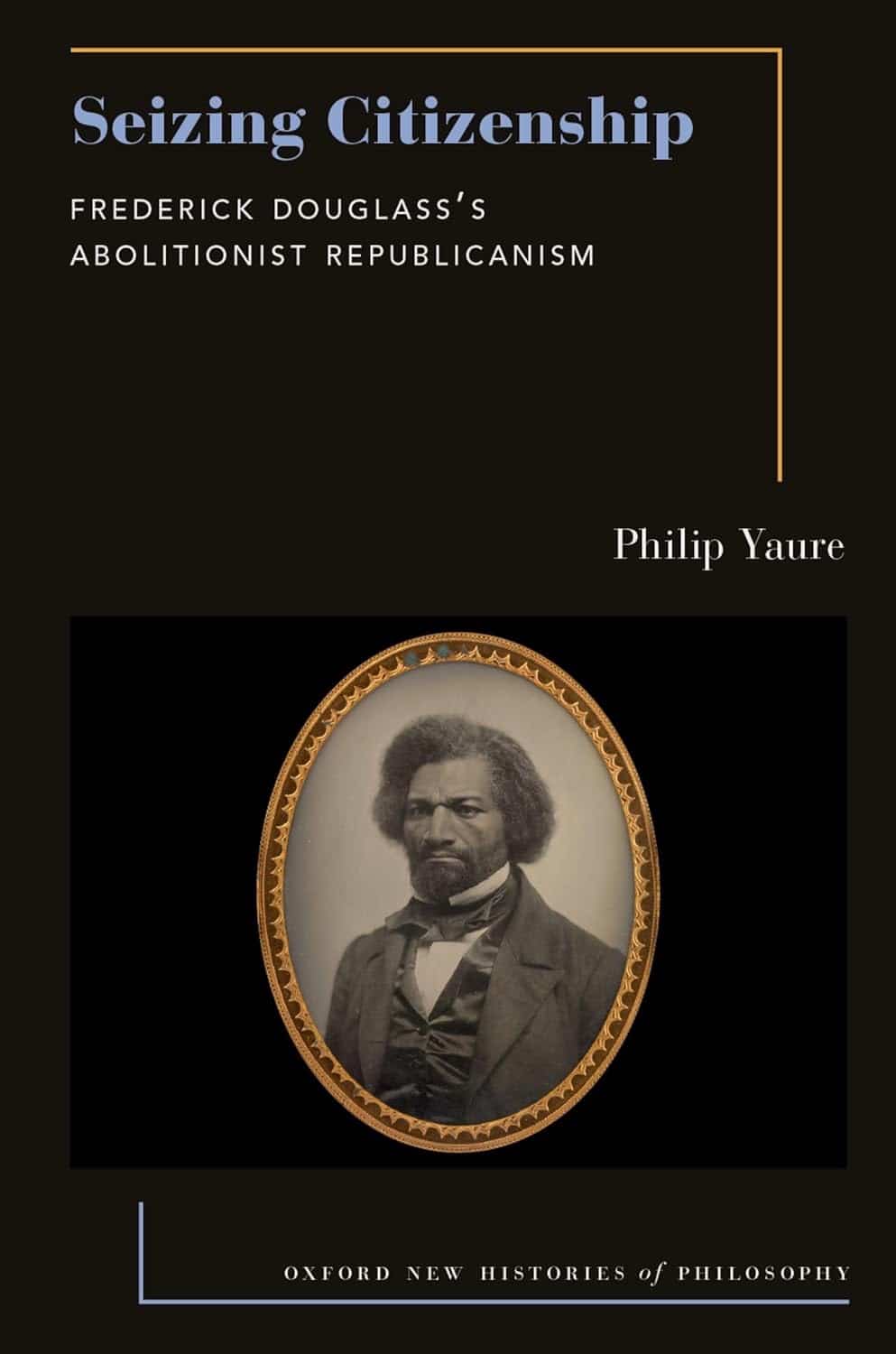
Seizing Citizenship: Frederick Douglass’s Abolitionist Republicanism. By Philip Yaure. New York: Oxford University Press, 2025. Paperback, 197 pp. $33.63.
Reviewed by Kevin C. Donovan
Freedom differs from citizenship. Freedom is an absence of restraint. By contrast, citizenship typically is accompanied by certain affirmative civic rights within a political body (a polity), such as suffrage. A polity decides the membership of its citizenry. In the United States, however, prior to the 1868 ratification of the Fourteenth Amendment with its concept of “birthright citizenship,” the Constitution did not specify who was included in the meaning of “citizen.” The definition thus was subject to debate.
Famed abolitionist speaker and author Frederick Douglass (1818–1895), who in 1838 escaped slavery in Maryland, was a key figure in that debate. Readers of Douglass’s writings—many now available at the Frederick Douglass Papers Project, https://frederickdouglasspapersproject.com/s/digitaledition/page/about—or David W. Blight’s comprehensive Frederick Douglass: Prophet of Freedom, know that Douglass relied upon many different sources in arguing both for freedom and civil rights for the enslaved. These included natural law, the Bible, Declaration of Independence, Constitution, Black Americans’ centuries of contributions to building the nation, and their service as U.S. soldiers during the Civil War. Douglass’s argument might thus be seen as a hodgepodge of morality and legality.
Seizing Citizenship: Frederick Douglass’s Abolitionist Republicanism takes a different approach. Its author explores what he characterizes as Douglass’s underlying lifelong argument that Black Americans not only deserved to be deemed citizens, but already had earned—or seized— that status through their own collective activities within the American republic.
Professor Philip Yaure specializes in the history of African American political philosophy. Yaure applies his expertise in an analysis of Douglass’s public speeches and writings, to identify a coherent philosophy underlying Douglass’s theory of Black Americans’ right to full participation in the American polity via “abolitionist republicanism.” (6) Douglass, in Yaure’s view, did not argue that citizenship should be conferred upon Black Americans for reasons of morality or legality, nor as a reward for any type of service. Rather, Douglass insisted that Black Americans already were citizens of the Republic and of right must be recognized as such.
Yaure commences his analysis by drawing on such disparate sources as Aristotle’s Politics, the writings of Machiavelli, Alexis de Tocqueville and others. Yaure explains how political theorists through the centuries posited that, “To be a citizen in the republican sense is to participate in the political life of the polity.” (12) Yaure shows how Douglass embraced that theory in expressing his belief that Black Americans, both enslaved and those “nominally free” (e.g., 19, 27) yet constrained by racial discrimination, qualified as citizens even without the freedom reserved for white citizens. In so doing, Douglass rejected the traditional political position that only those who already were free could aspire to citizenship.
For Douglass, the struggle for freedom is inexorably intertwined with the status of citizen. When a people combine to struggle against oppression within a republican nation, they are engaged in the very type of conduct that the republic values. They thus are acting as citizens, even if the polity has not yet recognized them as such in the legal sense.
Yaure’s thesis is: “What it means to be a citizen, on Douglass’s republican conception, is to contribute to a polity by acting in ways that shape the fundamental values of the polity.” (11-12) It is not necessary that the polity “shifts to affirm [the] fact” that the actor is a citizen-member of the polity. Rather, the actor’s “claim to membership consists in the activity of contesting what the public values; what it means to contribute to a polity, and thereby be a citizen, is to engage in such activity.” (12; emphasis in original) Stated differently, Yaure asserts that Douglass championed the idea that one’s own actions within a republican-based polity conferred citizenship, consistent with historical theories of republican citizenship.
Seizing Citizenship charts Douglass’s philosophy in four chapters. Chapter One (“On Plantation Politics”) explores how Douglass positioned the plantation as a site of resistance activity among groups of enslaved that espoused the same values of revolutionary resistance that the American colonists embraced as they formed themselves into an independent republic. Chapter Two addresses Douglass’s embrace of Constitutional interpretation as citizenship activity worthy of the status. Chapter Three, focusing on Douglass’s pursuit of “Black solidarity,” discusses how Douglass believed that “Black Americans, by bringing themselves into being a people organizing themselves around a mutual commitment to one another’s freedom and well-being, make themselves a constituent people of the American republic…” (135) The final chapter links Douglass’s philosophy to his actions during the post-War debates over the annexation of Santo Domingo. This seemingly odd inclusion actually highlights Douglass’s continual efforts at building a greater Black American polity to shape the values of the republic into a multi-racial nation.
Seizing Citizenship is not for the casual reader. It is a work of deep political philosophy and theory. Moreover, as Yaure notes, his thesis cannot be directly tied to Douglass’s actual statements. The author states that “My goal is to articulate a conception of republican citizenship that Douglass could by and large endorse as his own” while acknowledging that he is trying to “reorganize and elaborate his [Douglass’s] thought in ways that the historical Douglass did not.” (25)
Nevertheless, the author’s insightful analysis of Douglass’s words and arguments in the course of presenting a theory consistent with Douglass’s radical proclamation that Black Americans were citizens of the republic well before the passage of the Fourteenth Amendment is an intriguing addition to the study of a remarkable American citizen.


thanks Kevin, great review about a great American … nice to see a historian take hard look at Douglass’s many public addresses … after reading Blight’s bio, two that stick with me are his 4th of July 1852 speech and his address at the dedication of the Freedman’s monument in April 1876.