Early Civil War Mysteries of Virginia and West Virginia
Over the past several years researching the Civil War in Virginia and (what would become) West Virginia during the spring and summer of 1861, I’ve often encountered gaps in the historical record. Sometimes the information is out there in an archive, waiting for someone to connect the dots. That kind of detective work is what keeps the research fun and engaging.
At other times, I run into a mystery that resists every effort to solve it, at least with the resources and understanding I have now. Maybe someone out there has the knowledge, contacts, or just the luck to fill in the missing pieces. Maybe that someone is you.
Cox’s Missing Reports
In the summer of 1861, Jacob Dolson Cox, then a brigadier general, was assigned to drive Henry A. Wise and his “legion” from the Kanawha Valley in western Virginia. He succeeded. Despite winning the battle of Scary Creek, Wise abandoned Charleston a few days later and fell back to Gauley Bridge to avoid being cut off by Union forces advancing from the north.
Several of Cox’s reports from this campaign, received too late for inclusion in the Official Records of the Union and Confederate Armies, Series I, Vol. II (published in 1880), were later printed in Series I, Vol. LI, Part 1. In Appendix A of his memoir, Military Reminiscences of the Civil War (1900), Cox also noted that a number of letters and dispatches between himself, McClellan, and William S. Rosecrans were omitted from the O.R.[1]
More specifically, Cox’s dispatches to McClellan dated July 4, 6, 10, and 17, 1861, are missing. I contacted Oberlin College, which holds the Jacob D. Cox Papers, as well as the National Archives. Neither could locate them. I also searched the digitized McClellan Papers online, without success. This does not mean the dispatches do not exist somewhere, but my search has so far come up empty.
Who Killed Henry S. Cornell?
Shortly before midnight on May 31, 1861, shots rang out in the darkness at a picket post just west of Alexandria, wounding Privates Henry S. Cornell and Joseph Cushman of the 11th New York (Fire Zouaves). Cornell died soon after, becoming one of the first Union casualties of the war. Shouldn’t we know who killed him?
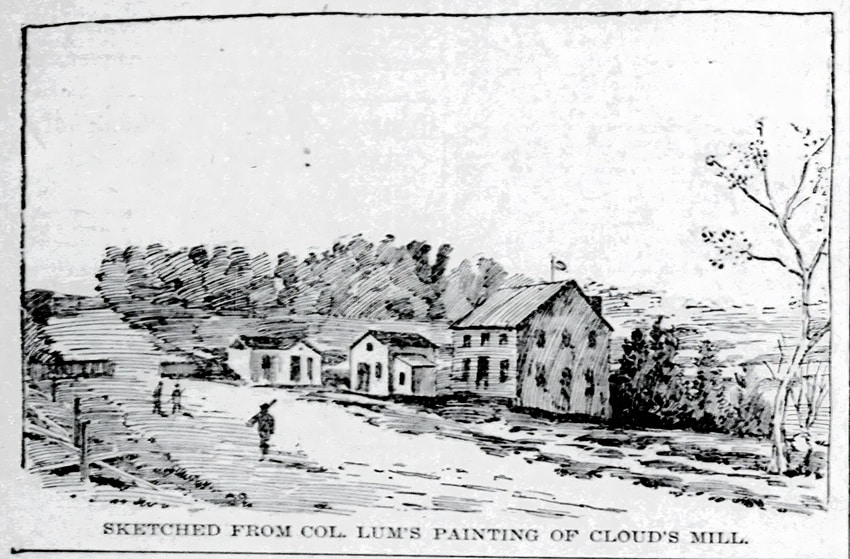
I’ve already shown that this incident, widely known as the “skirmish at Arlington Mills,” actually took place at Cloud’s Mill along the Little River Turnpike. The 1st Michigan and 11th New York were in the middle of a shift change when someone opened fire, and confusion took hold. The absence of Southern accounts leads me to suspect a tragic case of friendly fire, though I cannot say so with certainty.
I call it a “dog in the nighttime” problem.
“Is there any other point to which you would wish to draw my attention?”
“To the curious incident of the dog in the night-time.”
“The dog did nothing in the night-time.”
“That was the curious incident,” remarked Sherlock Holmes.
– Arthur Conan Doyle, “Silver Blaze”
If Cornell and Cushman were struck by enemy fire rather than their own men, who was responsible? What Confederate unit was involved? Only a handful of companies were in the area at the time. The Warrenton Rifles, Rappahannock Cavalry, and Prince William Cavalry were at Fairfax Court House. Both cavalry companies, however, were poorly armed and could not take part in the skirmish there on June 1. The Warrenton Rifles had only just arrived on the 31st. The Goochland and Hanover Light Dragoons were at Fairfax Station, three and a half miles to the south, while the remaining units were at Manassas Junction.[2]
I have yet to find a single Confederate account that does not rely on Northern sources to describe what happened.
Could they have been bushwhacked by locals angered by the incursion of federal troops into northern Virginia? It’s possible, but I have yet to find a smoking gun.
Who Died at Righter’s House?
On Friday, June 21, 1861, Capt. David F. Cable and men of Company I, 20th Ohio Infantry, surrounded an irregular Confederate force at the home of Peter Baker Righter in what is now Marion County, West Virginia, near the Harrison County line. In the fight that followed, Cable claimed to have killed four, wounded four to six, and captured seven.[3]
But who were they?
One man, Banks Corbin, was among those captured. He tried to escape and was shot dead, the only fatality I can verify. His date and place of death are documented on Ancestry.com.
In letters to the Wheeling Daily Intelligencer, a man signing himself “Harry,” who claimed to have interviewed locals after the incident, identified the other three dead as “the brothers Pill” and “Davis.” This only deepens the mystery, as “Harry” corroborates Capt. Cable’s claim that four men were killed.[4]
If four men were killed that day, why can I find a record for only one? A letter from D. S. Morris, published in the July 5, 1861 edition of the Rockingham Register, laments and vows revenge for the murder of Banks Corbin. Henry Haymond’s History of Harrison County, West Virginia (1910) likewise mentions only Corbin’s death in connection with the action at Righter’s house.[5]
Who were these other three men? Were their deaths lost in the fog of war, or did they exist only in someone’s imagination?
Who was John Lott?
In the chaos following the “battle” of Philippi, a Union soldier named John Lott confronted an elderly resident and shot him dead when he refused to renounce his rebel sympathies. What makes this incident remarkable is that both men are described in primary sources as “colored” or “negro.”
Andrew J. Grayson, in his memoir “The Spirit of 1861”: History of the Sixth Indiana Regiment in the Three Months’ Campaign in Western Virginia, recounted the episode in detail and added: “John Lott, of Madison, was the first colored man that shouldered a musket in the Union army, for I saw him standing in line with gun in hand and cartridge-box buckled to his hip when Capt. Gale’s company was drawn up in front of the Court House at Phillippi.”[6]
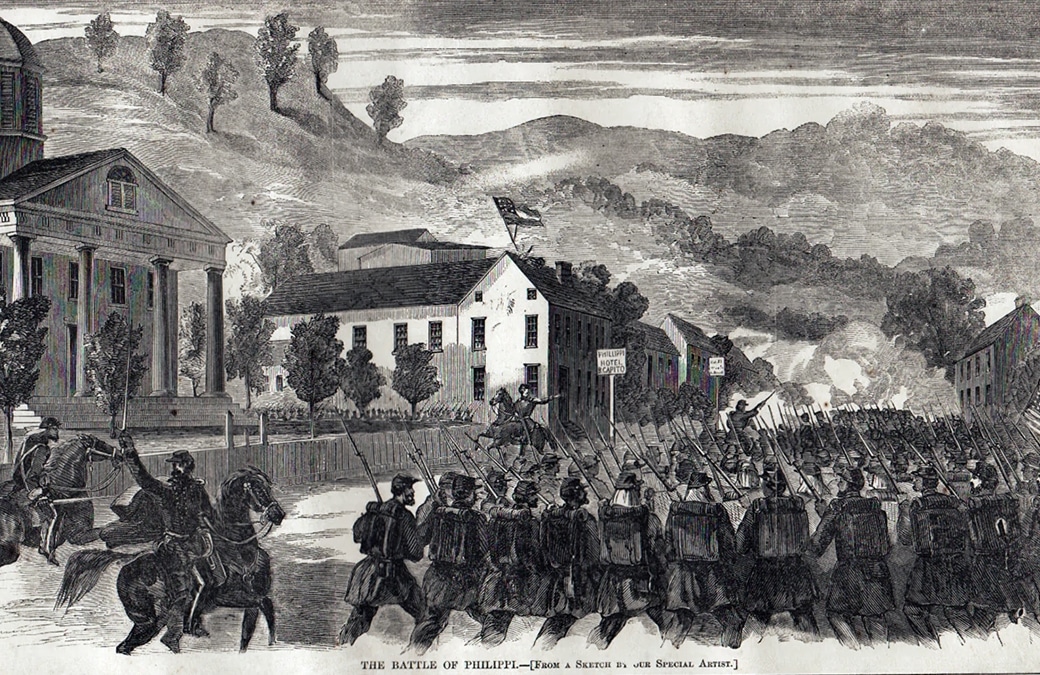
This was highly unlikely. The Second Militia Act of 1792 restricted U.S. militia service to “free able-bodied white male” citizens between the ages of 18 and 45, a provision not amended to include African Americans until 1862.
Rufus Gale commanded Company E of the 6th Indiana Infantry (three months). The regiment took part in the battle of Philippi on June 3, 1861. Grayson, a sergeant in Company E, described John Lott as a member of his company, yet no one by that name appears on its muster roll.[7]
We know the incident occurred because several contemporary newspapers reference it, identifying Lott as a prisoner and describing his crime, even as they muddle some of the details.[8] A “John Lott” appears in the 1860 census in Madison, Indiana, but he is about thirteen years old, and later censuses list his race as white. A search of Newspapers.com turns up nothing for that name or any clear variant.
So who was John Lott, if that was even his real name? He was not a uniformed member of the 6th Indiana, having been barred from enlistment by the Second Militia Act of 1792. Based on descriptions of his dress and the fact that he was armed, he may have served as a scout, though that remains my own speculation.
I think the answers to these mysteries are just sitting out there, waiting to be found.
[1] Jacob Dolson Cox, Military Reminiscences of the Civil War, Vol. I (New York: Charles Scribner’s Sons, 1900), 547.
[2] John W. Bell, ed. Memoirs of Governor William Smith, of Virginia: His Political, Military, and Personal History (New York: The Moss Engraving Company, 1891), 28-29, 33; Edward T. Wenzel, Chronology of the Civil War in Fairfax County, Part I (CreateSpace: By the Author, 2015), 61-63.
[3] Wheeling Daily Intelligencer, June 29, 1861
[4] Wheeling Daily Intelligencer, July 11, 1861
[5] Rockingham Register and Advertiser, July 5, 1861; Henry Haymond, History of Harrison County, West Virginia (Morgantown: Acme Publishing Company, 1910), 318.
[6] Andrew J. Grayson, “The Spirit of 1861”: History of the Sixth Indiana Regiment in the Three Months’ Campaign in Western Virginia (Madison: Courier Print, 1875), 25.
[7] Report of the Adjutant General of the State of Indiana, 1861-1865, Vol. 4 (Indianapolis: Samual M. Douglass, State Printer, 1866), 2-13.
[8] Cincinnati Daily Commercial, June 10, 1861; Wheeling Daily Intelligencer, June 7, 10, and 20, 1861.


Nice set of mysteries, and kudos for the Great Detective reference.