Discovering Spotsylvania’s “Ugliest” Monument
 Emerging Civil War welcomes William Miller
This past September, the Central Virginia Battlefields Trust featured a tour of the Spotsylvania Battlefield. Two busloads of the 2025 Annual Meeting attendees mounted up on Saturday morning to head out to the Battlefield to be treated by Chris Mackowski’s guidance and narration of the significant actions that occurred from the initial clash of arms at Laurel Hill to the disengagement by the Union forces after the fight at the Harris Farm.
For perhaps a few, the tour may have served as a flashback to the 2014 Sesquicentennial, when the National Park Service pulled out all the stops to feature the day by day and blow by blow story of the fierce combat that took place between the Po and Ni rivers over the course of 14 days in May 1864.
But Chris threw us a curveball shortly after our return from the mid-day break for rations by guiding us into the wooded rear of the Sixth Corps trench lines to view his description as to what might be the Civil War’s “Ugliest” Monument.
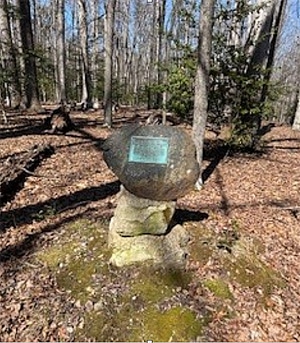 And so the photograph lends credence to the claim. The monument consists of a collection of mismatched natural rocks, placed upon a circular mound of moss-covered earth. The rocks, possibly gathered from nearby fields, are precariously locked in place by a mixture of gravel, sand, and cement, elevated to feature a square bronze plaque affixed to a large weathered blackish boulder. At first glance, the monument certainly appears to fit a “Rube Goldberg” description. But in retrospect however, the “ugliest” monument deserves a far better moniker to signify the importance of the history that the bronze plaque relates:
EDWARD TOBEY STUART
1876 – 1940
STUDENT OF HISTORY, PATRIOTIC
CITIZEN AND LOYAL COMPANION
WHOSE INTEREST AND DONATIONS
OF LAND CONTRIBUTED LARGELY
TO THE ESTABLISHMENT OF THE
BATTLEFIELD PARK
ERECTED BY HIS FRIENDS
So here we have a simple tribute, crafted by either an individual or perhaps several persons that is virtually hidden from public view, to honor Edward Tobey Stuart for his individual effort to preserve a substantial area of this great battlefield.
It’s interesting to note that a map application on a home computer indicates the name “Edward Stuart” along with the designation of contemporary tour roads and other monuments on the map of the Spotsylvania battlefield. While the location on the modern computer map indicates “Edward Stuart” in a wooded area, there is no trail indicated to lead a curious visitor to this seemingly unique landmark.
The rest of Edward Tobey Stuart’s story comes from The New York Times announcement of his death in December of 1940. The headline reads, “Edward T. Stuart, a retired banker, (and) authority on Battlefields of the Civil War, dies in Philadelphia at 64. Bought ‘Bloody Angle’ (and) Gave to Federal Government for a Memorial Park (at) Historic Spotsylvania Site.”
The Times article adds more information about Edward T. Stuart and his preservation effort. Stuart purchased the Landrum Farm at a court sale in 1930 and deeded it to the federal government on May 12, 1932, the sixty-eighth anniversary of the Union attack on the “Mule Shoe Salient” and the “Bloody Angle.” The May 12, 1864 assault by the Union forces was launched and fought over the Landrum Farm, a property that Edward T. Stuart singularly preserved for prosperity.
While there are more details about the life of Edward T. Stuart, this tiny bit of research serves to understand the meaning and the location of this hand-crafted memorial. It’s not an “ugly” monument after all. On the contrary, it’s the most beautiful monument on the battlefield, simply because it honors the individual who saved the most significant area in order to interpret the entirety of the combat that took place at Spotsylvania.
There were earlier individuals that stepped forward to place markers to preserve the memories of significant actions during the Civil War. The preservation efforts of James Power Smith’s ten stone monuments in the early 1900s comes to mind, as well as Douglas Southall Freeman’s later actions to identify the places where great battles were fought.
We owe a debt of gratitude to Edward T. Stuart for his timely initiative to preserve the area encompassed by the Landrum Farm on the Spotsylvania battlefield. It was he, and others like him, who planted the seeds of preservation, and we are the current benefactors and successors tasked to continue that mission.
William Miller is president of the Williamsburg Civil War Round Table and secretary/treasurer of the Civil War Round Table Congress


I had never before heard of Edward T. Stuart and his efforts to save and preserve the battlefield of Spotsylvania. Thank you for this great post.
What a great story!