Book Review: The Old Alcalde: Life and Times of a Texas Fire-Eater, Oran Milo Roberts

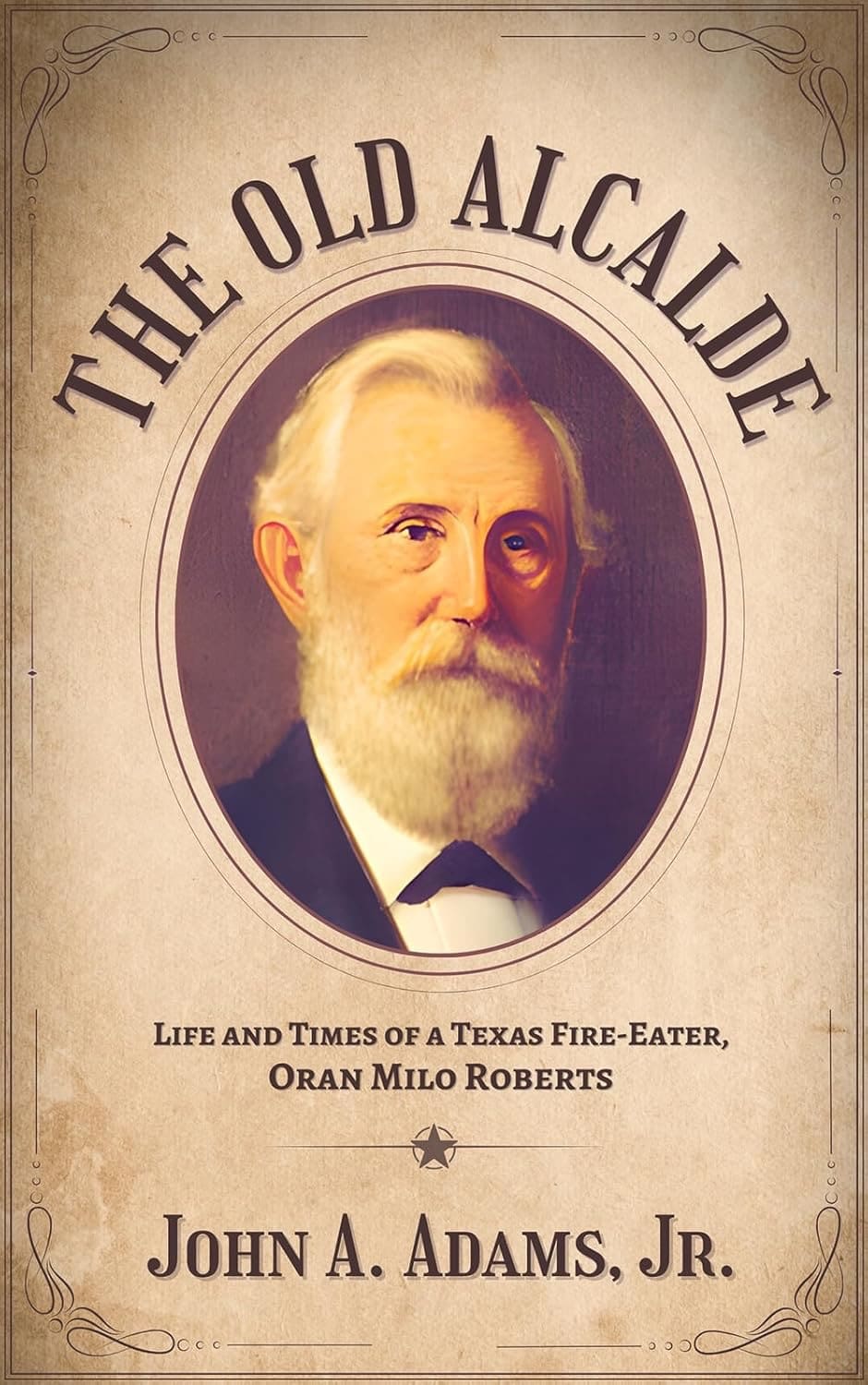
The Old Alcalde: Life and Times of a Texas Fire-Eater, Oran Milo Roberts. By John A. Adams, Jr. Wimberley, Texas: Stoney Creek Publishing, 2025. Hardcover, 275 pp., $34.95.
Reviewed by Brian Matthew Jordan
Oran Milo Roberts was “a most unlikely fire-eater” contends author John A. Adams, Jr. in his latest book, the first biography of a secessionist whose life traced the contours of nineteenth century Texas history. Though a “lackluster speaker” who “did not belong to the financial elite,” Roberts became the chief architect of Texas’s secession from the Union. (xi) Through the ordeal of the Civil War and Reconstruction and beyond, long after his mane of hair turned white, Roberts maintained the righteousness of the slaveholders’ rebellion.
Born in South Carolina, Roberts was reared in Alabama, where he read law before trundling west in 1841. Roberts likely felt at home in the burgeoning cotton plantation culture of East Texas; there, he became both “a key leader” in the effort to annex the Lone Star Republic to the United States and a “disciple” of the ardent nullifier John C. Calhoun. (25, 33) Roberts’s “fanatical states’ rights philosophy” and defense of the peculiar institution poised him against his one-time friend and fellow Democrat Sam Houston, who voted against the Kansas-Nebraska Act and later voiced his opposition to secession. (39)
In fact, it was Oran Roberts who, “without Houston’s or the legislature’s authority,” called for a secession convention in Austin. (63) Appropriately, the delegates elected Roberts—widely acknowledged as secession’s “principal philosophical leader” in Texas—as the convention’s president. After mere days of debate, the delegates inked a secession ordinance and submitted their resolves to a public vote. Tellingly, however, the disunion forces did not wait for the election returns before seizing control of many federal military installations in the state.
During the war, Roberts was tapped as the colonel of the 11th Texas Infantry. After tending to tedious garrison duties, his regiment finally found the thick of the killing in November 1863 at the battle of Bayou Bourbeau. But Roberts’s short and unhappy military career came to an end the following summer when, with a medical discharge in hand, he retook his seat on the Texas Supreme Court. After the war, Roberts grudgingly swore a loyalty oath to the United States but perhaps registered his real sentiments by joining “hundreds of Confederate veterans” on a short sojourn to Mexico in the fall of 1865. (82)
In 1866, the Texas state legislature voted to send Roberts to the United States Senate. However, citing Roberts’s “rebellious spirit,” the Senate refused to seat him. Roberts howled in protest, drafting a public manifesto that treated his “views on federalism, race relations, [and] the progress of Reconstruction.” (94) The rebuffed Roberts returned to Texas and the practice of law. In 1874, Governor Richard Coke tapped him as the chief justice of the Texas Supreme Court. Four years later, the Democratic Party named Roberts their “dark horse” candidate for governor; the chief justice’s “apparent lack of political ambition” was among his leading qualifications. (119)
Roberts won the election in a landslide. As governor, he proved a fiscal hawk unafraid to wield the veto pen. (148) He found ways “to fund and restructure a more robust educational system across Texas,” and “champion[ed] public higher education” in particular. (157) Upon leaving the governor’s office after two terms, he “turned his full attention for the next decade to the University of Texas.” (191) Roberts taught law and helped to “hand-pick” the institution’s “first faculty,” which he amply stocked with Confederate veterans. (197)
In retirement, he engaged in Civil War memory work, becoming a coveted speaker at Confederate reunions and a prolific writer whose lengthy bibliography included the entry on Texas in Clement Evans’s Confederate Military History. Given the relative dearth of studies on Civil War memory west of the Mississippi, one wishes that the author would have written even more about Roberts’s efforts to shape the historical narrative of secession, war, and Reconstruction in Texas.
“Oran Roberts,” the author concludes, “lived and died convinced of the righteousness of and responsibility to perpetuate the cause of states’ rights, the preservation of the peculiar institution of slavery, and protection of the foundations of southern social culture and traditions.” (230) Informed by deep research in relevant archives and period newspapers, this overdue biography yields valuable insights into a forgotten fire-eater and his rough and tumble world of nineteenth century Texas.


Beyond just filling a hole in historiography, how would you evaluate the author’s work? Did he have a thesis or argument he was trying to make? If so, was he successful in supporting that thesis?
Even when compared with its counterparts in other states, the Texas Declaration of Secession was particularly racist. I’ve always wondered why this was the case.