Book Review: The Legend of Wyatt Outlaw: From Reconstruction through Black Lives Matter

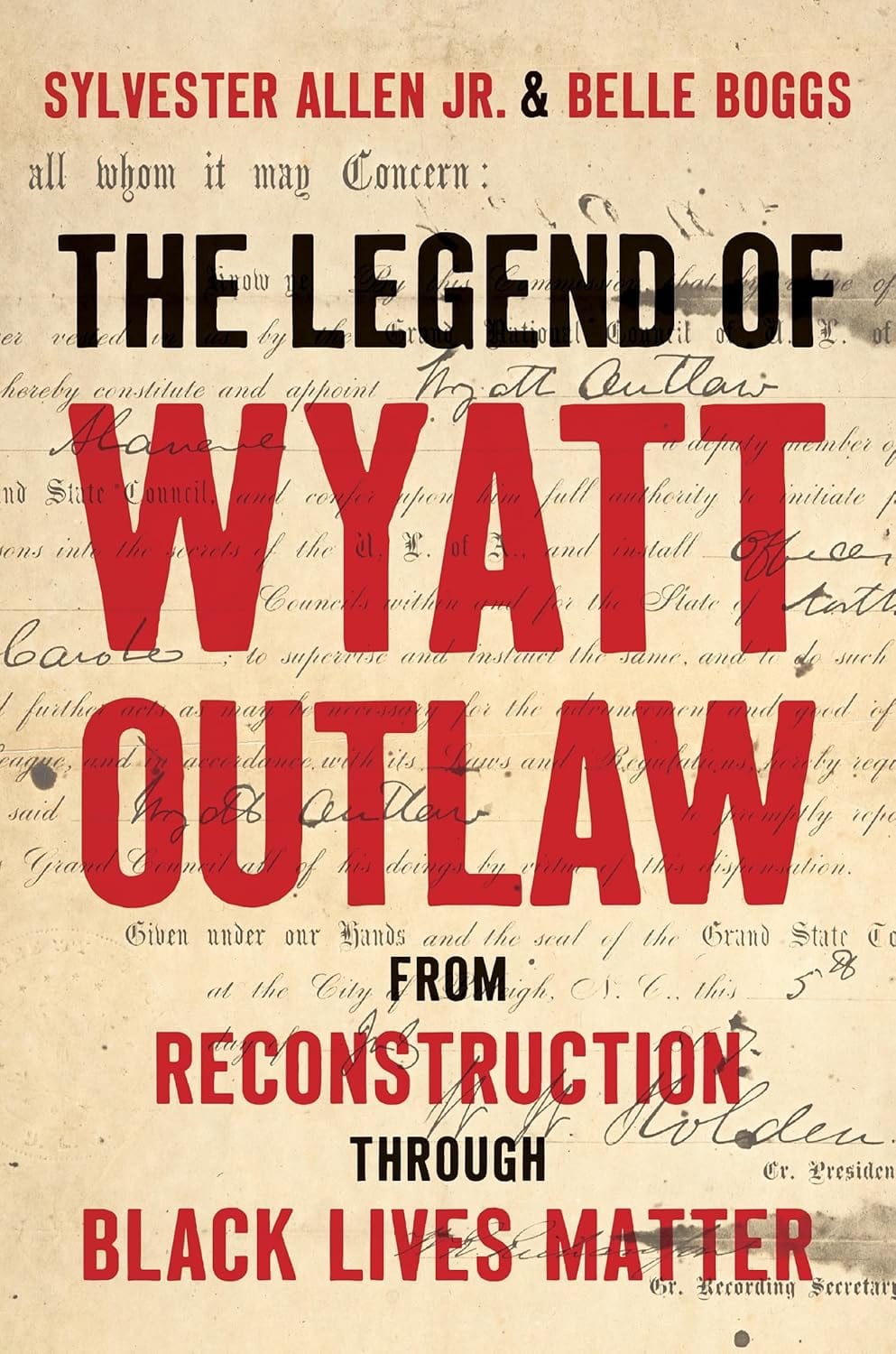
The Legend of Wyatt Outlaw: From Reconstruction through Black Lives Matter. By Sylvester Allen Jr. and Belle Boggs. Chapel Hill: University of North Carolina Press, 2026. Hardcover, 296 pp. $30.00.
Reviewed by Samuel Flowers
Recently, newly published books on the Reconstruction Era tend to seek connections between that time and the present day. For authors Sylvester Allen Jr. and Belle Boggs, they attempt to do just this by using local history both to uncover the past and draw attention to unresolved issues in the modern era. The Legend of Wyatt Outlaw: From Reconstruction through Black Lives Matter attempts to give justice to the life and legacy of Wyatt Outlaw, a Union veteran, business owner, and the first Black constable in Graham, North Carolina. Outlaw’s existence in a position of authority and his outspoken role in activism during the postwar years resulted in his murder by the Ku Klux Klan in February 1870, which set in motion a clash between the Klan and the state government known as the Kirk-Holden War. Allen and Boggs argue that Outlaw’s life and lynching were seen more as a local myth rather than history, and as a result, attempt to use his story as a connection to activism during the Summer of 2020 and beyond.
In terms of historiography, Wyatt Outlaw’s life had not been given a full academic book-sized treatment, although his murder’s significance in connection to the larger issue of political violence during Reconstruction has been included in some recent monographs. The two most recent places to find this are A Man of Bad Reputation: The Murder of John Stephens and the Contested Landscape of North Carolina Reconstruction by Drew A. Swanson and Klan War: Ulysses S. Grant and the Battle to Save Reconstruction by Fergus M. Bordewich, both published in 2023. (Both works have book reviews available for you to read here at Emerging Civil War.)[1]
The Legend of Wyatt Outlaw is divided into four sections, each focusing on a certain aspect of Outlaw and the connection to the authors’ experiences in recent years. Rather than a chronological timeline that starts with Reconstruction and leads to the present day, the sections jump around by theme. The first section, titled “Home,” focuses on the building of community in Graham and the greater Alamance County area during Reconstruction. The authors argue that Outlaw helped create Black schools, churches, and businesses and connected them to the contemporary community in the same area. Section Two, “Family Legacies,” brings in guest authors from Alamance County, ranging from current activists to the descendants of Outlaw’s murderers, to reflect on their lives and the lives of their ancestors as they grapple with the similarities between Outlaw and other victims of white supremacy.
The last two sections are the meat and cheese of Allen and Boggs’ book. Section Three discusses at great length the murder of Outlaw, with evidence based on eyewitness testimony that was given to a congressional committee shortly after. Chapter Eight was a personal highlight, as the authors share their reactions and interpretations from digging through the archives at the University of North Carolina’s Wilson Library. Historians very rarely discuss their time researching within the actual manuscript, but Allen and Boggs share their experience, giving the reader a glimpse of historical research firsthand. The rest of the third section and the last section bleed into each other as they come to connect that the Klan members who killed Outlaw either omitted or warped his story from any future narrative, just as many other political murders during Reconstruction across the South have happened. The authors connect the pieces to present by displaying evidence that the Klan in Alamance County was also responsible for erecting a Confederate monument in the courthouse square, which had become a focal point of controversy and debate at Black Lives Matter protests that increased in the Summer of 2020.
The Legend of Wyatt Outlaw is not a traditional history book. It does not follow a strict timeline and can jump sporadically from past to present. All that being said, the objective is not to tell a story but to argue that Reconstruction and its challenges are not as abstract as they are today. Rather, political pushback toward equal progress, racial violence, and debates over the memory of the Confederacy are subjects that Wyatt Outlaw faced just as frequently as historians and the general public have today. They also encourage readers to draw on the spirit and character of Outlaw amid the challenges in their communities today. If you are looking for a different, nontraditional case study of political violence and the memory of Reconstruction, I would recommend Allen and Boggs’ book.
[1] See https://emergingcivilwar.com/2024/03/05/book-review-a-man-of-bad-reputation-the-murder-of-john-stephens-and-the-contested-landscape-of-north-carolina-reconstruction/ and https://emergingcivilwar.com/2024/01/25/book-review-klan-war-ulysses-s-grant-and-the-battle-to-save-reconstruction/.


Long ago in graduate school I was taught the dangers of present-mindedness. The reviewer is right. This is not a traditional history book. It’s not even a history book per se. It is just another drop in the woke deluge engulfing us.
Spot on, Mr. Olson. See my extended response below.
It’s been a long time coming, but it’s finally here: A once proud university press, UNC, has gone full Maoist-Woke. Shocking, ugly, pitiful – and a danger to American Letters, especially in the study of history. No wonder a while back they refused to give me information on a Civil War officer who graduated from UNC-Chapel Hill Law School “because he was a Confederate, he was a white supremacist.” Happily, the laugh is on those National Socialists; the man happened to be descended from a Founding Father – and prominent Abolitionists, with his family for several generations prior to the Civil War, including his own generation, never owning slaves. For this violation of my 1st Amendment rights, his family – still quite prominent, is preparing to sue UNC. Fireworks a-comin’!