Members Only: Civil War Veterans’ Organizations
ECW welcomes back guest author Mike Busovicki.
Victorian-Era Americans were some of the first to enjoy leisure time, and the latter half of the 1800s was the golden era of social and benevolent societies. While a regimented lifestyle seems unlikely to persist in civilian life, Gilded-Age society prioritized self-control and order.[1] Veteran organizations were useful in asserting political influence to resolve collective problems faced by their comrades.
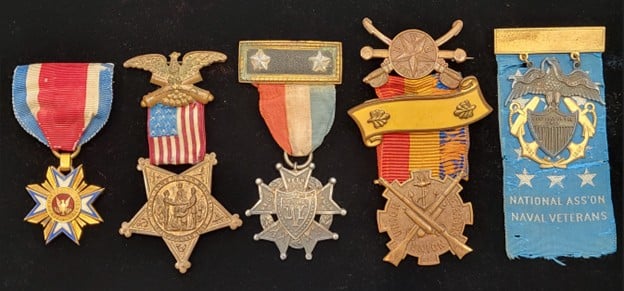
The first Civil War veterans group was formed with armies still in the field. Suspicions of rebel conspiracies were rampant in the wake of Abraham Lincoln’s assassination. Originally intended to serve as an honor guard for the president’s funeral, the Military Order of the Loyal Legion of the United States was formed in April 1865 by commissioned officers re-affirming their commitment to the post-war union. The following year, the Grand Army of the Republic (GAR) was formed, welcoming members of all ranks and promising to help needy comrades, widows, and orphans while promoting patriotism.[2]
The selection process for most organizations was the same. A secret vote was made ahead of the initiation by the members; any initiation “tests” were a formality. Fraternal societies of the day were fond of anonymous voting by dropping a marble into a ballot box: White, to recommend acceptance, and black if they felt strongly against accepting the recruit.
While some applicants might be rejected with a single “blackball” vote, this was rare. Those rejected, however, would have their name recorded, which might affect future reapplications. Surprisingly, more “exclusive” groups were less likely to reject recruits, though exclusivity was maintained through higher dues or qualifying service (officers only, length or type of service, no draftees, etc.).[3]
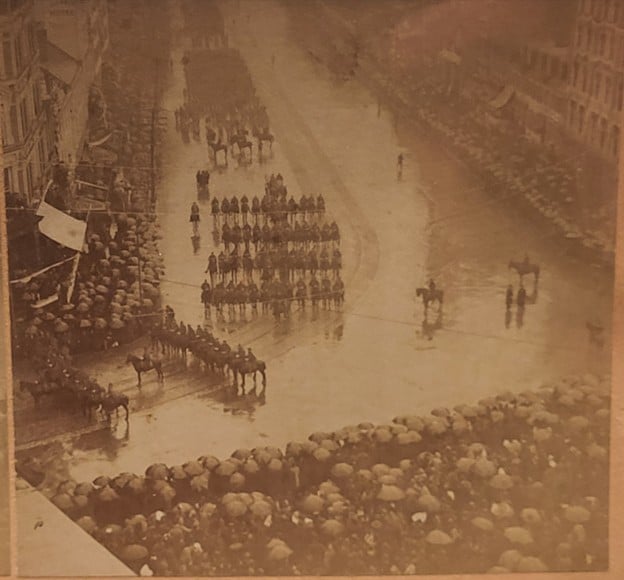
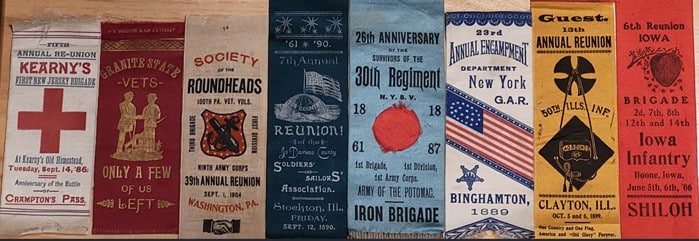
State departments oversaw local posts, enforcing standards and collecting dues. General coordination and the organization’s unity of purpose were managed at the national level. Some posts sponsored drill competitions and were fond of parades. Others staged performances that satirized the pomp others might have taken too seriously. The showmanship kicked into high gear when delegates met at the annual national encampments, marked by several days of parades, dinners, and speeches. Many veterans belonged to multiple associations, and encampments might host the annual reunions for several of them.[4]
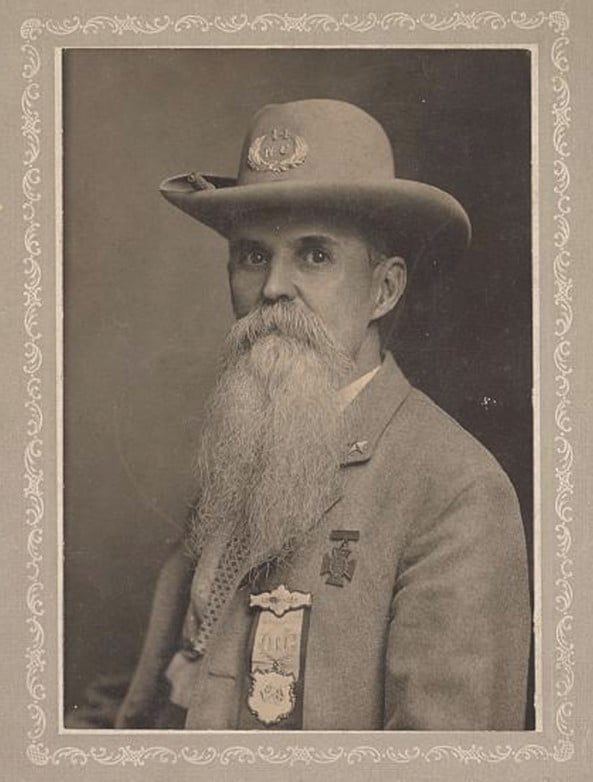
Confederate groups also promptly organized; the first was the Oglethorpe Light Infantry Association in Savannah in 1865. Groups for the Army of Northern Virginia, Army of Tennessee, Cavalry Veterans, Confederate Survivor’s Association, and more followed. The largest, the United Confederate Veterans (UCV), was founded in New Orleans on June 10, 1889, holding their first reunion the following year in Chattanooga. The UCV grew exponentially, boasting 1,555 camps by 1898. They counted over 160,000 members at their peak in the early 20th century, a testament to years of organization. When the monument to Jefferson Davis was unveiled in Richmond on June 30, 1907, an estimated 100,000 visitors attended.[5]
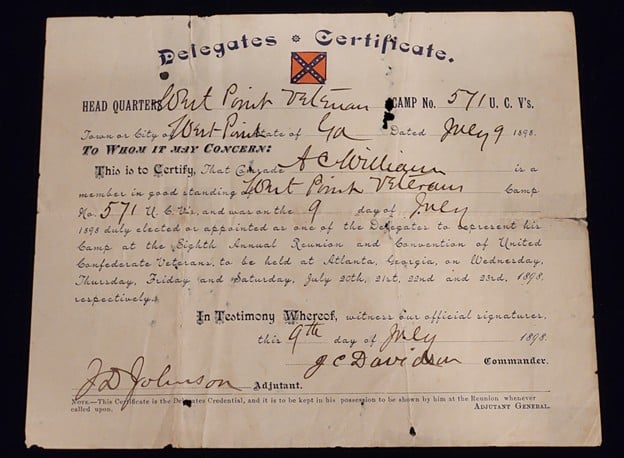
While some dismissed the titles, costumes, or secret meetings and handshakes as boyish frivolity, they belied a more serious purpose. Ritualistic “trials” gave meaning and gravita, and strengthened fraternal bonds, recalling the trials by fire and campaign. The GAR further implemented a tiered system in 1869 where one could attain different grades or levels of membership: Recruit, Soldier, and Veteran, which clearly mirrored the “degree” system of the Masons (as did the mock “execution” on initiation night). However, the degree system was unpopular and was eventually abolished. The initiation would also evolve in favor of more solemn proceedings, adding Christian hymns and lectures on charity. The staged interrogation, procession, and mock execution began to be phased out in 1874 and were formally eliminated by 1881.[6]
While the GAR was indisputably the largest and most effective veterans advocate in the postwar years, it had its critics. The National Association of Naval Veterans took a thinly veiled swipe at the Army-centric GAR and its tiers in its founding principles: “The social barriers that formerly separated the quarter-deck from the gun-deck have been cast aside by our Association and we meet upon a common level as shipmates. Patriotism knows no distinction of class.”[7]
Over time, GAR membership ranged between 80 percent and 97 percent volunteer soldiers, including those serving 90-day terms or emergency troops; the UVL and UVU conversely held the GAR up as too inclusive. They instead required service of at least two years (UVL) or at least six months with some of that in combat (UVU). They may not have enjoyed the rigors of war, but for many, service defined them, and their memories were irreconcilably different from those who had not faced the same hazards.[8]
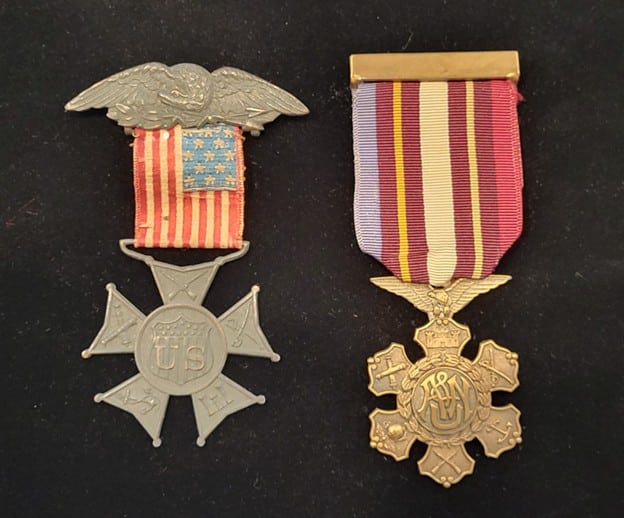
With the quick victory over the Spanish in 1898 and expansion of a global empire, by the 20th century survivors of the War of the Rebellion had a new foe: relevance. Confederates had their romanticized version of the past injected into the culture; the Federals, claiming the moral high ground of ending slavery, had saved a union that was no longer in danger of splitting apart. They had no more battles to wage, and most were content knowing their organizations would pass into history with their last comrade because only those who had “drank from the same canteen” could understand their experiences. So, it was a new generation of veteran organizations that next rose to preeminence, ones that prioritized a perpetually renewing membership base and common veteran kinship so that generations could learn from the past.[9]
Mike Busovicki is an Iraq War Infantry Veteran. He evaluates disability claims for the Department of Veterans Affairs and holds a master’s degree in public and international affairs.
Endnotes:
[1] James Marten. Sing not war: The Lives of Union & Confederate Veterans in Gilded Age America (Chapel Hill, NC: University of North Carolina Press, 2011), 11-17; Stuart McConnell, Glorious Contentment: The Grand Army of the Republic, 1865 – 1900 (Chapel Hill, NC: University of North Carolina Press, 1992), 50-51.
[2] Paul A. Cimbala, Veterans North and South: The Transition from Soldier to Civilian after the American Civil War (Santa Barbara, CA: Praeger, 2015), 114-117.
[3] McConnell, 56.
[4] McConnell, 121-122.
[5] Robert C. Jones, The Civil War Veterans Organizations: UCV and GAR ( Kennesaw, GA: RCJ Books, 2019), 37.
[6] McConnell, 32, 86-87, 99, 102.
[7] William Simmons. History of the National Association of Naval Veterans from the First to the Tenth Annual Convention, Inclusive (Philadelphia: Dunlap Printing, 1895; Scholar Select reprint, Lightning Source, LLC), 10.
[8] Marten, 284; McConnell, 121-123, 199
[9] Cimbala, 128-131; Jones, 40; Marten 285; McConnell, 204, 237.


Very interesting! That’s quite a nice collection of artifacts. Can you say more about the political influence these organizations asserted? Did they advocate for certain laws or back certain candidates? For example, did a politician need to be a veteran to win their support?
I think there is good evidence of the political power of Civil War Veteran organizations – no less than five U.S. presidents were members of the GAR (Grant, Hayes, Garfield, Harrison, and McKinley). Additionally, Garfield defeated Winfield Scott Hancock in 1880 and John Logan was the Vice-Presidential candidate on the losing ticket in 1884. Supreme Court Justice Oliver Wendell Holmes Jr. was also a prominent GAR member. Ascendency in Veteran organizations (particularly at the national level) was often an indication of political aspirations and were a valuable way to “test-run” or assess one’s viability for office.
The GAR’s Second National Commander General John Logan himself warned against these faults in the organization’s earliest years, warning against gratifying ill feelings, whether it was black-balling candidates at the local post or mud-slinging at rivals for officer positions within the organization. Both he and George Lemon, editor of the GAR’s official newspaper, “The National Tribune”, openly and repeatedly reminded the membership that such biases would turn public opinion against the organization, detracting from its philanthropic success and mission of honoring those who served and sacrificed. Nonetheless, these groups were imperfect and were not immune to instances of individuals holding grudges, promoting more connected candidates and settling old scores.
There were also instances of groups fighting with each other; I mentioned the National Association of Naval Veterans’ beef with the social barriers they saw in the GAR. And the Union Veterans Union (UVU) was established with an intent on focusing on the interests of the common Union Veteran (a critique of the perceived elitism and political coziness of the GAR over the previous 20 years). The Union Veterans Legion (UVL) and GAR “almost came to blows” when it came to who would have the honor of leading the 1888 Memorial Day festivities in Fairmont Part (Philadelphia). The UVL national commander J.S. Reed went so far as to disparage the GAR as full of “pardoned deserters and bounty jumpers”, who boasted the loudest but had done little actual fighting. It is worth noting that many Veterans (like today) were members of multiple organizations, so this was not a commonly held belief among the public or Veterans, but is and example of how organizations could definitely be at odd with each other, and therefore the candidates they backed when election day came around. (McConnell, pp. 121-122)
The GAR was by far the largest of the organizations and held considerable lobbying power and made very good use of it. Prior to the war Veteran pensions were administered by the Department of the Interior and the organization was ill-prepared to handle the disability claims from hundreds of thousands of disabled men and widows (the VA didn’t exist until 1930 when the Veterans Bureau, Bureau of Pensions, and National Homes for Disabled Volunteer Solders were consolidated into a single department). Veteran groups, spearheaded by the GAR, used their membership as a powerful lobby to improve compensation benefits, organize better medical treatment, and obtain employment for those handicapped by service. Then, as now, Veterans had difficulty transitioning from combat back into society, but these lobbies gave them a voice and validity to their concerns. Veterans today would not enjoy the pension and disability law reform and extent of the benefits we have now without them.
Amazingly, in the decades following the Civil War, Veteran benefits were seen as a “white elephant” – a continuous financial drag on taxpayers. The public failed to realize the cost of war also includes lifelong physical impairment plus the opportunity cost of going into the military when one could have stayed home and enriched yourself. Veterans would not have had a way to make up for lost time or lost earning capability without consistent lobbying for improvements, continuous funding, and backing candidates who understood that soldiering was not a one-time expense.
I find the study of these groups very interesting – how they were simultaneously a fraternal body, charitable organization, and an advocate for social change all in one. They may not be a direct antecedent of today’s Veterans Service Organizations, but we can certainly learn from them.
I think there is good evidence of the political power of Civil War Veteran organizations – no less than five U.S. presidents were members of the GAR (Grant, Hayes, Garfield, Harrison, and McKinley). Additionally, Garfield defeated Winfield Scott Hancock in 1880 and John Logan was the Vice-Presidential candidate on the losing ticket in 1884. Supreme Court Justice Oliver Wendell Holmes Jr. was also a prominent GAR member. Ascendency in Veteran organizations (particularly at the national level) was often an indication of political aspirations and were a valuable way to “test-run” or assess one’s viability for office.
The GAR’s Second National Commander General John Logan himself warned against these faults in the organization’s earliest years, warning against gratifying ill feelings, whether it was black-balling candidates at the local post or mud-slinging at rivals for officer positions within the organization. Both he and George Lemon, editor of the GAR’s official newspaper, “The National Tribune”, openly and repeatedly reminded the membership that such biases would turn public opinion against the organization, detracting from its philanthropic success and mission of honoring those who served and sacrificed. Nonetheless, these groups were imperfect and were not immune to instances of individuals holding grudges, promoting more connected candidates, and settling old scores.
There were also instances of groups fighting with each other; I mentioned the National Association of Naval Veterans’ beef with the social barriers they saw in the GAR. And the Union Veterans Union (UVU) was established with an intent on focusing on the interests of the common Union Veteran (a critique of the perceived elitism and political coziness of the GAR over the previous 20 years). The Union Veterans Legion (UVL) and GAR “almost came to blows” when it came to who would have the honor of leading the 1888 Memorial Day festivities in Fairmont Part (Philadelphia). The UVL national commander J.S. Reed went so far as to disparage the GAR as full of “pardoned deserters and bounty jumpers”, who boasted the loudest but had done little actual fighting. It is worth noting that many Veterans (like today) were members of multiple organizations, so this was not a commonly held belief among the public or Veterans, but is an example of how organizations could definitely be at odd with each other, and also the candidates they backed when election day came around. (McConnell, pp. 121-122)
The GAR was by far the largest of the organizations and held considerable lobbying power and made very good use of it. Prior to the war Veteran pensions were administered by the Department of the Interior and the organization was ill-prepared to handle the disability claims from hundreds of thousands of disabled men and widows (the VA didn’t exist until 1930 when the Veterans Bureau, Bureau of Pensions, and National Homes for Disabled Volunteer Solders were consolidated into a single department). Veteran groups, spearheaded by the GAR, used their membership as a powerful lobby to improve compensation benefits, organize better medical treatment, and obtain employment for those handicapped by service. Then, as now, Veterans had difficulty transitioning from combat back into society, but these lobbies gave them a voice and validity to their concerns. Veterans today would not enjoy the extent of the benefits we have now without them.
Amazingly, in the decades following the Civil War, Veteran benefits were seen as a “white elephant” – a continuous financial drag on taxpayers. The public failed to realize the cost of war also includes lifelong physical impairment plus the opportunity cost of going into the military when one could have stayed home and enriched yourself. Veterans would not have a way to make up for lost time or lost earning capability without consistent lobbying for improvements, continuous funding, and backing candidates who understood that soldiering was not a one-time expense.
I find the study of these groups very interesting – how they were simultaneously a fraternal body, charitable organization, and an advocate for social change all in one. They may not be a direct antecedent of today’s Veterans Organizations, but we can certainly learn from them.