In Defense of Questions: A Look into Public History
Because I am a public historian, and because I’m always trying to improve, I like to read and listen to other public historians. How do they create tours? How do they do research? How do they synthesize difficult subject matters into easy-to-understand concepts? With that curiosity I listened to Garry Adelman’s recent interview with The Civil War Monitor (available here). There is no doubt in the world that Garry, a Licensed Battlefield Guide at Gettysburg, and the chief historian of the American Battlefield Trust, knows more than a thing or two about public history.
As I listened, I found myself agreeing with much of what Garry said, but I was somewhat stumped when he got to a part in the interview about some common questions he gets on tours.
Garry said this in response:
“I hope I’m not judging other guides too harshly, but, to me, you shouldn’t get questions very frequently. If I get a question early on in 30 or 40 or 50% of my tours, it meant that I was not delivering the information properly, and I have done away with the common question that I haven’t addressed. You know, let’s say that I’m spitting out a lot of information and speaking quickly as I’m known to do and they don’t catch everything, that’s okay. But usually somebody else in the car or van or walking tour will say, “No, he already covered that.” And they’ll sort of save me. So, to me, if you’re getting the same question with any frequency, you have failed to incorporate that information into your tour. . . . But you don’t want to be in the position where you’re getting these similar questions overall.”
With all due respect to Garry, whom I consider an acquaintance and a friend, I fundamentally disagree with his assertion that the presence of questions equals a failure on an interpreter’s part. Let’s examine, in my opinion, the benefits of questions and answers within a public history program.
Every tour is slightly different. Even if one is working off a script, the way things are presented are going to vary each time. How one interacts with a group of 35 is going to be different than how one interacts with a group of two. Within those groups there can be a wild variation of backgrounds, cultures, societal norms, and expectations of background knowledge. It’s not an interpreter’s job to assume that everyone on a tour has the same background—in fact, it’s quite the opposite. I want people who have literally no idea when the Civil War occurred to be as comfortable on a tour as people who could reasonably write their own books about the topic. Because you never know when an audience member will ask a question that doesn’t just get the interpreter thinking, but the entire group to reflect on what they knew, or thought they knew. Questions are a goldmine for an interpreter, because they gauge what an audience is following, or where I may have lost them. Even if I just got done saying, “The battle of Fredericksburg took place in December 1862” and immediately someone asks, “When was the battle?” that’s okay. Different people intake information differently, or maybe someone had one of a million thoughts that bug us each day about life interfere in that particular moment, and they lost the thread for just a moment.
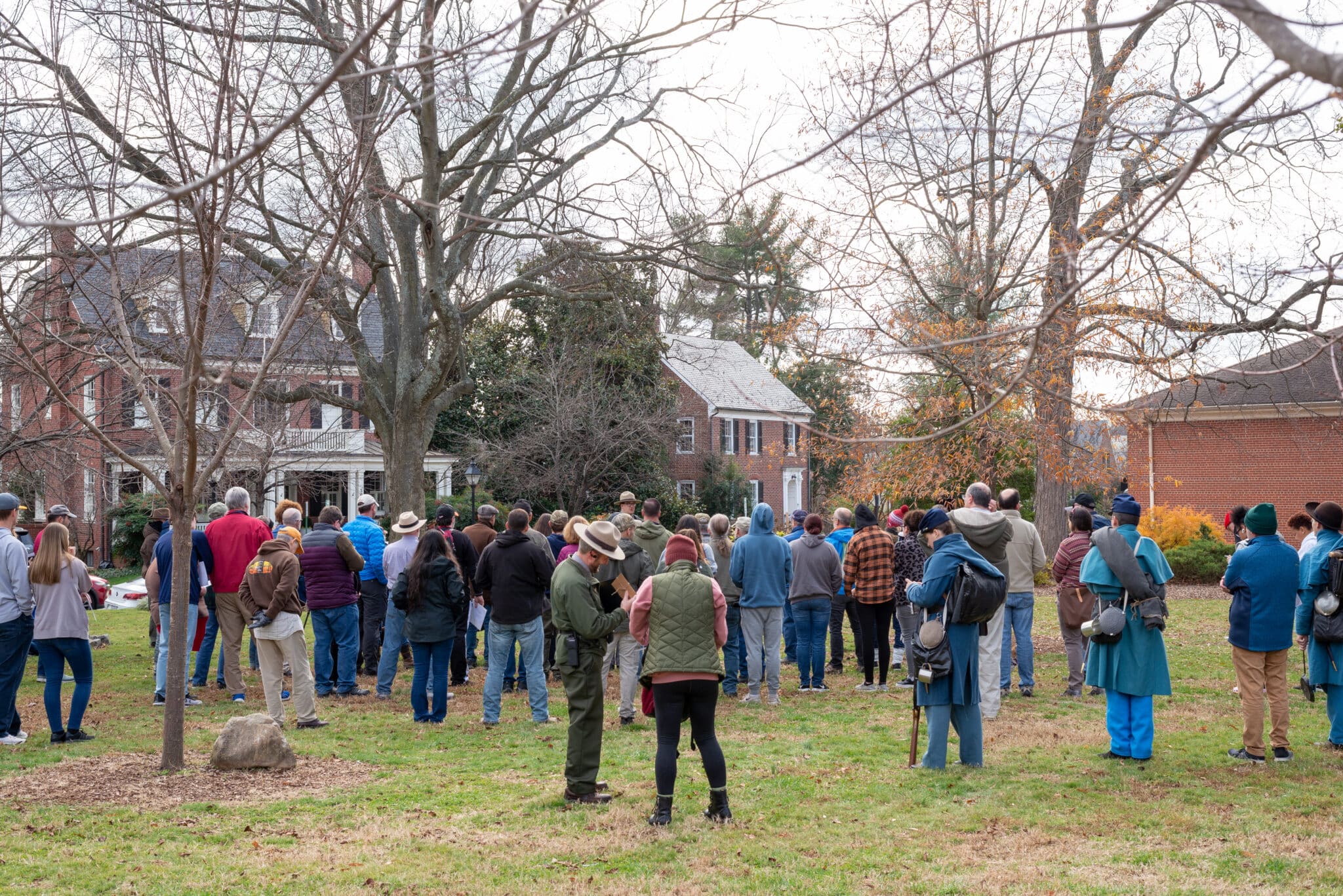
Having a tour consist entirely of nothing but questions is also a valid approach to public history. The National Park Service’s focus on interpretation in the 21st century is known as Audience Centered Engagement (ACE), wherein the group or audience is as much a resource as the thing being toured. There are a wide variety of methods and practices to get people engaged, especially through the use of questions. And as park guides and rangers use ACE techniques to impart knowledge, it’s just as important to keep the road open to two-way traffic: the audience should feel comfortable enough and welcome enough to express doubt, or ask clarification, or think aloud, “What about. . .”
The NPS’s use of ACE is decidedly a newer strategy, moving away from what was known as “The Sage on a Stage.” For many people over the years, that’s what they got when they showed up to a site. Someone wearing a Smokey Bear hat would stand in front of them for 30-45 minutes (or maybe more if they got chatty…) and just talk—spouting dates and facts and generals’ names, and maybe an odd quip or two to spark some polite laughter. But at the end of the day, a Sage on the Stage, as much as they’re respected for their encyclopedic knowledge on a topic, can just as easily become an uncontrolled fire hose of information. They can spout those same facts and dates and statistics and generals’ names without actually recognizing that members of their audience have tuned out because they don’t know all those names and are embarrassed to speak up, or perhaps because such a flow of info presented that way can be boring. Taking the time to ask the audience “Any questions?” is an easy, built-in way to track in real time that everyone is on the same page.
And so what if the audience is asking the same questions as previous tours? Let that be part of the experience for the audience—let them hear “Hey that’s a great question, lots of people wonder the same thing.” What do you imagine the chance of a follow-up question is after that, as opposed to an eye-roll or an “I already answered that”?
There’s a philosophy in public history—no one’s really sure where exactly it came from, though it’s commonly (mis)attributed to Edgar Dale, the well-renowned educator—that people only remembered 10% of what they read, and 20% of what they heard. If that’s true (and generations of interpreters have been taught it is) even if an audience had the greatest interpreter in front of them who enraptured them with a solid 45-minute talk, that audience would walk away promptly forgetting 80% of what that interpreter said. But, that same interpretive philosophy went on, 70% of audiences remembered what they themselves said or wrote, and a fully 90% remembered what they personally did. If we go with these numbers, an audience’s tendency to remember information simply by asking questions or repeating the info rises in a flash from 20 to 70%. That seems a small but easy way to get a victory in the interpreter’s column.
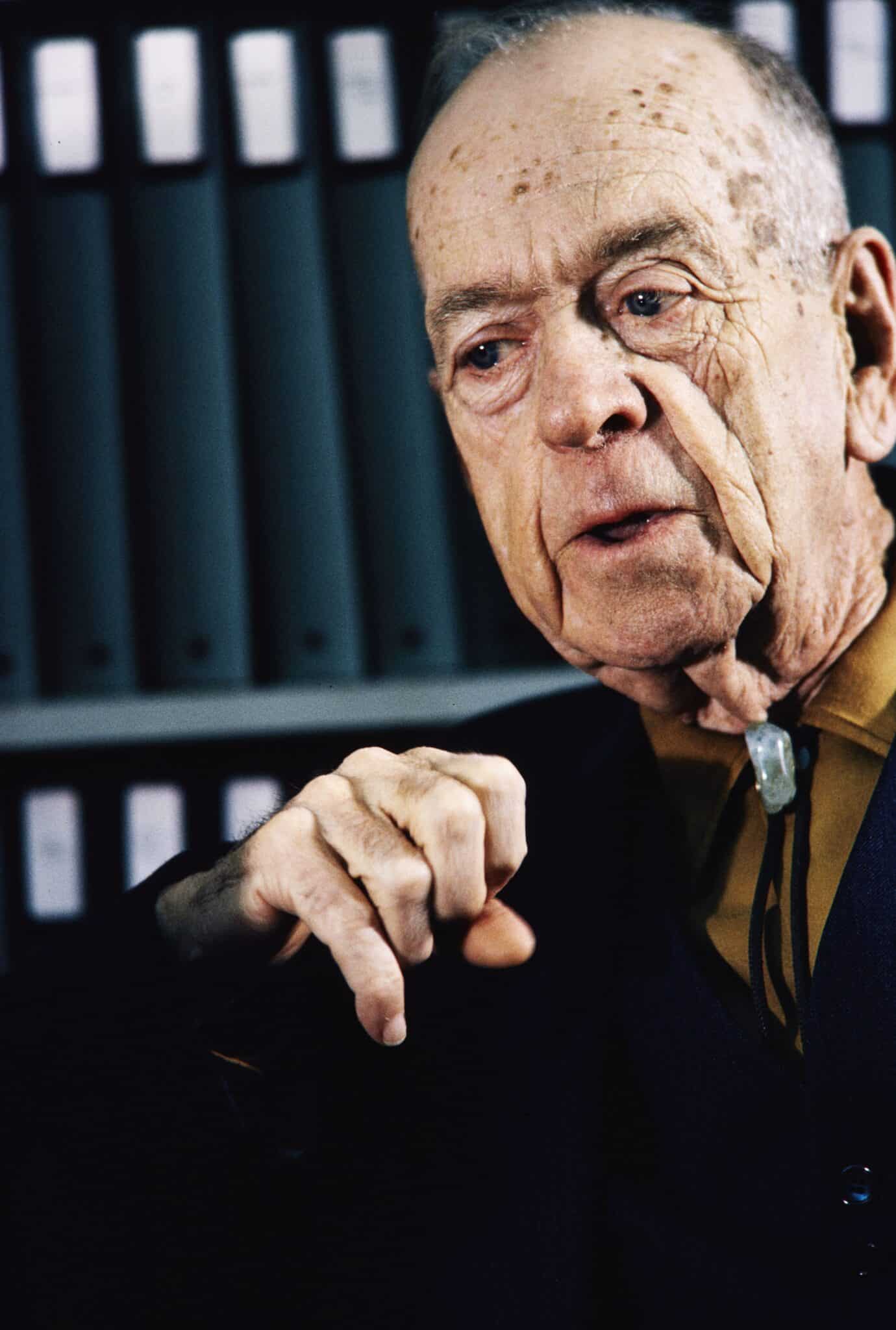
I want to finish my defense of questions by going back to the grandfather of interpretive philosophies, Freeman Tilden. In his seminal Interpreting Our Heritage, Tilden lays out six guiding principles on what is, and isn’t, interpretation. For the sake of our argument, let’s highlight Principle 1: “The chief aim of Interpretation is not instruction, but provocation” and Principle 3: “Information does not equal interpretation, but all interpretation contains information.” In other words, listing a series of facts or generals or brigades on a battlefield is not, in and of itself, interpretation. But rather how do we use that information to provoke our audiences to think about and interact with what we’re talking about. I believe the usage of questions is a perfect way to gauge that provocation.
As we finish here, I’d ask people to reflect on a particularly good tour or talk they’ve been to. What made that tour so memorable? Was it that the interpreter had such a masterful knowledge of the material, or how they used it?
Were you inspired to ask questions?


Thought provoking open-ended questions with no “right” answer leaves a memory in each member of the audience.
I understand where Garry is coming from, but I ultimately agree with you. I think there are folks out there who maybe don’t know anything about the Civil War but are curious, and feeling secure in asking questions other people might think are “dumb” is important. I’m not saying Garry would ever be dismissive of a questioner, but he shouldn’t look at it as a failure on his part, but an opportunity to engage people of all levels of knowledge.
They’re great points/questions, Ryan. Ultimately, we must realize that styles vary amongst speakers, just as they do amongst writers. We are planning an extended reading tour in the US and Europe when my book, ‘Till The Stars Appeared,’ is published next year. The benefit to me is that as a marketing director, I’ve done countless seminars and trainings on three continents, plus I’ve taught university on two. It’s mainly been business management courses for undergrads and MBAs, but I also had the honor of being the first American to teach American History in Viet Nam since the war.
The Civil War is endlessly fascinating, not least because we have a gigantic supply of information from it – and occasionally, as in my case, we find something new – so for this topic, the key is to control the flow of information. One does not want to overwhelm the audience, as you noted, or go off on tangents. One could begin a two-hour talk on the a Civil War subject and end up spending six days discussing the various carbines that cavalry troopers used. Thus one cannot let it get out of control. While I will entertain questions during trainings and will during my book tour, they must be kept quick and the speaker must shut down a tangent before it grows. Another tangent that can occur, with the Civil War, is trolls. You get the folks who have hardly read a Civil War book, but have made the grievous error of watching ‘Gettysburg’ and Ken Burns’ PBS series a dozen times each and thinks he knows everything about the war and want to make a noise contradicting the speaker on his topic – or on something he’s not even talking about. The trick is to not entertain his nonsense and to shut him down quickly, e.g. “You paid to come to this event and hear about my book – and so did these other people. I didn’t pay to listen to you. If you think you have a point to make, write your own book, and for now, be quiet. These folks want to listen to me.”
How does one create tours? Taking the key information, the heart of the story that audiences want to hear, and presenting that with supporting photographs and maps. In my case, the story is an intensely personal one, so I’ll go light on battles and campaigns except for vital things that directly involved the people I’m discussing.
How does one do research? Believe it or not, despite doing endless research for one’s book, new research must be performed for the tour – pulling from the book what is salient, and also weaving this with what is currently popular in Civil War studies, and what your audience is likely to want to hear. All are interested in your story, but speaking to veterans, or people over age 60, or university students – who often have to have their heads emptied of the politicized nonsense that’s been shoveled into them – you have to tailor your talk to the audience. That’s marketing research – being a marketing guy, I love to do it.
How does one synthesize difficult subject matters into easy-to-understand concepts? Boil it down, take the essence of the issue, and emphasize that most of these topics are gray, not black and white. People will claim it was a war about slavery…but the Union included six slave states. Many Southerners fought for the North. Many Northerners – more than historians want people to know – fought for the South. Maryland, Kentucky and Missouri remained in the Union – and sent entire regiments to the Confederate armies. Again, historians in dereliction of duty will tell you that no blacks fought for the South, but not only did many individual blacks do so, but an entire company of blacks was in a regiment of Albert Sidney Johnston’s Army of the Tennessee at Shiloh. That’s the most effective way of keeping people engaged when they hear facts they’ve been trained to disbelieve.
And, like any talk, any story or book: Have a beginning, middle and end. You must leave the audience with a finite understanding of something that is new and/or fascinating to them as they depart.
To extend the thought process here even further, I will add to the concept of questions via teaching. In the classroom (which of course is not a battlefield tour) I am regularly asking questions from students to determine the schema of the class as a whole, to get them thinking about a topic/theme, and to help move things on to the next concept. It is true that there is only so much time in a tour, class, or lecture and that you cannot cover everything you might want to. For educators, sometimes we deliberately leave out information to force students to ask the questions. Not every instructor does that, but it can be a useful tool if done well. A good classroom lecture is really a back and forth with students, not just someone speaking to students. I have done some bus touring before involving historic sites (admittedly not major battlefield tours) and questions from those in the tour helped me tailor the day’s activity to the interest of those taking the tour itself.
Ryan,
Questions are the stepping stones to understanding. And to improve understanding one must be able to land on each stone, maintain one’s balance and pivot in a stable direction. That might be straight ahead, left or right, backwards, or stand still until balanced.
But audience silence during a public history, battlefield tour, does not help the speaker guage audience understanding. There must be an exchange of communication between speaker and audience. Questions produce that exchange and improve the path ahead;
Questions from the audience or questions posed by the speaker.
I try to improve with each public presentation and look forward to researching that which is questioned by my audience or the unconscious insight that arises to myself and emerges as a question to cover next time out.
But above all, the public speaker must set the tone for active exchange, making it clear right from the start, that all questions are encouraged and there is no such thing as a dumb question, and all are free to ask whatever they feel will enlighten them or the group.
Ryan, yours is a thoughtful, and thought-provoking, piece. Thank you. Your discussion on the topic of “questions” brings to mine what I was taught as a young lawyer, a lesson that may have application here.
Lawyers poised to appear before a judge – say in connection with a motion filed seeking some result for the client – of course prepare their arguments. They may have a full speech ready, they may only have an outline, but always they have the points they wish to stress in attempting to persuade the judge to adopt their position. The lawyer walks into court wanting to make their carefully chosen points.
But then the darn judge asks questions. Some lawyers are thrown off by questions from the bench. Some may even resent the interruption, thinking that if only the judge will hold his/her tongue, the lawyer will enlighten the judge according to the lawyer’s planned script. The lawyer may give a brief reply just to humor the judge, while seeking to get back to the lawyer’s planned presentation.
But I was taught that a judge’s question was a gift. The fact of a question revealed what was on the judge’s mind, what issue the judge was thinking about, and perhaps what concerned him/her. The question itself was a golden opportunity. Good lawyers during oral argument thus embrace questions as an opportunity to educate, enlighten, correct, persuade.
I submit that the same principle applies to tour guides, or other types of presenters. Do not characterize questions as a failure of presentation on your part, or any type of distraction. Questions reveal more about the questioner (and his/her interests) than the presenter. They are a golden opportunity to make whatever overall point you wish to advance. Embrace questions.
Kevin: As we know, it’s even more challenging at the appellate level when you have a designated time to argue (such as 15 minutes or 30 minutes) and you’re facing questions from three/seven/nine judges. No matter how much you prepare, unanticipated questions come up and it’s an opportunity to (1) gain insight into what somebody involved in the decision is/may be thinking and (2) explain how your argument fits that point. Separately I’ve done some CWRT presentations and I’ve never seen questions as indicative of failure but as the chance to get into details that might not be logically covered in the outline.
Great post and topic, Ryan. I second all the comments above. And Tilden still holds up really well after all these years . . .
I actually listened to the same Civil War Monitor podcast, but I understood Garry’s answer a little differently. While I don’t think he was trying to eliminate questions altogether, I felt that he was trying to incorporate some of those ‘common’ questions so they wouldn’t have to be asked.
If the last 5 tour groups all asked “Why isn’t it just called Pickett’s Charge anymore?” or “Where were all the pontoon crossings at Fredericksburg?”, then that seems like information that could be incorporated into the presentation without having to wait for someone to ask that question.
But don’t get me wrong, I love tours with more public engagement, and thought-provoking questions, too.