Book Review: A Nation Unraveled: Clothing, Culture, and Violence in the American Civil War Era

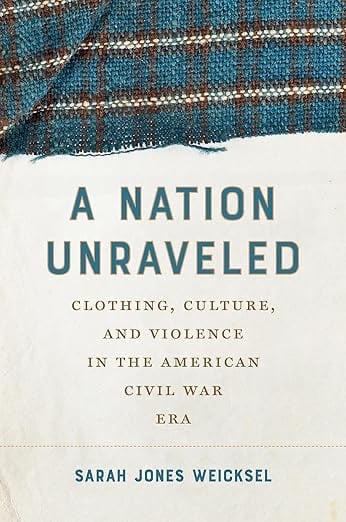
Sarah Jones Weicksel’s new book, A Nation Unraveled: Clothing, Culture, and Violence in the American Civil War Era is a well-researched work that covers the topic of material culture, specifically clothing and textiles, explaining the societal importance of clothing worn by soldiers and civilians, including white men and women of all classes from both the North and the South, and by previously enslaved individuals. It joins a large number of books on this heavily studied topic but sheds new light on the important role clothing played before, during and after the Civil War.
The book moves away from the battles and leaders. Instead, the narrative focuses on the lives of everyday men and women whose stories are contained in personal letters and diaries. These are the words and feelings of those who experienced the war. They provide raw emotion and intimate, honest insight. The work is well-organized and contains many pictures so the reader can feel how the war was affecting people in their daily lives. These personal records and newspaper accounts illustrate how the war disrupted people’s daily lives, right down to the clothes they wore, and how they reacted to these changes.
From the diary of Sarah Morgan Dawson, a member of the white planter elite, we learn that after meeting acquaintances while wearing a dirty dress admitted that she was “ashamed” by her appearance: “every one as dirty as possible; I had on the same dress I had escaped in, which, though then perfectly clean, was now rather—dirty.” (186-187)
Other women and children displaced by the advancing armies were not so fortunate, as noted by a relief worker observing many “in fields or hovels, scantily clad in garments ill suited to the season and daily dying from exposure and want.” (187) Further, a diary notation by Kate Cummings expressly talked about the rising cost of fabric. She was able to purchase calico for “three dollars per yard” (187) in July 1863, but that same material in November 1864 cost eight dollars per yard.” (187)
The book is divided into four sections: “Making,” “Wearing,” “Destroying,” and “Saving,” taking the reader deep into the life cycle of clothing during the era covered. The detailed Introduction outlines what each section of the book will cover.
In Part II, “Wearing,” Chapter 4, Confronting Emancipation, Clothing and Transformation, the author discusses at length how relief workers provided the hordes of recently freed enslaved with second-hand clothing. She states, however, that “although supportive of emancipation, many relief workers—white and Black—still harbored biases toward formerly enslaved people and worried about the challenges posed by the upending of a social order that was predicated on enslavement. They worried about the social and economic implications of emancipation… But they also worried about the material world in which they lived. What should a post emancipation society—and the people who lived in it—look like? How could material goods shape new definitions of freedom? And how might clothing be employed in limiting the bounds of that freedom?” (119)
In Part III, “Destroying,” in Chapter 7 The Garb of Treason, Struggles over Clothing at War’s End, the author points out that the wearing of Confederate uniforms post-war caused a dilemma for the Federal Government. While the government accepted a reconciliatory tone, its military commanders objected to clothing that represented rebellion. In both Tennessee and West Virginia, wearing a Confederate uniform could subject the wearer to arrest and imprisonment. (201)
This is a very well-written, successful book, well-organized, and a must-read for anyone who wants to “see” and “feel” the conflict beyond the battlefield.
This book has received high praise from critics and Civil War historians alike and would be of particular interest for a number of readers including Civil War reenactors who will appreciate why soldiers and civilians dressed the way they did and what those choices meant, both socially and politically. History buffs and Civil War enthusiasts would appreciate this book as it goes beyond the battlefields. It would have particular appeal as well to those who enjoy reading narrative-driven, well-researched non-fiction. This reviewer in particular is interested in the Civil War from its cultural perspective so discovering how people of different classes, genders, and races were affected is very enlightening.
Betty Shideler, a longtime student of the Civil War with continuing education certificates from the American Battlefield Trust, is a living historian who has portrayed multiple civilian personas including Francis Steptoe Burwell of Avenel Plantation in Bedford, Virginia. Betty’s emphasis on the civilian experience is highlighted by her “Death and Mourning in the Civil War Era” program, which she has presented at numerous venues, including the American Civil War Museum at Appomattox and the History Museum of Western Virginia, among others.
Betty is a member of the Friends of Lucy Breckenridge which host events at the Jubal Early Homeplace in Hardy, Virginia where she is a docent. She is also a Civil War sites tour planner and guide for numerous sites, including Brandy Station, Chancellorsville, Culpeper, Harpers Ferry, Harrisonburg, Lynchburg, New Market, and Saltville.
She is an officer of the Roanoke Civil War Round Table (past Treasurer and current Editor of its newsletter, The Civil War Dispatch).


A unique perspective on a topic that usually receives little attention
thanks Betty, great review … does the author comment on the cultural significance of all the variation in uniforms — Zouaves with red pants and fez hats, sharpshooters with green coats, et al … it would seem that early in the war uniforms weren’t very uniform.