The Other Side of the Coin: Mildred Lewis Rutherford and the Paradox of Female Power
ECW welcomes back guest author Mark Harnitchek.
To fully understand the mechanics of female political power in American history, we must also examine the powerful conservative women who marched in exactly the opposite direction from progressive women reformers. This is an under-explored chapter of women’s history that features staunchly conservative, anti-suffrage Southern women who wielded tremendous political and cultural clout. As architects of the Lost Cause, they were highly effective actors who shaped government policy and public memory as forcefully as any man who cast a ballot. They were on the other side of the women’s movement coin. And no one embodies this power more than the educator and Lost Cause activist from Athens, Georgia: Mildred Lewis Rutherford, a.k.a. Miss Millie.
Born into Georgia aristocracy in 1851, Rutherford was a child of wealth and privilege. Her family was well connected with the southern political and academic elite; her uncles included two Confederate generals and a former (U.S.) Speaker of the House. When the Civil War demolished the Old South, Rutherford did not retreat into quiet, impoverished nostalgia — she turned to ideological instruction and shaping the South’s cultural memory of the war.[1]
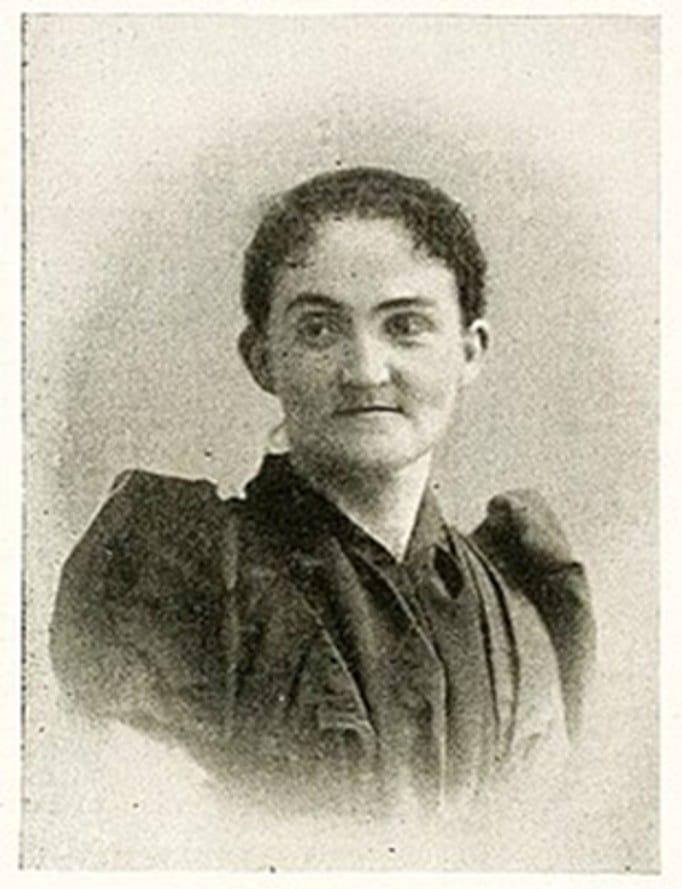
Crucial to her eventual rise to power, however, and much like other powerful women of her era, Rutherford never married. In 19th-century society, this allowed her to keep legal, financial, and professional independence throughout her life. Spinster status permitted her to freely maneuver in public and political circles in ways a married woman could not.
For over forty years, she focused that independence on serving in various capacities, including president of the Lucy Cobb Institute in Athens. Under her leadership, the school went from a small, failing local academy to the premier finishing school for the daughters of the Southern elite. But Rutherford was not just teaching French and literature to empty-headed debutantes; she was indoctrinating future generations of Southern matriarchs. She used her position to craft a loyal, highly sophisticated network of women who were in step with her version of the Old South, the War Between the States, and the Confederacy.
Rutherford also used her platform to fiercely oppose women’s suffrage, arguing that women did not need the vote. She argued that “feminine influence and persuasion (was) power enough to direct legislative bodies.” Despite living a decidedly non-traditional life as one of Georgia’s most recognized and outspoken women, she stridently contended that southern ladies should stay out of the public eye and fully embrace traditional domestic roles. This was the ultimate paradox of Rutherford’s life, a contradiction that she never acknowledged. [2]
In time, Rutherford’s local renown in Georgia propelled her onto the national stage. From 1911 to 1916, she was the historian general of the United Daughters of the Confederacy (UDC), and she used the Confederate Veteran magazine to get her message out. While she did not edit this widely read periodical, she leveraged its significant reach. Recognizing that the magazine was the center of gravity of the south’s memorial network, Rutherford used UDC’s dedicated section of Confederate Veteran to publish her monthly articles and study guides. By 1916, she had her own byline: the “Historian General’s Page,” and Rutherford used it to ensure that her unreconstructed vision of the Old South was read by the magazine’s 30,000 subscribers.
Rutherford was a key leader in the south’s cultural counter-offensive. In addition to her literary skill, she was a compelling public speaker who traveled the country dressed in her hoop skirts, delivering lectures defending the Southern cause and the truths of the Confederacy. Rutherford was also never averse to bending the truth. In Dallas, Texas, at her farewell address as the UDC’s historian, she delivered a 90-minute history lesson on the Lost Cause stating “…the negroes in the South were never called slaves. That term came (from) the abolition crusade. They were our servants, part of our very home, and always alluded to as the servants of a given plantation.”[3]
Looking back, it is easy to imagine the prim 65-year-old Miss Millie — the picture of lace-collared, matronly charm — delivering this outrageous bit of historical fiction in a warm, perfectly polite Georgia drawl. But beneath the crinoline and lace was a hard-nosed organizational genius and skilled culture warrior who understood a basic truth: Whoever controls the schoolbooks eventually controls the narrative.
Rutherford’s most devastatingly effective contribution to the southern cause was her 1919 manifesto, A Measuring Rod to Test Textbooks, and Reference Books in Schools, Colleges, and Libraries. The purpose of the 24-page pamphlet was to ensure that textbooks adopted for colleges, schools, and other scholastic institutions accord full justice to the South (and) presents the truthful facts of Confederate history.” [4]
The book was a set of general orders for UDC chapters across the South. If a publisher wanted to sell books below the Mason-Dixon line, they had to pass Rutherford’s litmus test. Her ten commandments for acceptable “full justice and truthful facts” were comprehensive and absolute. Here are a few:
- “Reject a book that calls the Confederate soldier a traitor or rebel, and the war a rebellion.” (The acceptable title was the War Between the States).
- “Reject a book that says the South fought to hold her slaves.” (The acceptable cause for the war was States’ Rights).
- “Reject a book that speaks of the slaveholder as cruel and unjust.” (The acceptable portrayal was slavery as a benevolent institution).
- “Reject a book that speaks of the Constitution other than as a compact between sovereign states.” (This laid the legal groundwork for students to believe secession was constitutional).[5]
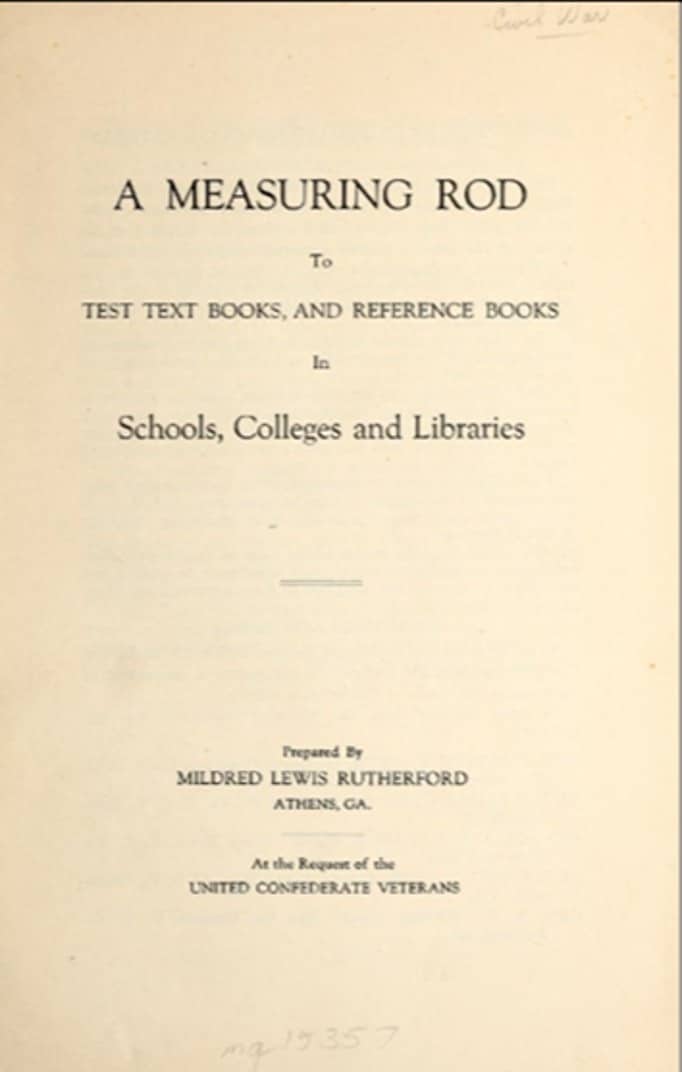
The genius of the Measuring Rod was its utility in the hands of UDC women. Brandishing the little book like a rifle musket, Rutherford expected UDC chapters to march into county school board meetings and demand removal of textbooks that were “Unjust to the South.”[6] Fearing boycotts and the wrath of the UDC, publishers gave in and often printed sanitized “southern editions” just to pass her inspection.
Rutherford spent her life constructing this historical narrative, gathering thousands of documents, letters, and artifacts to support her work. But in a twist of supreme irony, Rutherford’s archives did not survive her. On Christmas night of 1927, a fire destroyed her Athens home. She survived the blaze, but her life work turned to ash. Rutherford died eight months later, in August 1928.
Yet, her cultural and physical footprint outlasted the flames, leading directly to modern battles over historical memory. Today, the University of Georgia houses students in Rutherford Hall. Built as a women’s dorm in 1939, the university demolished the old building in 2012 and built another dorm on the same site and kept the name. Today, it remains the center of controversy, as some students and faculty wage campaigns to remove the name of the South’s premier propagandist from their campus.
Rutherford reminds us that female power in American history has not always been a tool for righteous causes and progressive ideas. Sometimes, it has been a brilliantly organized, tastefully dressed engine of white supremacy disguised as historical “truth” and sold so effectively that generations, North and South alike, believed it – the other side of the women’s power coin. Rutherford’s culture warriors did not want equal rights or the vote; they had all the rights they needed to advance their agenda and were perfectly secure in their role as powerbrokers atop the social hierarchy. Acknowledging the effectiveness of women like Miss Millie is essential to understanding the often-complicated arc of women’s history.
Mark Harnitchek is a retired military officer and currently a student in George Mason University’s History Ph.D. Program.
Endnotes:
[1] One of Rutherford’s uncles was Howell Cobb, former Speaker of the House, Governor of Georgia, and Secretary of the Treasury. He commanded a brigade in the ANV and Georgia reserves in the Western Theater. Thomas Reed Rootes (T.R.R.) Cobb famously commanded Cobb’s Legion. T.R.R. was killed at Fredericksburg. In popular culture, Cobbs Legion was Ashely Wilkes’ unit in Margaret Mitchell’s Gone with the Wind.
[2] Sarah Case, “The Historical Ideology of Mildred Lewis Rutherford: A Confederate Historian’s New South Creed,” The Journal of Southern History, Aug. 2002, Vol. 68, No. 3, 614.
[3] Mildred Lewis Rutherford, The Civilization of the Old South: What Made It, What Destroyed It, What Has Replaced It (Athens: United Daughters of the Confederacy, 1916), 6.
[4] Mildred Lewis Rutherford, A Measuring Rod to Test Text Books, and Reference Books in Schools, Colleges, and Libraries (Athens: United Confederate Veterans, 1919), 2-3.
[5] Ibid, 5.
[6] Ibid, 3.


Excellent article. Miss Millie’s propaganda is well presented. I always knew that there were thise who wished.to keep the idea of a glorious Douth alive, but this is the first time hearing about Rutherford and her life’s work. A real zealot no matter how wrong she was.
This article is a prime example of “might makes right” propaganda. In fact, Ms. Rutherford was and still is correct on each of the enumerated points, all based on economic and political facts. The real zealotry is this recent effort to denigrate the entire existence of the South, similar in scale and tone to the propaganda Ms. Rutherford was addressing. This article and its appearance on a FB page named “Emerging Civil War” perhaps reflect the fact that interest in the War had simmered down over the many decades to a general detente, with interest mainly in the battleground logistics and strategies, until it was mysteriously resurrected c. 160 years later to wage current day political warfare. Needless to say, this is irritating to those who know the real history, in depth, and don’t appreciate being called “zealots” by people who are singlemindedly bent on telling the story “their way or the highway”.
I’d like to hear how she was correct on each of the enumerated points. Confederate soldiers gloried in the name “Rebel” before, during and after the Civil War. For the millionth time, we have “The cornerstone speech” and plenty of State constitutions saying that secession and in turn the war was about slavery. At the barest of minimums, owning another person is cruel and unjust. Finally I’ll take the word of Daniel Webster over the word of John C Calhoun any day. Stay on Facebook. You Lost Causers should secede from this blog, and start your own. “Submerging Civil War” has a nice ring to it.
It is always fascinating to see someone accuse modern scholars of waging “current day political warfare” while simultaneously defending one of the most ruthless political warfare operatives of the 20th century.
Let’s be honest for a moment. I harbor a grudging admiration for Miss Millie. As an information warfare officer, she was a force of nature. Armed with nothing but hoopskirts and Southern Belle willpower, she executed a PSYOPS campaign that quarantined southern schools from objective primary sources for half a century. It’s a good thing she didn’t have the internet, or there would be a whole lot more people still whistling “Dixie.” Building a propaganda juggernaut that still generates devoted foot soldiers like Mr. Carson 160 years later is an organizational masterclass. I have to respect her hustle.
But claiming her writings were based on “economic and political facts” is pure comedy. Miss Millie famously published a rubric instructing schools and libraries to ban any book that didn’t glorify the antebellum South. That isn’t knowing history “in depth;” it’s curating fan-fiction. Modern historians aren’t “resurrecting” political warfare to denigrate the South—they are simply reading the actual secession declarations that Miss Millie spent her entire career desperately trying to hide.
PS (for all you Lost Causers): The men who served in the war understood exactly what it meant to surrender. When the ANV stacked its arms at Appomattox, the operational reality was permanently settled. Armchair historians whining about the outcome a century and a half later dishonor those soldiers and that military finality. The war was fought and the loss was absolute. Recommend you take that loss like those men and move on.
Thanks Josephine … i came across Miss Millie’s little book at a church book sale many years ago … and i agree with you, she was a true believer … it’s also in the National Archives at: https://archive.org/details/measuringrodtot00ruth/mode/2up … it’s only 24 pages and worth a read.
thanks Josephine … I met Miss Millie when I ran across her little book at a church book sale … she was definitely a true believer … if you to know more, her little book is available in the National Archives at: https://archive.org/details/measuringrodtot00ruth/mode/2up
Excellent article!
And a timely reminder that “Freedom [from quackery] requires eternal vigilance.”
Thanks for adding to our understanding about Miss Rutherford and others like her who carried forward these perspectives which certainly shaped those of us growing up in the South in the mid-20th Century. It has been quite a journey for me in letting go of them and in learning a far more complex and accurate picture of the Civil War, as well as of the pre and post war decades.
This is a fascinating article about an evidently underrated historical figure! I had heard of similar movements to monitor and censor Southern textbooks in the early 20th century before, but never about Mildred Lewis Rutherford in particular. Thank you for shedding some light on her unique story.
I’m surprised to learn Confederate Veteran only had around 30,000 subscribers. Was it really that influential? The satirical magazine Puck had a circulation of nearly 90,000 in the 1890s. By 1900, Ladies’ Home Journal was approaching a circulation of 1 million. That’s just what I was able to find with a quick google search. Don’t get me wrong, this is an interesting topic, but when I read things like this, I can’t help wondering if the influence these characters had is somewhat overblown.
I had the same thought when I first came across that 30,000 number—it seemed incredibly small compared to other periodicals of the era—so I dug a little deeper. What I found is that you have to distinguish between mass-market consumer entertainment (like Ladies’ Home Journal) and targeted political machinery. Confederate Veteran wasn’t casual reading; it was the blueprint for political mobilization and the ideological battle plan for the United Confederate Veterans, the United Daughters of the Confederacy, and the Confederated Southern Memorial Association.
I first really understood this when reading David Blight’s Race and Reunion: The Civil War in American Memory. He notes that the Confederate Veteran and these organizations actively steered the Lost Cause movement at the turn of the century. Blight argues that the magazine ‘became the voice of the UCV, the clearing house for Lost Cause thought, and the vehicle by which ex-Confederates built a powerful memory community.”
As the official organ for the UDC and UCV, the magazine consolidated the communications of the entire Lost Cause apparatus into one centralized publication. A single subscription sent to a local chapter was read aloud at meetings, shared among dozens of members, used to draft local school board curriculums, and placed in public libraries. So, while 30,000 physical subscribers seems small, its ‘pass-along’ readership was exponential. Finally, it was hyper-concentrated among the southern political and educational elite—the exact people writing the laws, funding the monuments, and approving the textbooks. You don’t need a million casual readers to change a culture if you have 30,000 disciplined organizers.
Well, I guess the question then is, were the people reading Confederate Veteran getting “marching orders” from its editors, or were they reading it because they were already inclined toward that perspective and ideology? And Ladies Home Journal definitely had a domestic agenda it was pushing. One of its editors, Edward William Bok, also wrote over 20 articles opposing women’s suffrage. It should be noted that women’s suffrage was enshrined in the Constitution, so both Bok and Rutherford failed to pursuade a majority of the public, despite LHJ’s widespread popularity.
This is a reply to Michael – you said that “One of its editors, Edward William Bok, also wrote over 20 articles opposing women’s suffrage. It should be noted that women’s suffrage was enshrined in the Constitution, so both Bok and Rutherford failed to pursuade a majority of the public” – However, if you look at a ratification map, the only former Confederate states that voted to ratify the 19th Amendment prior to its adoption in 1920 were Texas, Arkansas, and Tennessee (which reluctantly finally provided the last state needed to complete the process). To put it more plainly, the ONLY states that refused to ratify the 19th Amendment were those of the former Confederacy plus Connecticut and Vermont. I’d say the editors were quite persuasive in their quest for anti-suffrage.
My kind of gal.