Book Review: John Yates Beall, Son of the South: The Life and Death of a Confederate Privateer

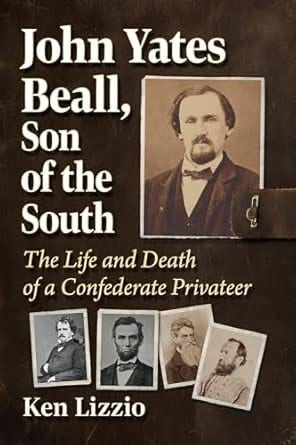
John Yates Beall, Son of the South: The Life and Death of a Confederate Privateer. By Ken Lizzio. Jefferson, North Carolina: McFarland & Company, Inc., 2026. Paperback, 216 pp. $39.95.
Reviewed by Robin Friedman
Abraham Lincoln was renowned for his compassion in issuing pardons or commutations to Union and Confederate alike. But there were times when Lincoln resisted strong public pressure to commute. Perhaps the most famous instance involved Nathaniel Gordon, a captain of a slave trade ship who was convicted and sentenced to death. Lincoln rejected widespread appeals for clemency, and on February 21, 1862, Gordon was hanged in New York City.[1]
Another case in which Lincoln resisted strong pressure to commute a death sentence involves John Yates Beall (1835 – 1865). A military tribunal sentenced Beall to death for spying and for guerrilla warfare for his Canadian-based actions on Lake Erie and in the State of New York. Lincoln anguished over the decision but let the sentence stand. Beall was hanged on February 24, 1865.
Beall’s interesting life is explored in John Yates Beall, Son of the South, by Ken Lizzio, a professor of anthropology and Middle East Studies. Lizzio’s book draws on historical sources, including memoirs and biographical notes by Beall’s lifelong friend, Daniel B. Lucas, the records of Beall’s trial, and on recent studies.[2] Lizzio presents a highly sympathetic portrayal of Beall and criticizes strongly his sentencing and hanging. More broadly, Lizzio argues against much current historiography which sees slavery as the underlying cause of the Civil War. Lizzio writes: “I hope to demonstrate that while slavery was surely an abomination, the Civil War cannot simply be viewed as a binary struggle between good and evil. The example of Beall’s conduct in the war, the Union’s unjust death sentence, and the courage he showed in his final days before the gallows demonstrate that the war was far more nuanced than that. As war goes, there was much to deplore on both sides—as well as to commend.” (3-4)
As Lizzio recounts, Beall fought under Stonewall Jackson early in the War. He was wounded and disabled from further army service. His subsequent meetings with Jefferson Davis led to two terms of service as a privateer even though Beall lacked naval experience. The first term occurred on the Chesapeake Bay where Beall became known as “Mosby of the Chesapeake” for his daring exploits. He was captured and treated harshly at Fort McHenry before being released on May 5, 1864, in a prisoner exchange.
Beall then became involved with the clandestine Confederate organization in Canada under Jacob Thompson that was responsible for planning certain desperate Confederate terrorist activities in the late stages of the War. These terrorist activities included an attempt to set fire to New York City (albeit Beall was not involved in that plot). Instead, Beall operated as a privateer on Lake Erie with the goal of capturing a Union gunboat, the USS Michigan, and freeing Confederate officers imprisoned on Johnson’s Island. This daring plan, which included an effort to drug the Michigan’s crew, did actually succeed in capturing a ship to be used in the plot, but ultimately proved unsuccessful.
Beall next tried to derail a train to free Confederate officers he believed were on board. Again, the effort failed. Beall was arrested in Niagara, New York and under the direction of Major General John A. Dix was tried and convicted for spying and guerilla activities and sentenced to death. The great defense lawyer James T. Brady represented Beall, but to no avail. President Lincoln refused the many requests to intervene in the case. He deferred to the view of Dix that Confederate actions in Canada needed to be deterred. Beall had been operating in Canada, a neutral country, behind enemy lines, threatening Union cities and civilians not directly involved in the conflict. Sometime after Beall’s February 24, 1865 hanging, Lincoln said:
“There are cases where the law must be executed. The case of Beall on the Lakes—there had to be an example. They tried me in every way. They wouldn’t give up. But I had to stand firm. I even had to turn away his poor sister when she came and begged for his life, and let him be executed, and he was executed. And I can’t get the distress out of my mind yet.” (193)
Despite other merits of his book, Lizzio’s discussion of what he perceives as the injustice of Beall’s fate and of what Beall’s life shows about broader issues of the Civil War is less than convincing. Lincoln acted carefully and thoughtfully under the circumstances and reached a reasonable, if difficult, conclusion even though many people plausibly urged leniency. On the broader issue, there is little in Lizzio’s account of Beall, his character and his loyalty to the Confederate cause that challenges the position that slavery was the underlying cause of the Civil War, even assuming that Beall was unjustly executed. Beall nevertheless tells his story of Beall’s Civil War exploits well. The book will enhance the reader’s knowledge of a relatively obscure but fascinating part of the Civil War.
Robin Friedman retired from a career as an attorney with the United States Department of the Interior in 2010. In retirement, he pursues his passion for American studies, including literature, history, philosophy, and the Civil War.
[1] See Hanging Captain Gordon: The Life and Trial of An American Slave Trader, by Ron Soodalter. New York: Washington Square Press, 2006.
[2] Lizzio uses two recent studies of Beall which have been reviewed on ECW. The first study is “Confederate Privateer: The Life of John Yates Beall” by William C. Harris, reviewed by Gordon Berg on December 19. 2023. The second study is “Confederates from Canada: John Yates Beall and the Rebel Raids on the Great Lakes” by Ralph Lindeman, reviewed by Robert Grandchamp on April 16, 2024.


