Loose Lips Sink Steam-Sloops: Civil War OPSEC on CSS Sumter
Civil War participants wrote voraciously. Letters and diaries pack archives across the United States, and thousands of postwar memoirs and reminiscences have been published. In their writing, wartime soldiers and sailors did not hold much back, penning about everything from combat experiences to food to boredom. Also frequently included in these writings were extensive details of troop movements, operational plans, and leadership characterization – information which, frequently enough, ended up in the press and later the hands of the enemy.
Today, members of the armed forces undergo extensive training in OPSEC – operational security. Knowing when to keep quiet, knowing what information can be shared with who, and always being alert to potential phishing for information is just the baseline of such security. Back in my time in the Navy I sat through countless briefings about the process. It is safe to say, however, that Civil War soldiers and sailors were not trained in operational security.
While diving into the files at the National Archives recently, I ran into a surprising case of clear operational security implementations made by the officers aboard the Confederate commerce raider Sumter. Skippered by Raphael Semmes, the raider dashed past the blockade of the Mississippi River at the end of June 1861 and quickly began taking prizes. Semmes made port in Trinidad and Curaçao before docking in Puerto Cabello, on Venezuela’s coast, at the end of July. The Confederates “found an empty harbor, there being only two or three coasting schooners anchored along the coast; there was a general dearth of business, and the quiet little city was panting for an excitement.”[1]
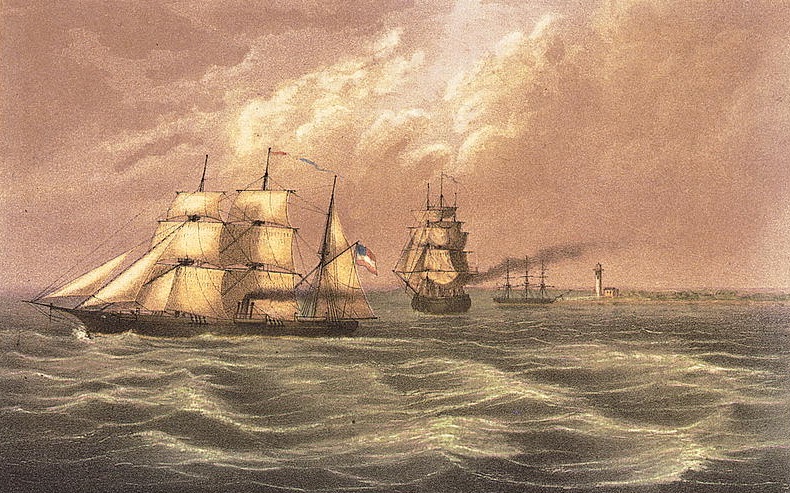
Sumter docked in Puerto Cabello because it had just captured a prize named Bradford and Semmes wanted to “see whether I could not prevail upon” Venezuela’s government “to admit my prizes into his ports,” hoping that “an arrangement could be made with some of these beggarly South American republics, the revenue of which did not amount to a cargo of provisions, annually, and which were too weak, besides, to be worth kicking by the stronger powers.”[2] After docking, Semmes ordered a prize crew to take Bradford to New Orleans, where it arrived in August.
When making port, sailors hurried to communicate with loved ones. Today, phone calls and emails flood home, just as letters filled mail bags in the nineteenth century. Sumter’s officers were no exception, with most rushing a quick note addressed to their loved ones in the fledgling Confederacy. What stands out is that these notes home all had a similar aura of OPSEC, hinting that the officers were coached on exactly what to write.
Lieutenant John M. Kell, Sumter’s executive officer, set the tone in his letter home: “We ran in here [Puerto Cabello] yesterday morning, my beloved wife, with our ninth prize, and dispatch her this morning for the United States. We are all well and doing well. Can not write more for fear of this falling into the hands of the enemy. Kiss our little ones.”[3]
Lieutenant William E. Evans’s note was shorter, but echoed those same sentiments: “My dear mother: I am well; in good spirits; and all well and doing well. I cannot write more for fear of this falling into the hands of the enemy. We have thus far captured nine prizes. My love to all.”[4]
Lieutenant Robert T. Chapman said as much (or as little) in his own note home: “My darling Mildred: All well and doing well. I cannot write any more for fear it will fall into the hands of the enemy. Write to Pa, and believe me yours till death.”[5]
Lieutenant John Stribling’s note was another carbon copy letter home: “My own dear wife: I am well. We have taken nine prizes. I cannot write more. Love to all, particularly Ma. May God Bless you and restore us to each other speedily.”[6]
Surgeon’s Steward Ralph P. Darby’s letter home was slightly more detailed, but nonetheless still largely reserved: “Friend Green: I take the opportunity offered by our ninth prize which is the only one so far, we have sent home, to let you know we are well and in good spirits. The Sumter has proved herself more than a match for everything so far.[7]
All these letters, which were loaded onto the prize Bradford and arrived safely in New Orleans, contained similar language, almost as if the officers were told exactly what to say. That coaching likely came from Kell, not Semmes. After reaching Puerto Cabello, Semmes wrote a status update to Navy Secretary Stephen Mallory, admitting in his memoir that “I did not resort to the use of the cipher, that had been established between us” for this report.[8]
Though Semmes himself did not maintain good operational security in his visit to Puerto Cabello, Sumter’s junior officers carried themselves better in one clear example of good Civil War era OPSEC. Just imagine if all wartime officers kept a similar tone; the impact on the war could have been striking, but the impact on historians today deciphering information from wartime letters and diaries would be severely diminished in the trade-off.
Endnotes:
[1] Raphael Semmes, Memoirs of Service Afloat in the War Between the States (Baltimore: Kelly, Piet, and Company, 1869), 164.
[2] Semmes, Memoirs of Service Afloat, 161.
[3] John M. Kell to Wife, July 27, 1861, Confederate Navy, Area 8, Area File of the Naval Records Collection, 1775-1910, M625, RG 45, U.S. National Archives.
[4] W.E. Evans to Jane B. Evans, July 26, 1861, Confederate Navy, Area 8, Area File.
[5] Robert T. Chapman to Mildred Chapman, July 26, 1861, Confederate Navy, Area 8, Area File.
[6] John M. Stribling to wife, July 27, 1861, Confederate Navy, Area 8, Area File.
[7] Ralph P. Darby to Green, July 26, 1861, Confederate Navy, Area 8, Area File.
[8] Semmes, Memoirs of Service Afloat, 165.


Seeing as how they all wrote basically the same thing, apparently being told what to write, had they *really* captured nine prizes by that point? Or was the “nine prizes” a form of operational security obfuscation in case the letters were captured and reprinted in the news?
Hey Henry, so by the time these letters were dated, Sumter had indeed captured 9 US-flagged merchants:
– July 3, Golden Rocket, burned
– July 4, Cuba, boarding party sent to take it to a friendly port (Sumter’s crew did not know for a while that Cuba’s crew recaptured their ship from Sumter’s prize crew).
– July 4, Machias, boarding party sent to take it to a friendly port.
– July 5, Ben Dunning, boarding party sent to take it to a friendly port.
– July 5, Albert Adams, boarding party sent to take it to a friendly port.
– July 6, Naiad, boarding party sent to take it to a friendly port.
– July 6, Louisa Kilham, boarding party sent to take it to a friendly port.
– July 6, West Wind, boarding party sent to take it to a friendly port.
– July 25, Bradford, boarding party sent to take it to a friendly port (ship was eventually overhauled by the US blockade).
Interesting to point out that the letters might fall into enemy hands, as the ship Bradford indeed was captured by blockaders as it attempted to reach the Confederacy.
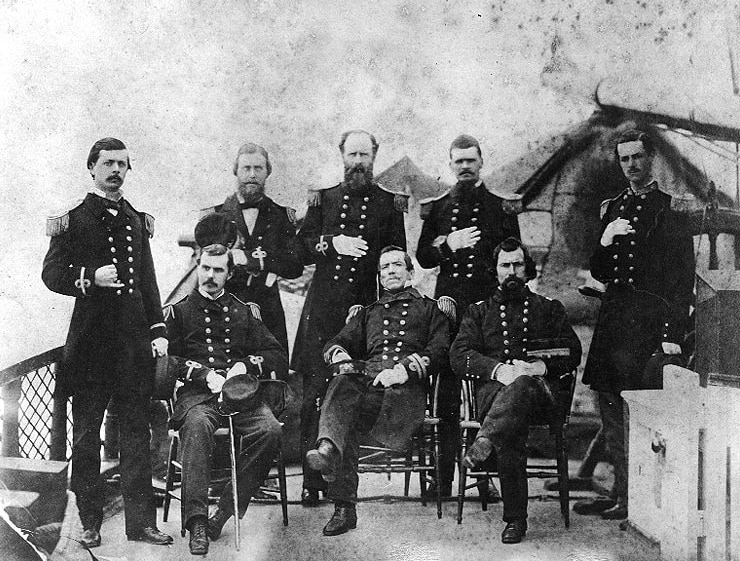
Interesting article. Thank you Neil. What struck (and surprised) me the most, however, was the fact that the CSA officers in the photo had such fine uniforms.