Shrouded Veterans: Dismissed Colonel’s Cryptic Vicksburg Message
In June 1876, a reporter with The Philadelphia Inquirer described “a man whose head is adorned with the frosts of sixty winters” and whose “pale, intellectual face is covered with a snowy beard that extends at least a foot,” presenting a peculiar invention that attracted the attention of scientists and machinists alike.
The man, Dr. John Jacob Updegraff, constructed a parallel-motion machine of the finest steel money could buy, including planes composed of solid silver, weighing 400 pounds. The machine reportedly had the power to lift 50 pounds. The device operated with metal balls roughly the size of billiard balls and a wheel located near its center, giving it the appearance of a clock. “[I]n the discovery of this new motion,” the reporter declared, “Dr. Updegraff has conferred a substantial benefit upon mankind.”
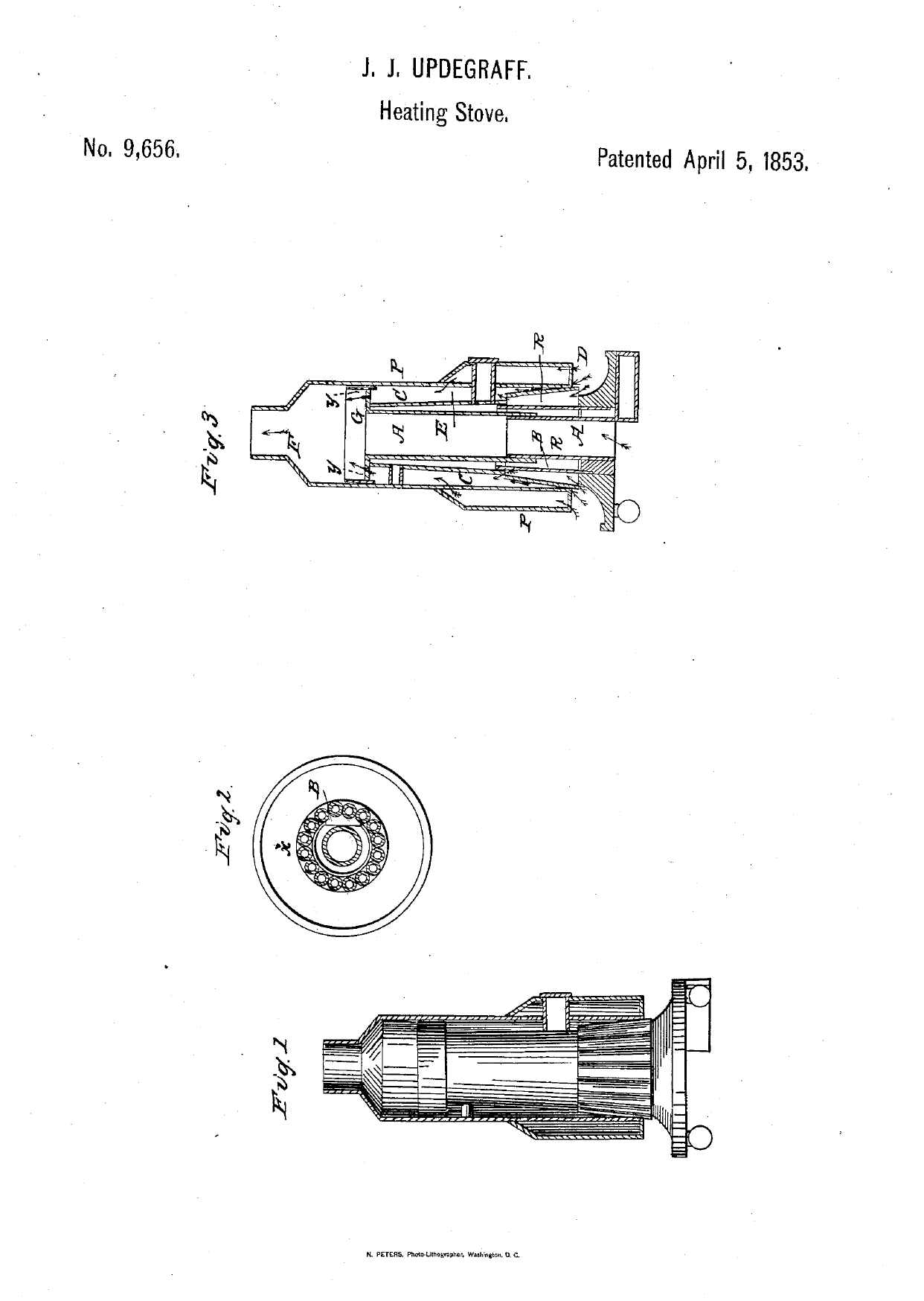
Eight years earlier, Updegraff invented a perpetual-motion machine that derived its power from four brass balls. “It is a simple matter of four balls, two on each side, weighing about six ounces each, so manipulated by this principle of combination leverage that while one on one side is descending and moving the entire machine it is raising the other in position to do the same work,” one observer noted. “Thus do they alternate in their work, and keep up a constant and regular movement.” It was estimated that with 50-pound balls, the power obtained would be equal to eight horses.
The machine ran in a small room on the first floor of a building on Sansom Street in Philadelphia for eight years, until the materials from which Updegraff had constructed it wore out from long service. That led him to use better metal for his parallel-motion machine. He claimed that he had once been offered $100,000 for the rights to the invention, but he turned it down.
Clifford B. Hicks, in an article for American Heritage, wrote that perpetual motion, dismissed by physicists, “was a field made to order for fakers, and all kinds of humbugs were built to fleece a gullible public.” The most notable of these was Updegraff’s predecessor, Charles Redheffer. Updegraff — an eccentric surgeon, possible genius, opium addict, and dismissed cavalry colonel — fit comfortably within the class of perpetual-motion schemers.
Before he embarked on unraveling the “illusive phantom” of perpetual motion, Updegraff had once been a respected eye and ear surgeon in Pennsylvania and New York. He advertised his many years of experience operating “on all the various forms of blindness, cross eyes, club feet, harelip, cleft palate,” as well as performing “the extraction of tumors, amputation of limbs, and all other surgical diseases.” He described his tools of the trade as “all instruments in modern Surgery, of the latest improvement and finest finish.”
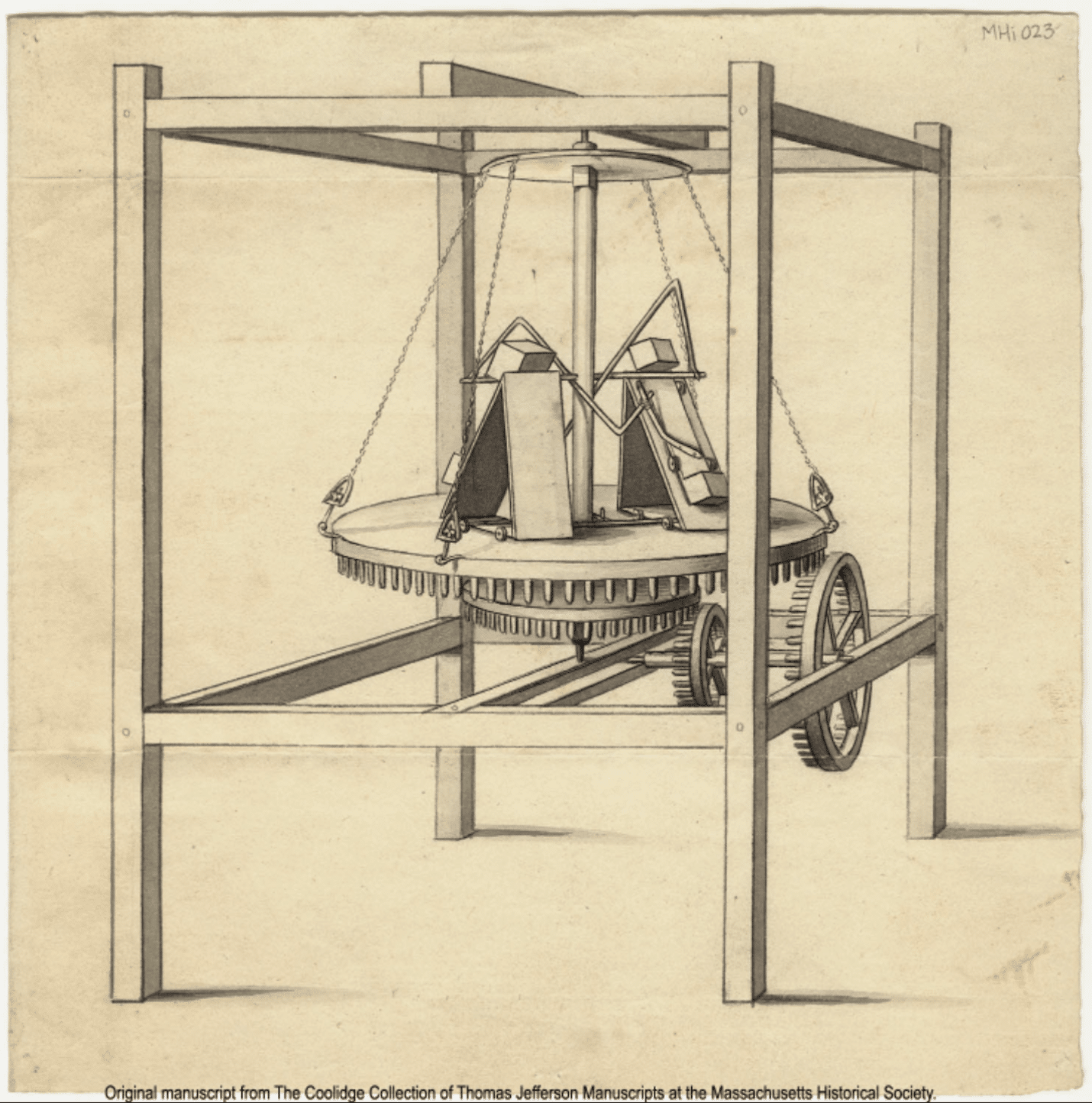
In September 1849, Updegraff’s beautiful home in Jackson Township, Pennsylvania, went up in flames. After finding his headboard and pillow on fire, Updegraff gathered his family and fled the burning home in the nick of time. He lost nearly everything, but the most painful losses were his library of 1,500 volumes and surgical instruments valued at $2,000. All the family managed to salvage was some bedding and a few books. Updegraff estimated his total loss at about $8,500.
After paying out $3,200, Updegraff’s insurance company, Lycoming Mutual Insurance Co., charged him with inflating the value of his property and took him to court. “The trial was attended with considerable excitement in Lycoming County,” Pennsylvania’s Sunbury American recalled on December 22, 1849. “The sympathies of the people were with the Doctor, and his acquittal, we understand, was received with tremendous applause.”
With war fever at an all-time high three weeks after the fall of Fort Sumter in 1861, Updegraff wrote to Pennsylvania’s adjutant general seeking a military commission. At the time, he was living in Mattoon, Illinois. “You no doubt have forgotten me being absent from Pa. for some years, but I am of the old stock of the Updegraff family of Dauphin Co., Pa.,” he told him. “A family who never asked or desired office. This is an exception and desire none other than one of a military character.”
He claimed to have had 20 years of experience in battalion and regimental drill and to have held commissions as major and colonel in a volunteer corps. An ad in the March 31, 1849, issue of the Sunbury American mentioned him as a candidate for brigade inspector and noted, “Should he be elected, he trusts that a military education, with considerable experience in military tactics, will enable him to discharge the duties of the office in a creditable and satisfactory manner.”
Instead of receiving an appointment in Pennsylvania, Updegraff was appointed colonel of the 5th Illinois Cavalry by Illinois Gov. Richard Yates on September 9, 1861.
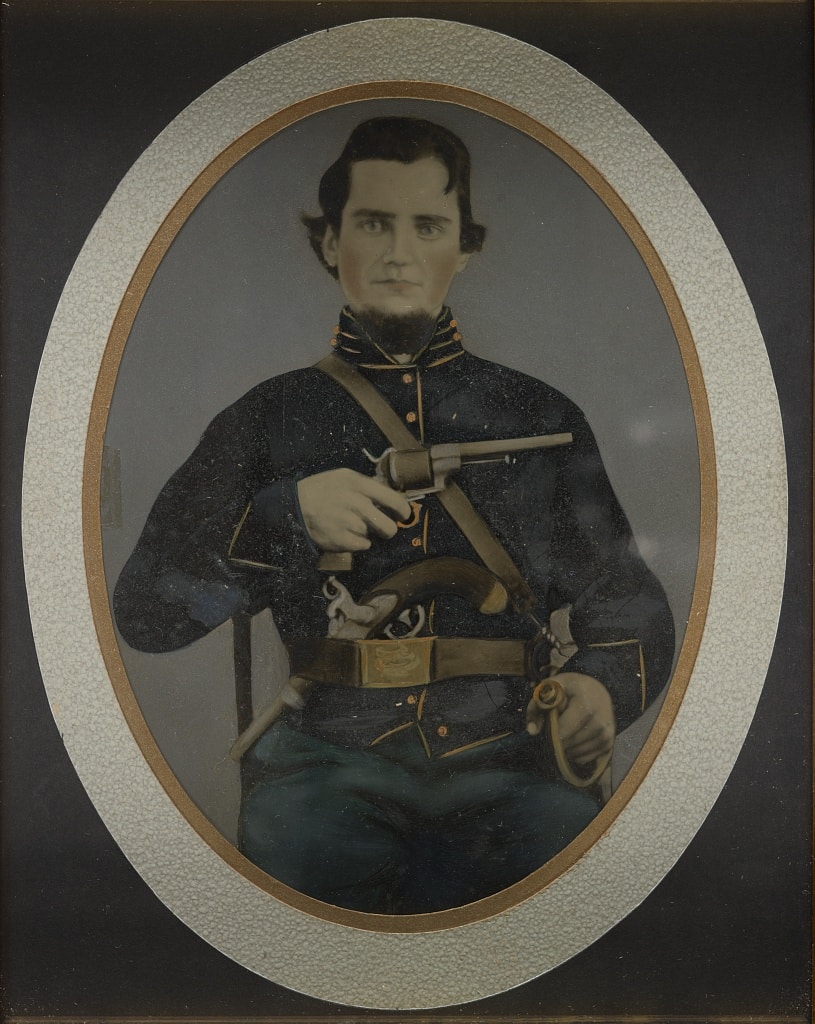
Updegraff’s four sons also volunteered for military service. One son, Joseph M. Updegraff of the 23rd New York Infantry, was shot and killed near Bristow, Virginia, on April 13, 1862. He and a companion had gone foraging and strayed about a mile from camp when a sergeant confronted them. Updegraff refused to return to camp because the sergeant was not wearing any insignia. When the sergeant ordered Updegraff to stop, he refused, prompting the sergeant to shoot him. Another son, Alphonso F. Updegraff of the 21st Pennsylvania Cavalry, was killed in an accident on the Northern Central Railway while returning home in January 1865.
Even before the 5th Illinois Cavalry left the state for the front, Lt. Col. Benjamin L. Wiley and Maj. Thomas A. Apperson brought a charge of “conduct unbecoming an officer and a gentleman” against Updegraff. On October 24, 1861, the court convened in the U.S. District courtroom in Springfield, Illinois. It was composed of 12 officers, including John A. “Black Jack” Logan, then a colonel. Updegraff requested that the proceedings be made public.
The 11 specifications that made up the charge, published in the Illinois Journal, included:
- 1st. That he, Col. Updegraff, recommended to the Secretary of War the appointment of E. Blank, of St. Louis, as sutler of his regiment, in consideration of having received from said Blank $150 in money, a basket of champaign, and ten demijohns of whisky.
- 2nd. That he has been intoxicated several times in public places since his appointment as colonel.
- 3rd. That he has introduced liquor in the camp, and thereby encouraged drunkenness on the part of the soldiers.
- 4th. That he has several times visited houses of ill-fame in the city of Springfield, to the public disgrace of the service and of his regiment.
- 5th. That he publicly introduced two women of ill-fame into his camp while the regiment was on dress parade, and at the hour of dusk publicly walked out with them beyond the limits of the camp, also to the disgrace of the service.
- 6th. That he endeavored to excite insurrection amongst the soldiers of his command by inflammatory speeches and distributing liquor among them.
- 7th. That he made speeches in camp, charging his subordinate officers with having defeated his efforts to equip and arm the regiment.
- 8th. That he endeavored to excite mutiny against the Lieutenant-Colonel and Major of his regiment.
- 9th. That he issued furloughs to his men in violation of the orders of Col. Pitcher, commandant of the camp, and told his men not to obey the orders of Col. Pitcher.
- 10th. That he publicly declared that Major-General John C. Frémont intended to surrender the army under his command to the rebel forces, and that he, Col. Updegraff, intended to take the 6th Illinois cavalry to Fremont’s army, and surrender it to the rebels.
- 11th. That at the Virginia Hotel in the city of St. Louis, he falsely registered his name as F. Shepherd.
“Updegraff pleaded not guilty to the 3d, 5th, 6th, 8th, 9th and 10th specifications, and filed exceptions to the remainder, averring that if true they were not contrary to the articles of war, and the court therefore had no jurisdiction over them,” the paper recorded.
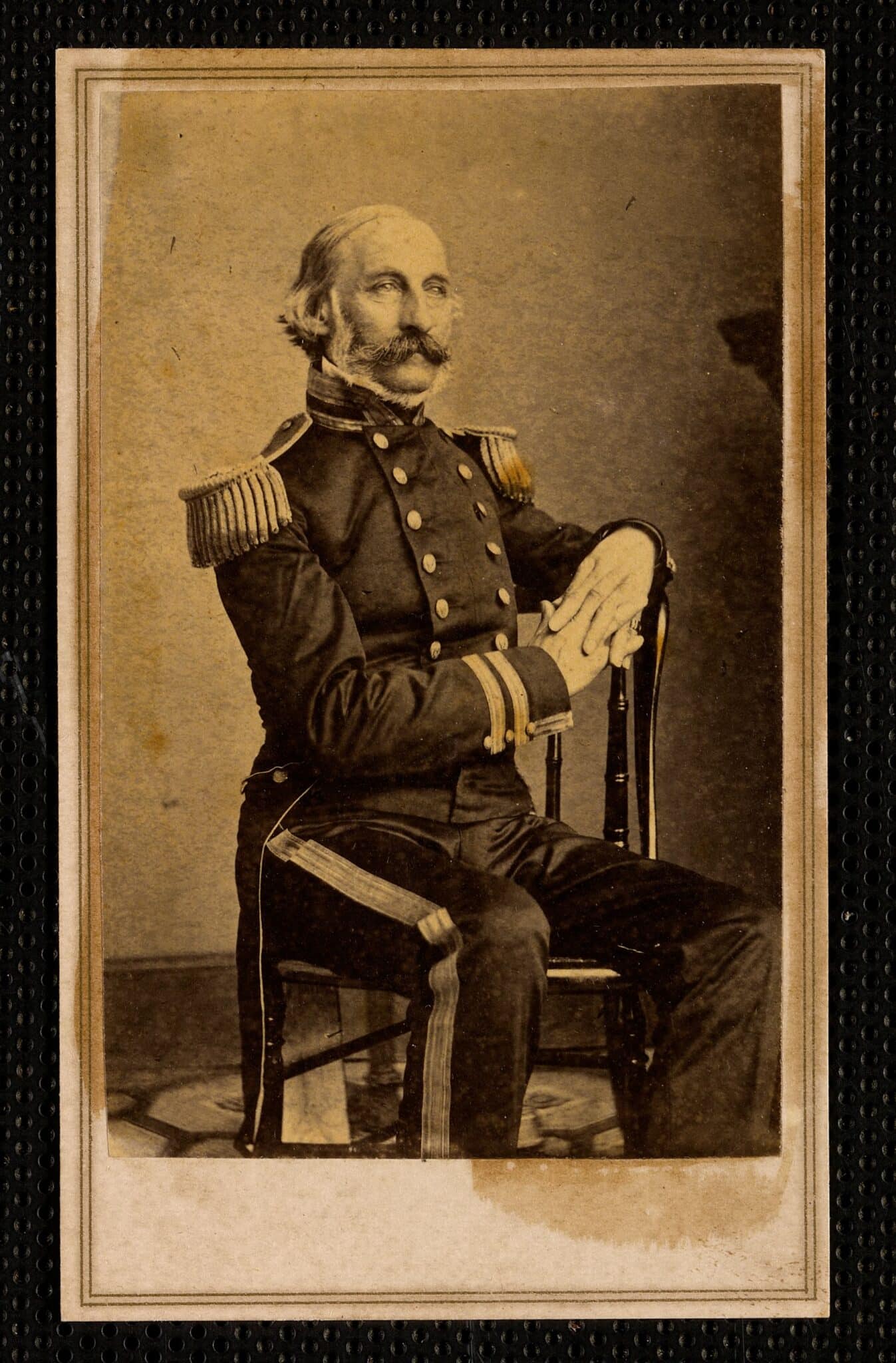
The court found Updegraff guilty only on the fourth specification. On December 3, 1861, Gov. Richard Yates approved his dismissal.
But that wasn’t the last time Updegraff’s name appeared in the war records. On June 8, 1862, he penned a cryptic letter from the Commercial House in Memphis, Tennessee, to Commodore Charles H. Davis, commander of the Western Gunboat Flotilla, claiming to have secret plans of the Confederate fortifications at Vicksburg in his possession.
“I have in my possession the plan of the fortification of Vicksburg, with the number of guns, their caliber, location, number and distribution of troops, and other particulars,” he noted. “If this is valuable, you can have an interview with me. I am here on business on my own, and there is some suspicion against me here. Please be cautious, as it may incur inconvenience and perhaps difficulty.”
It’s unclear whether Davis responded to Updegraff, whether Updegraff had obtained this information from an informant, risked his life to jot down these details while spying in enemy territory or completely fabricated them.
That same month, The Chicago Evening Journal reported that Updegraff “has turned up here as an avant courier for a strolling band of minstrels.” The paper did not elaborate on who composed the group.
Updegraff’s oldest son, Thaddeus S. Updegraff, was wounded at the Battle of Mill Springs during the war and later ran the Eye and Ear Institute in Elmira, New York, after resigning his commission. He was a gifted oculist who reportedly could cure blindness. He died in 1885, and in his obituary for the Proceedings of the American Microscopical Society, his friend George E. Blackham wrote, “His father was a distinguished surgeon of eccentric habits and great mechanical genius, but unfortunately a slave to the opium habit. From him the subject of this memoir inherited his genius and an extremely sensitive, nervous organization.”
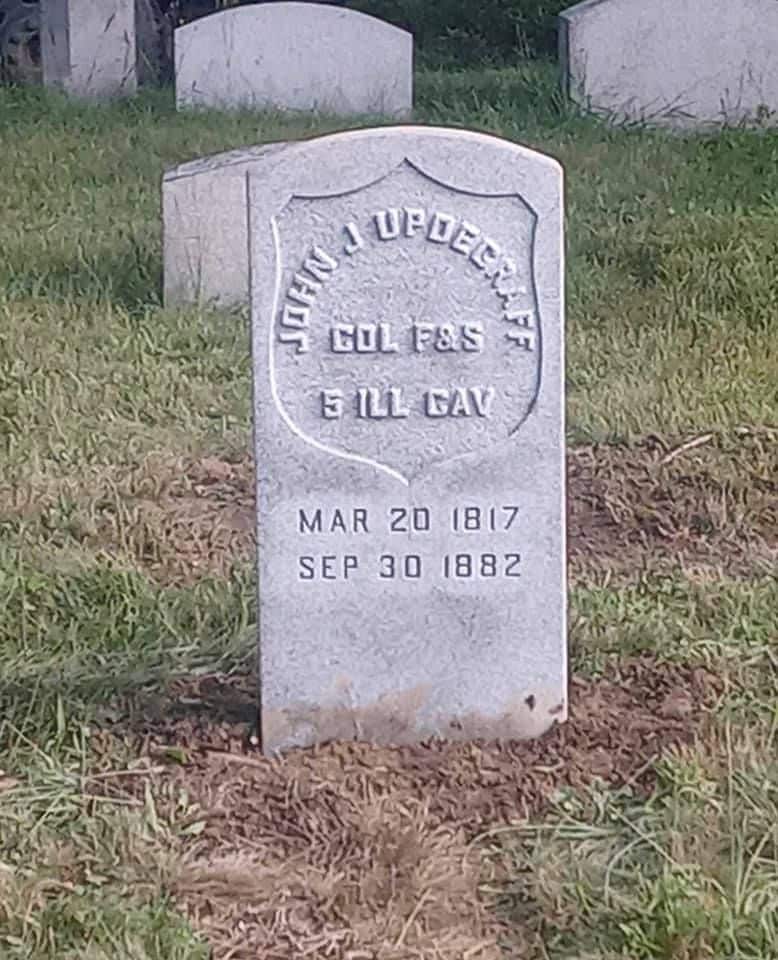
John J. Updegraff died on September 30, 1882, in Flint, Michigan, and his remains were taken to Elmira, New York, where they rest at Woodlawn Cemetery alongside other Updegraffs. In his death notice, Michigan’s Grand Rapids Weekly Leader noted that he “is now in the place where everything is supposed to be perpetual” — a nod to, or perhaps a jab at, his fixation on perpetual motion. A veteran headstone was added to mark his previously unmarked grave.
Shrouded Veterans is a 501(c)(3) nonprofit organization dedicated to rescuing the neglected graves of 19th-century veterans, primarily Mexican War (1846-48) and Civil War (1861-65) soldiers, by identifying, marking, and restoring them. You can view more completed grave projects at facebook/shroudedvetgraves.com.
We’re now on Substack! We’ll gradually be adding past and recently completed headstone projects.


