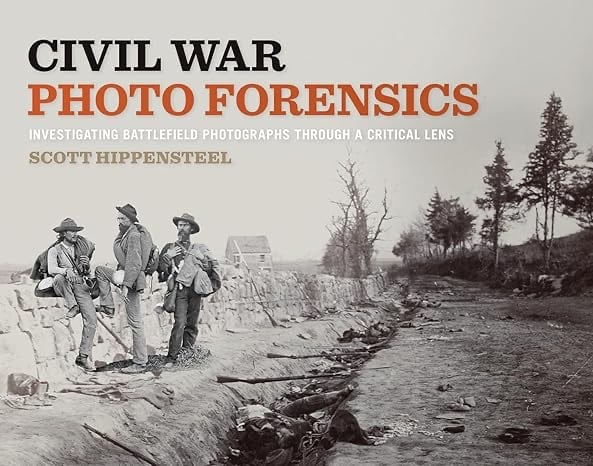
Book Review: Civil War Photo Forensics: Investigating Battlefield Photographs Through a Critical Lens
Civil War Photo Forensics: Investigating Battlefield Photographs Through a Critical Lens. By Scott Hippensteel. Knoxville: University of Tennessee Press, 2026. Hardcover, 214 pp. $35.95.).
Reviewed by Melissa Winn
Scott Hippensteel’s Civil War Photo Forensics: Investigating Battlefield Photographs Through a Critical Lens sets out with striking ambition. Its stated goal—to identify the most “iconic” Civil War photographs and the most “historically significant”—immediately places it in anxious territory. Civil War photo historians have long been cautious of absolutes. Labels such as “most popular” or “most significant” defy a neat definition, shaped instead by shifting scholarship, public memory, and even the dynamics of modern digital circulation. Any effort to quantify them is almost certain to draw skepticism from experts in the field.
Hippensteel contends the book offers “an entirely novel approach to determining the most iconic—by this measure, best known and most republished—photograph from the last 100 years and ends with the discussion and argument for the war’s most historically important photograph and photographer.” (ix) The first section of the book explores his methodology and its photographic findings. Which photos he concludes to qualify, I’ll leave to you to find out.
Three additional sections of the book then tackle the argument of historical significance by analyzing multiple topics, including what the subtle details of an image reveal about the photographer’s motivations, how the technological process of taking photos impacts the images and can help us identify time and place, how to apply scientific analysis to determine the chronology of a series of photographs, and an exploration of whether Civil War photographers were photojournalists or artists. Here, Hippensteel admits he “delves into controversy” (4) as he explores the issue of image manipulation, including the practice of staging or rearranging elements within a scene. The book includes an ambitious number of provocative topics to address.
One of the book’s central case studies underscores this. The infamous “Harvest of Death” photograph—taken in the aftermath of the battle of Gettysburg by Timothy O’Sullivan and printed by Alexander Gardner—serves as a focal point for extended analysis. Few images in Civil War photography have generated as much debate as this one and its ambiguous location. Photo Historian William A. Frassanito introduced the mystery in his groundbreaking studies of Gettysburg photography in the 1970s, and it has since fueled decades of articles, online discussions, and, even recently, spirited social media exchanges.
Hippensteel devotes a substantial chapter of the book to this image and its longtime debate, even offering up his own theory to solve the mystery location with a hypothetical application of modern technologies including Geographic Information Systems (GIS). While intellectually interesting to the most ardent of Civil War photo historians, this extended analysis of the battlefield’s shifting geology may test the patience of more casually interested readers. Hippensteel ultimately (and accurately) concedes that his proposed identification is unlikely to achieve consensus.
There are lighter, more accessible elements to enjoy in the book. Brief biographical sketches of prominent Civil War photographers provide helpful context, and a playful “Where’s Mathew Brady?” feature—reminiscent of the popular “Where’s Waldo?” game—injects a bit of levity. Perhaps most appealing is the visual presentation itself. With more than 100 Civil War photographs reproduced in high-quality, glossy format, the book succeeds as a visual experience, especially in its cropped-in photo details akin to Garry Adelman’s popular inspection of Civil War photos. (Adelman’s devotion to the study of these photographs, including the Harvest of Death, makes an appearance here, as well, even if his first name is unfortunately misspelled. Sorry, Garry!)
Even for readers well acquainted with these images, there is always value in revisiting them with fresh eyes, scrutinizing details, and considering new interpretive angles, and this book delivers on that account.
The book may not provide definitive answers for the lofty questions (or rankings) it proposes—nor, perhaps, should it. Its value lies more in the questions it provokes than in the conclusions it reaches. It offers a reminder that even the most familiar images still have stories left to tell, whether or not we can agree on what those stories are and which ones matter “most.”