Book Review: Point Lookout, Maryland: The Largest Civil War Prison

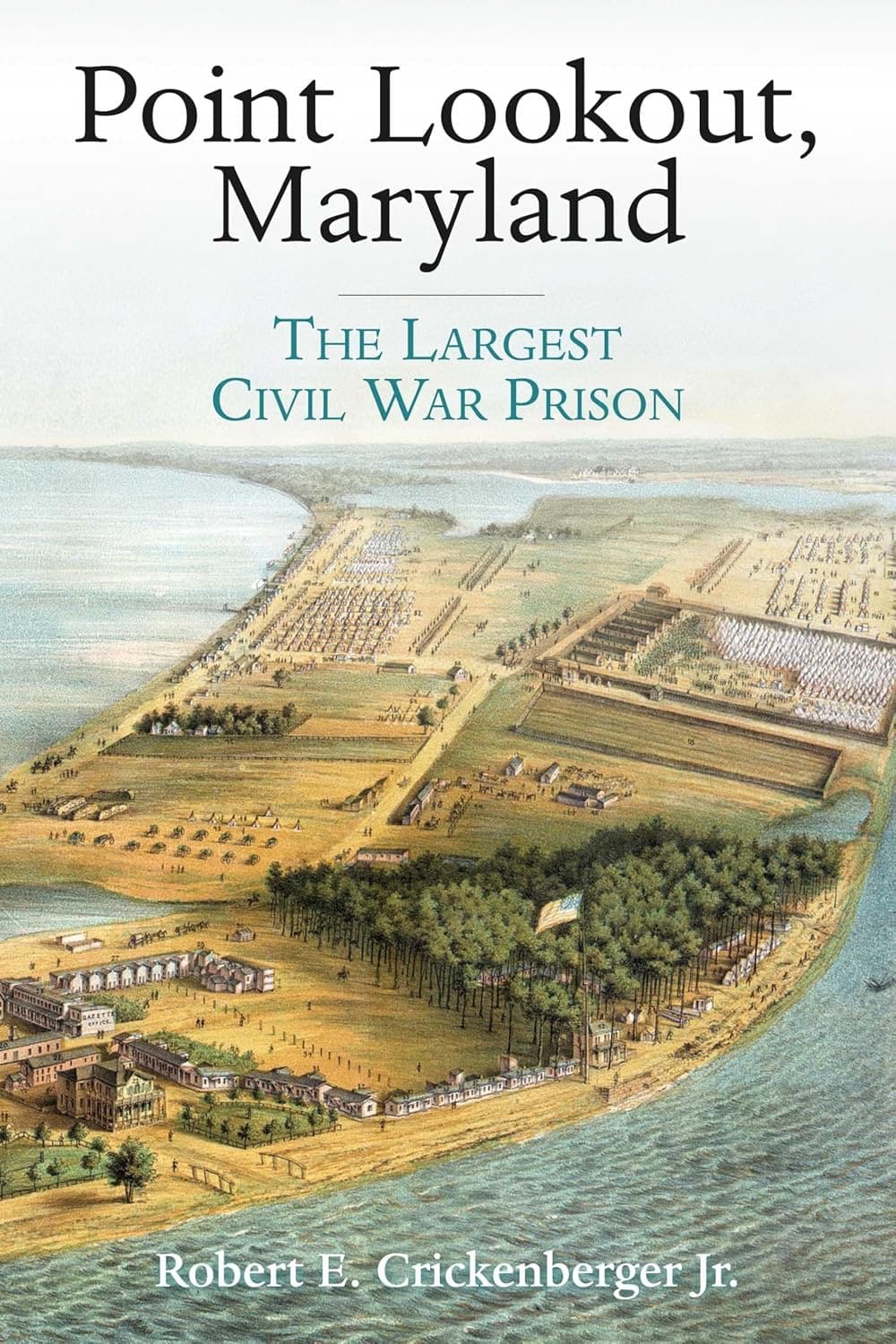
Point Lookout, Maryland: The Largest Civil War Prison. By Robert E. Crickenberger Jr. El Dorado Hills: Savas Beatie, 2026. Paperback, 262 pp. $20.28.
Reviewed by Kevin C. Donovan
Once the guns fell silent, Civil War veterans turned to ink and paper in bitter argument over a myriad of controversies arising from the conflict, from whether slavery caused the war to whether James Longstreet and/or Jeb Stuart lost the battle of Gettysburg, to whether Ulysess S. Grant was a “butcher” who only prevailed through bloody attritional warfare. The contested issues are well known.
It is asserted, however, that “no controversy ever evoked such emotions as the mutual recriminations between Northern and Southern partisans over the treatment of prisoners of war.”[1] Indeed, the only Confederate official hanged after the war was Capt. Henry Wirtz, the commandant of the infamous Andersonville prisoner of war camp, who was charged with deliberate cruelty to those under his sway. Even Robert E. Lee was interrogated by a Congressional committee seeking to determine if he shared responsibility for the suffering of U.S. POWs.[2] By contrast, Southerners pointed to Northern POW camps, especially that in Elmira, New York, as places where Confederates allegedly were deliberately starved to death.[3]
Into this morass of charges and counter-charges steps Robert E. Crickenberger Jr. In his Point Lookout, Maryland: The Largest Civil War Prison, Crickenberger seeks to “clarify the record,” while avoiding the “many postwar memories and diaries which often contain significant biases and faded memories, distorting the debate over responsibility for the conditions suffered by the prisoners at Point Lookout.” (xix) The author also wishes to highlight the role that the camp played in the overall U.S. POW system.
In thirteen chapters, Crickenberger provides a comprehensive overview of all aspects of the camp that at one point housed an enormous number (22,000+) of POWs. He first explores why the site seemed to make sense at first. The locale offered a broad expanse of available land coupled with a willing property owner, and an apparent healthy climate marked by sea breezes. Indeed, prior to its conversion into a POW camp, it had been used as a seaside resort for the wealthy. A major U.S. hospital was located there.
Yet, as Crickenberger explains, the environment actually was ill-suited as a place to drop thousands of prisoners, as it lacked adequate fresh water, hosted marshes filled with disease-bearing insects and exposed the inhabitants to adverse weather conditions. But the decision to site a POW camp there was made with good intention.
The author addresses the key issues that mattered most to the inmates—quantity and quality of food, shelter, and clothing issues. He observes that conditions changed over time, sparked by evolving opinions of the jailers as to what the prisoners legitimately needed for reasonable comfort, but then what was sparked by a policy of retaliation imposed after reports of mistreatment of U.S. prisoners by the Confederacy.
The author discusses complaints of hunger, to the point that some POWs turned to eating rats in desperation. Still, Crickenberger notes elements favoring their fair treatment, such as dedicated medical care and efforts to provide the POWs with vegetables to prevent scurvy and allowing fresh provisions from local merchants. He discusses overzealous camp guards accused of using excessive lethal force against perceived rule breakers, especially by United States Colored Troops serving as guards but carrying grudges against their former enslavers, but also records efforts by camp administrators to reign in any such abuses.
Crickenberger also calls out exaggerated claims of abuse by POWs who had no first-hand evidence to support their claims, as well as asserting that some claims of abuse made against Maj. Gen. William Hoffman, Commissary General of Prisoners, were ‘generated by the so-called “Lost Cause Myth.”’ (239) He notes that Hoffman followed what he understood to be the governing regulations and also operated from a perspective of trying to spend as little money as reasonably possibly on supporting those who, after all, were the enemy.
In short, Crickenberger provides what he set out to do—a balanced, fact-based assessment of the conditions facing the POWs at Point Lookout, coupled with an assessment of where the responsibility for such lies.
Along the way, Crickenberger furnishes interesting stories related to his thesis. He recounts the constant worry experienced by those charged with guarding the prisoners, who often confronted an overwhelming number of POWs compared to guards (at times a ratio of 10-1).
Moreover, the authorities in Washington realized the risk attendant with placing a POW camp with tens of thousands of Confederates so close to the capital. Crickenberger highlights this danger with the fact that in February 1864 a mass breakout almost took place. Only the happenstance that a rock with a planning note wrapped around it failed to reach its intended recipient alerted the guards to the impending plan for 9,000 POWs to stage a mass breakout. In panic, double-canister shotted artillery was deployed, and a sweep of the camp performed, which yielded POW-hidden muskets and other elements of the escape plan.
Crickenberger tells the story of some guards (draftees) conspiring with POWs to escape together, which resulted in the death by shooting of Rebels and Yankees, one POW noting that he saw blue and gray bodies crumpled up on the beach together.
The author reveals that Point Lookout was the site of the first effort to persuade Confederate POWs to join the U.S. army (“galvanized Yankees”) to fight in the West, resulting in the U.S. 1st Volunteer Regiment. Crickenberger also discusses the innovative use of U.S. Veteran Reserve Troops (the “Invalid Corps”) and United States Colored Troops as POW camp guards.
The author ends with the story of what happened to Point Lookout’s facilities after the war, and how the area returned to what it had been, a recreational site, but with its history preserved, including a Confederate cemetery site.
In sum, Crickenberger has furnished the Civil War community with an interesting study of an important Civil War site. As he notes in his conclusion: “This work is not intended to be the final word on Point Lookout as a military prison. Rather, it is hoped that it will inspire further interest…” (245) In that respect (and others), Crickenberger has succeeded.
[1] William B. Hesseltine, Ed., Civil War Prisons (Kent, OH, The Kent State University Press, 1962), 5.
[2] U.S. Congress, House of Representatives, Report of the Joint Committee on Reconstruction, 39th Congress, 1st Session (1866), 134-135.
[3] One modern author concedes that “the camp’s high death rate does invite speculation that Elmira was deliberately made into a death camp.” Michael Horigan, Elmira: Death Camp of the North (Mechanicsburg, PA, Stackpole Books, 2002), 190.


Excellent book. Very favorable review.
An outstanding and deeply researched study of one of the Civil War’s most infamous Union prison camps, Point Lookout Prison, combines compelling firsthand accounts, rare images, and meticulous scholarship to vividly portray the harsh realities of life inside the prison.
The book successfully balances military history with the personal stories of the soldiers, guards, and civilians connected to Point Lookout, making it equally valuable to both serious historians and casual readers. Its detailed analysis, maps, and photographs firmly establish it as one of the definitive works ever published on the subject. I also found the companion website, http://www.PointLookoutPrison.com, to be an extremely helpful resource that complements the book with additional material and information.
Thank you for the review. Conducting research on Point Lookout and the prison system, has been a 30-year passion that has been both rewarding and revealing. When I began, I had certain goals in mind. One was to present new research on Point Lookout. A second, was to let readers know that there is still much to learn about Civil War prisons. A third, was to let people know that there is still much to see and discover at several prison locations such as Point Lookout as well as Elmira and Camp Lawton prisons. I would welcome any questions readers should have regarding the Point Lookout location, my work and my book.