Book Review: A Fate Worse Than Hell: American Prisoners of the Civil War

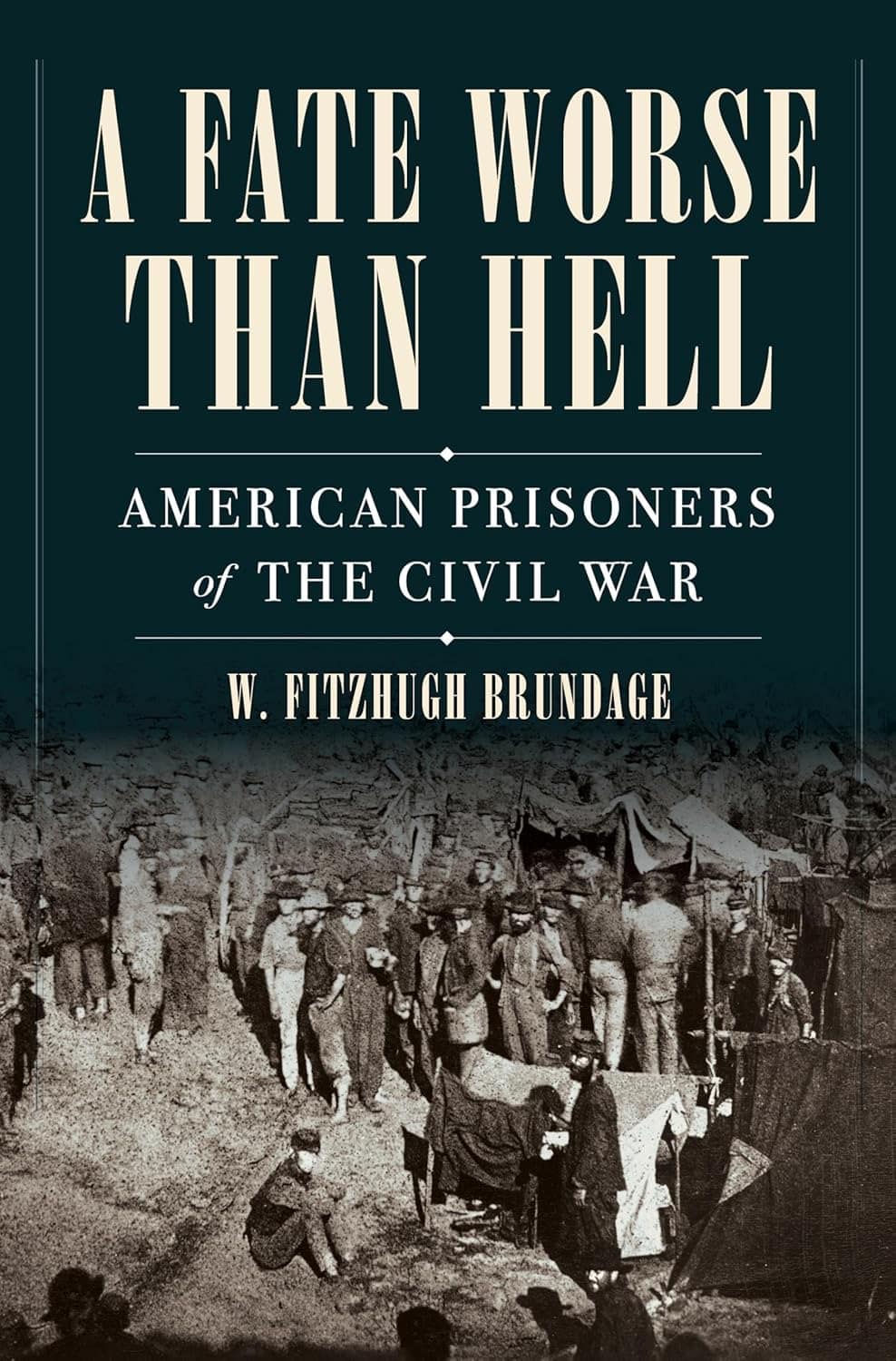
A Fate Worse Than Hell: American Prisoners of the Civil War. By W. Fitzhugh Brundage. New York: W. W. Norton & Company, 2026. Hardcover, 464 pp. $38.99.
Reviewed by Madeline Feierstein
The Civil War prisoner-of-war experience is often condensed into individual situations, one-off events, or the consequence of sheer rotten luck in the wake of fraternal warfare. W. Fitzhugh Brundage, however, diverts from this trend by assessing the unique cultures that emerge in each spotlighted POW facility and addressing the systematic and administrative reasons behind one of the darkest aspects of the Civil War.
Brundage synthesizes what would typically be relegated to economic, political, or ideological studies on the war in order to holistically analyze prisoners, their captives, and their joint realities. Through a combination of personal diaries, daily reports, civilian reactions, and government actions, A Fate Worse Than Hell considers that the severity of prison life was not generally accidental or inevitable, but instead a result of decision-making and blurred lines between morality and duty spurred by national conflict.
This book is organized chronologically from the war’s beginning through to the legacy of imprisonment during Reconstruction. Rather than generalize prison life, this narrative expands on themes that permeate across borders, boundaries, and battlefields such as food rationing, poor hygiene, mail delivery, and religious observance during captivity. It emphasizes the critical fact that the impact of imprisonment extended far past wartime itself. By reflecting on the evolution of the prisoner-of-war system across history, Brundage’s arguments shed light on how radical, extreme, and unmanageable the system became in a few short years. As an author and historian, Brundage does not shy away from distressing topics, choosing to lean into the records and anecdotes in order to tell a grander, more complex tale than meets the eye.
A Fate Worse Than Hell complements the existing literature on Civil War prisons. It provides additional insights and necessary background information on the Union and Confederate systems, as well as how the two sides played on the other’s treatment of their captured soldiers. The subtitle, American Prisoners of the Civil War, negates an “us versus them” stance and unites the North and South under a common condition: prisoner status.
The continued inclusion of minority and specialized experiences, rather than a sole chapter dedicated to these populations, makes this publication stand out. The circumstances of the United States Colored Troops, pious prisoners, high-ranking officials, and the disobedient behind bars make regular appearances as their stories relate to introduced topics of discussion. This aspect truly harmonizes Brundage’s arguments instead of viewing them as isolated opinions.
As a student and active scholar of Civil War prisons, I particularly enjoyed Brundage’s broadened consideration of well-known facts about famous POW facilities, such as Andersonville or Elmira. Through exemplifying the experiences of handpicked prisoners, one gets a glimpse into not only the day-to-day schedule, but also the far-reaching impacts for the war itself. This book is perfect for both storied readers and newcomers to the subject due to its established authority and conversational tone.


Yes, I would be interested in the day to day endurance of these prisoners.
It is surprising to me that after all this time there really has been no compilations of the records of the various prisons and their prisoners. No one seems to have gone beyond Mark Neely’s two studies of Civil War prisons with more details. Neely made a mistake in saying that the Camp Chase records were lost, I found a number available on Family Search, the LDS website, which apparently are taken from old microfilm copies made in the 60s and 70s. Some are so bad only the highlights of the ink entries are visible, but most are legible. I compiled a database of West Virginia civilian arrests from Camp Chase, around 1600 civiliansbetween 1862-64, which must be the highest number of civilian arrests for any state. My mistake in going through those records was limiting my transcriptions to just West Virginia civilians as there were many from Kentucky and further south.