Book Review: France and the American Civil War: A Diplomatic History

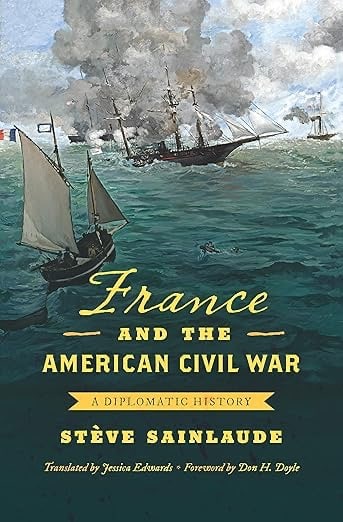
France and the American Civil War: A Diplomatic History. By Stève Sainlaude. Translated by Jessica Edwards. Chapel Hill: The University of North Carolina Press, 2025. Paperback, 285 pp. $29.95.
Reviewed by Hunter Haskins
In the ever-expanding field of international American Civil War scholarship, the diplomatic maneuvering of European influences, especially when centered mainly on London’s corridors of power, too often feels like a well-worn tale devoid of scope or deeper contribution. Stève Sainlaude’s France and the American Civil War: A Diplomatic History (recently appearing in paperback, resulting in this review) provides a necessary and sophisticated shift in that perspective, moving the focus across the English Channel to the Quai d’Orsay, a metonym for France’s Ministry of Foreign Affairs. Through mining previously underutilized diplomatic correspondence, Sainlaude offers a modernizing account that challenges long-held assumptions about French sympathies and the mechanics of imperial foreign policy.
The book’s central thesis is that French diplomacy was governed by a realistic assessment of national interest, not singularly the sentiment or the whims of Emperor Napoléon III. Sainlaude identifies a fundamental tension at the heart of the Second Empire: while the Emperor was often captivated by “fanciful ideas” and “daydreams” regarding his policymaking, his professional diplomats, specifically Foreign Ministers Édouard Thouvenel and Édouard Drouyn de Lhuys, served as a crucial brake on his interventionist impulses. (5) These men “regularly thwarted his plans” to maintain a prudent policy vision that prioritized French strategic stability over the Emperor’s so-called “Grand Design” overseas. (59)
Sainlaude organizes his study into three thematic sections rather than a strict chronological narrative. This structure allows him to dissect complex issues such as maritime law, the so-called “cotton famine,” and the cultural myths of Dixie, in isolation. (140) However, the author himself acknowledges that this “analytical approach” requires the reader to accept “the primacy given to ideas over the order of events” and warns of the “backtracking that inevitably occurs in each chapter.” (10) While this allows for deep thematic dives that appeal to an academic audience, it can occasionally hinder a general reader, as it assumes a degree of familiarity with the war’s timeline as well as specific diplomatic flashpoints pre-dating and during the conflict. A non-scholarly audience would do better to first consult a chronologically-organized overview of the topic before diving into this text.
The book’s greatest strength lies in its stunning evidentiary base. Sainlaude relies heavily on the Archives Diplomatiques, particularly the dispatches of French consuls stationed throughout the US. He brings to the forefront the reports of Alfred Paul, the Richmond consul, whom he hails as “a truly great diplomat” with a “visionary viewpoint.” (161) Paul’s ground-level intelligence allowed French policy-makers to see through Confederate propaganda regarding “King Cotton” and the purported inevitability of a Southern victory.
Frequent consultation of the book’s endnotes reveals a litany of other diplomatic figures and facts to explore, whose lives and stories make for a provocative and eye-opening study. They hint at the author’s nearly decade-long compilation of research preparing his doctoral dissertation, published in 2011 in two French-language works eventually rewritten and translated by Jessica Edwards into English for this text.
One of the book’s most provocative contributions is its exploration of the role of slavery in political decision making. Sainlaude argues that for French leaders, “slavery was a secondary consideration” and a “marginal issue that could on no account steer or determine its diplomatic policy.” (108) While the French public may have found the institution repugnant, the professional diplomats viewed the conflict through a cold geopolitical lens. They feared that a Confederate victory would not lead to a stable balance of power but would instead unleash a new wave of Southern “staunch expansionists” who had long coveted territories in Mexico and the Caribbean. (124)
Furthermore, Sainlaude bolsters France’s political agency and disputes contemporaneous claims that France blindly followed Great Britain’s foreign policy. He highlights a relationship marked by mutual suspicion, where the French often used the British refusal to intervene as a convenient “excuse to shirk all responsibility” for Confederate recognition. (64) This realism extended to economics; Sainlaude demonstrates in his eighth chapter that trade with the North, which provided essential wheat and consumed luxury French exports, was ultimately more valuable to the Empire than Southern cotton.
In the broader context of foreign American Civil War historiography, this work fills a significant gap. Not since Case and Spencer’s monumental 1970 exploration of the subject in The United States and France: Civil War Diplomacy has a major English-language study so thoroughly utilized the French diplomatic archives to explain questions such as why Napoléon III failed to recognize the Confederacy. By moving the “death certificate” of the Union from a foregone conclusion to a contested diplomatic struggle, Sainlaude successfully internationalizes the war through the ever-globalizing lens of France. (130)
Ultimately, France and the American Civil War is a masterful study of “disorganized diplomacy.” (187) While its topical organization may occasionally dissuade those seeking a simple timeline, its depth of research and clear-eyed analysis of French realpolitik make it an essential read for the interested academic of political, military, and especially diplomatic histories. Sainlaude’s argument convincingly supports the conclusion that the fate of the American Union was decided not just on the battlefields of the United States, but through the “resolve and obstinacy” of French bureaucrats, too, who refused to let their Emperor’s imperial daydreams jeopardize the interests of France. (55)
Hunter Haskins is the Assistant Director of the Salem Museum & Historical Society in Salem, Virginia. A graduate of Roanoke College, he double majored in History and Political Science while pursuing a concentration in Public/Applied History. Before joining the Museum, Haskins taught history and epistemology at the Carlisle School in Axton, Virginia, and worked as a guide, interpreter, and blacksmith for Ferrum College’s Blue Ridge Institute and Museum. He is an active member of the Fincastle Company Living History Interpreters. He lives in Salem.


